Dairy herd Management Market
According to MarketsandMarkets The global dairy herd management market is projected to reach USD 8,884.00 million by 2032 from USD 4,998.53 million in 2025, at a CAGR of 8.6% during the forecast period. The growing herd size of dairy farms and the increasing consumption of dairy products are the primary growth drivers for the dairy herd management market. Rising funding initiatives in dairy farming and growing technological advancements are further driving the growth of the market. On the other hand, ongoing campaigns to save dairy animals from unethical herd management practices are expected to restrain the growth of this market during the forecast period.
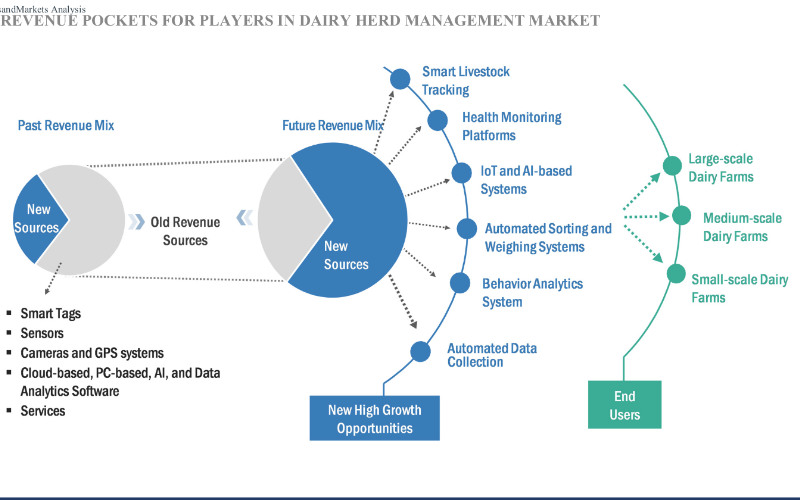
New revenue pockets for players in dairy herd management market
The global consumption of dairy is increasing, with deficit regions experiencing demand that exceeds domestic supply. While milk production growth in major exporters like Europe and New Zealand is increasingly constrained by environmental regulations, the US is emerging as the region with the strongest production potential. According to USDA projections, US milk output is forecast at 228.3 billion pounds in 2025 and 229.1 billion pounds in 2026, with growth largely attributed to higher yields per cow rather than herd expansion. This shift highlights the strategic role of herd management solutions in improving per-cow productivity, enabling producers to meet domestic and export demand while navigating regulatory and sustainability pressures.The US dairy sector's performance reflects this trend. For instance, an article in Hoard's 2024 data shows that total US milk production reached 225.9 billion pounds in 2024, representing a 3.4% increase over the five-year average, despite a slight year-on-year decline. Notably, the national dairy herd stood at 9.35 million cows in 2024, down 0.4% fr om the previous year, yet average milk yield per cow rose to 24,164 pounds annually, up more than 1,000 pounds per cow over five years. This efficiency gain, coupled with larger herds (24,810 dairies averaging 377 cows each), demonstrates how rising output is increasingly tied to productivity gains per animal. For farmers, this dynamic makes herd management technologies ranging from automated milking and feeding systems to health and reproduction monitoring essential tools for sustaining growth.
Similarly, robust pricing dynamics further highlight the importance of efficiency and herd management adoption. USDA's 2025 outlook indicates strong wholesale and export demand across major product categories. For example, butter prices in early July 2025 averaged USD 2.57 per pound domestically and climbed as high as USD 3.59 per pound in Oceania and USD 3.90 per pound in Europe, reflecting tight supplies and resilient demand. Similarly, non-fat dry milk and whey prices increased due to constrained availability and firm export markets. These favorable price environments and rising consumption encourage producers to invest in technologies that boost yields and optimize herd health, directly driving growth in the dairy herd management market.
One of the most significant barriers to the broader adoption of dairy herd management technologies remains the high capital required, particularly for automation systems such as robotic milking units. Robotic milking units typically cost between USD 150,000 and USD 275,000 per unit, capable of servicing 60-70 cows, not including infrastructure alterations or maintenance expenses. Many farms purchase two to four units, leading to initial outlays approaching USD 500,000-1 million even for modest operations.
Furthermore, alternative cost estimates suggest an average of USD 220,000 per robot, including installation and housing. This pricing can be particularly prohibitive for small and mid-sized dairy farms. When viewed on a per-cow basis, a conventional robotic approach may cost USD 3,200-4,000 per cow, with payback periods ranging from 7 to 10 years.
Though targeted automation options might offer shorter ROI, the high operational complexity and extended recovery period can deter investment. Therefore, these high costs are further compounded by added expenses for software platforms, ongoing maintenance, and facility upgrades required to accommodate automation.
Thus, while automation offers long-term productivity gains, the substantial upfront investment, often running into hundreds of thousands of dollars, remains a critical barrier, especially for farms with limited financial access or fragmented ownership structures. Until costs decline or affordable financing mechanisms expand, adoption across smaller-scale operations will likely remain constrained.
Limited awareness and technology adoption in developing regions
The growth of the dairy herd management market is significantly restricted by limited awareness and technology adoption in developing regions, coupled with infrastructure limitations in rural areas. In regions such as Sub-Saharan Africa and parts of South Asia and Latin America, traditional farming methods still dominate, and many farmers remain unaware of the potential benefits offered by livestock monitoring technologies. These technologies, which include milk harvesting management, heat detection monitoring, feeding management, heat stress management, health monitoring management, and sorting & weighing management, can significantly enhancetiva productivity and efficiency. However, the lack of understanding about their advantages and the technological knowledge needed to Se operate these systems impedes widespread adoption.The rapid adoption of smart wearables in dairy herd management is emerging as a major opportunity for the market. These technologies transform traditional farming practices by providing real-time data and actionable insights into critical functions such as milk harvesting, feeding management, heat stress detection, health monitoring, sorting, and weighing. Their integration into farm operations enables improved productivity, animal welfare, and long-term profitability. Advanced wearables like the MooMonitor+ and AfiCollar provide continuous tracking of cow activity, heat detection, rumination, and rest cycles. This supports early interventions that improve reproductive performance, optimize milk yields, and enhance herd health, thereby reducing operational inefficiencies.
Moreover, innovative solutions such as the Afimilk Cow Leg Sensor (AfiAct II) monitor rest patterns and heat detection, supporting timely health interventions and ensuring well-being. Beyond health and fertility, wearables play a crucial role in heat stress management. Devices such as HerdDogg and CowManager enable continuous monitoring of parameters like body temperature, mobility, and activity levels. By detecting early signs of heat stress, these devices allow farmers to implement cooling strategies and maintain productivity during extreme weather conditions. Integration with loT platforms and cloud systems further enhances decision-making by providing farmers with real-time insights through mobile apps.
The growing availability and affordability of smart wearables present significant opportunities for farms of all scales to adopt data-driven management practices. As these solutions continue to advance, they enable farmers to enhance efficiency, reduce costs, and implement sustainable dairy farming practices. This positions smart wearables as a key opportunity area in the dairy herd management market, driving innovation and shaping its long-term growth trajectory.
The increasing integration of automation in livestock farming presents a significant growth opportunity for the dairy herd management market. Advanced autonomous feeding and milking solutions are transforming farm operations by improving productivity, reducing labour dependency, and lowering operational costs. For instance, in March 2023, DeLaval (Sweden) introduced the Opti Wagon, an autonomous feed distribution robot integrated into the DeLaval Optimate system. This innovation enables the precise delivery of customized feed mixtures up to twelve times daily. By leveraging the DeLaval DelPro farm management system, Opti Wagon improves feed efficiency, reduces waste, and enhances farm sustainability.
GEA Group (Germany) launched the Dairy Feed F4500 in September 2022, designed for herds of up to 300 cows. Using advanced sensor technologies, the robot manages weighing, mixing, and distribution with high accuracy. Integrated with the GEA Dairy Net management system, it allows remote monitoring and control, reducing feed waste, cutting operational costs, and lowering the carbon footprint of dairy farms. Additionally, in September 2024, Lely (Netherlands) expanded automation with the Juno Max, an autonomous feed pusher for large-scale farms. Featuring advanced navigation technology and real-time management via mobile app, it optimizes labour use, enhances feeding consistency, and contributes to more sustainable dairy practices.
These developments illustrate how automation is becoming a key opportunity driver, particularly for large and mid-sized farms aiming to address labour shortages, optimize resource use, and improve herd productivity. As adoption widens, automation is expected to accelerate digital transformation across dairy herd management systems and open new markets in developed and emerging economies.
The adoption of dairy herd management products or technology in developing countries is slow, primarily due to high installation costs and low awareness among farmers. However, growing demand for milk and dairy products, increasing per capita income of farmers in developing countries, rising herd size, and growing focus of governments on livestock farming and the agricultural sector are expected to increase the demand for advanced dairy herd management solutions in developing countries in the coming years. Considering this, emerging markets such as India, China, Turkey, and other developing countries are expected to offer significant opportunities to key players operating in the dairy herd management market.
A large population base, especially in India and China, is expected to offer a sustainable market for dairy herd management products, owing to the increasing demand for better quality and quantity of milk and dairy products. According to UN figures, India's population was around 1.37 billion in 2019, while China had 1.47 billion. India is expected to add nearly 273 million 2050 to its population. Governments of different developing countries have realized the importance of adopting Al, robotics, and loT technologies in the traditional methods of dairy herd management. They are running various initiatives to promote dairy herd management solutions. This creates high-growth opportunities for various players to be involved in the dairy herd management solutions.
Key market players are undertaking strategic initiatives to leverage the high-growth opportunities for dairy herd management products in these markets, such as expansions, acquisitions, training programs, and entering agreements/partnerships with regional/domestic players. Such developments are expected to create more opportunities to drive the growth of the dairy market.
Rapid urbanization
Demand for milk and dairy products is increasing rapidly due to an increasing population, urbanization, and shifts in dietary patterns. According to the United Nations (UN), 68% of the population worldwide is projected to live in urban areas by 2050. Due to urbanization, the consumption of milk and dairy products is expected to increase. A large part of the population from these countries is moving from an "Activa agricultural lifestyle" to an urban setting. This trend is evident in emerging economies, such as Brazil, Russia, India, and China, wh ere rapid Go to Se urbanization drives the demand for milk and dairy products.The dairy herd management market is undergoing rapid transformation, fuelled by digitalization, automation, and sustainability initiatives in the dairy industry. Technologies such as advanced herd monitoring sensors, automated milking systems, precision feeding solutions, and cloud-based farm management platforms are reshaping farm operations by enhancing productivity, animal health, and profitability. Rising emphasis on animal welfare and sustainable farming practices is driving the adoption of smart solutions that reduce labour dependency, optimize resource utilization, and lower environmental impact. The growing integration of IoT, Al-driven analytics, and robotic solutions is enabling real-time decision-making for farmers. At the same time, regulatory pressures around milk quality, traceability, and emissions management are influencing innovation. As global demand for dairy products increases, companies are adapting to provide more efficient, data-driven, and welfare-focused herd management solutions that cater to small-scale farmers and large dairy enterprises.
Dairy herd management market: ecosystem analysis
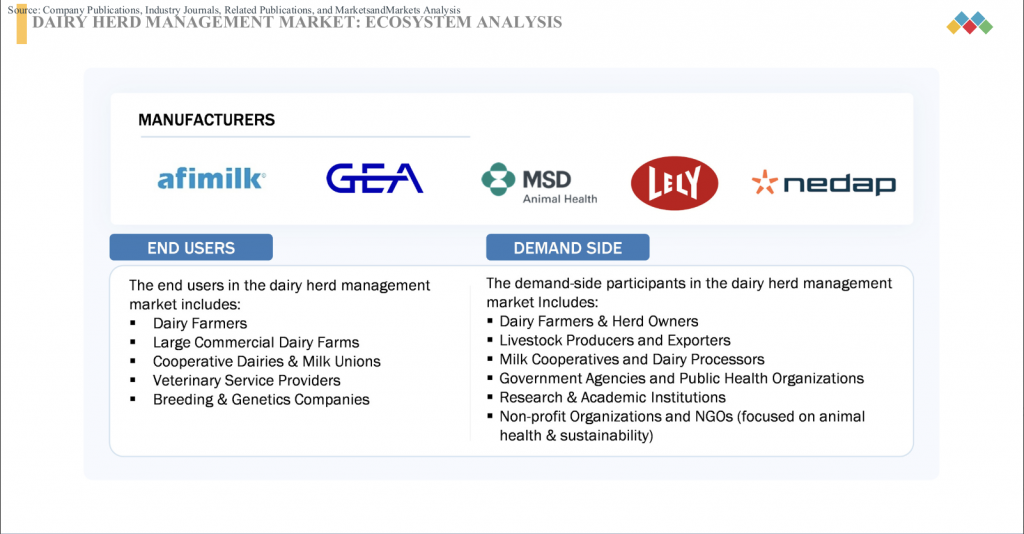
The ecosystem of the dairy herd management market comprises a complex network of stakeholders, including manufacturers, research institutions, regulatory authorities, distributors, veterinary healthcare providers, and end users such as clinics, hospitals, and government agencies. Innovation is driven by R&D collaborations and the growing demand for preventive animal healthcare. Regulatory bodies ensure safety and compliance,