Sustain MENA: How Al Ain Farms Turns Sustainability and Local Production into a Competitive Advantage
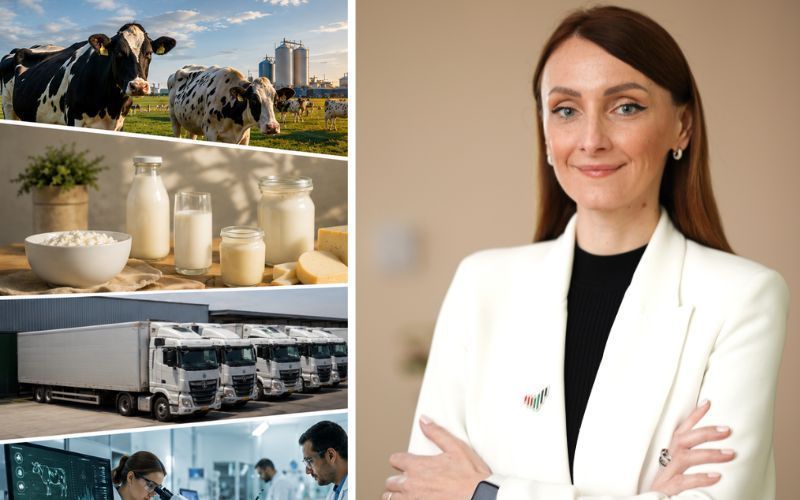
As part of the Sustain MENA project, we continue speaking with companies across the region to better understand how businesses are adapting to shifting market conditions, changing consumer behavior, and ongoing uncertainty. This time, DairyNews spoke with Milana Boskovic, Chief Marketing and R&D Officer at Al Ain Farms Group — one of the UAE’s leading and longest-established dairy producers. In this interview, she discusses why local production has become a key factor of consumer trust, how demand for dairy products is evolving, and why investments in clean-label innovation, functional nutrition, and vertically integrated operations are shaping the future of the industry.
How did the recent situation in the MENA region impact Al Ain Farms at the initial stage, particularly fr om a product and consumer perspective?
Our position as a fully vertically integrated local producer meant the immediate operational impact was close to none and enabled us to maintain business continuity and supply of essential goods at all times uninterrupted. We process, manufacture, package, and distribute within the UAE, so supply continuity was maintained throughout.
The bigger change was on the consumer side and the support the communities have shown to the local economy. Consumers began paying closer attention to wh ere their food comes from, and local production moved fr om not only a preference but to a conscious purchasing criteria and choice. For Al Ain Farms, that reinforced the value of what we've spent building over 40 years of UAE operations.
Have you observed any changes in consumer behavior when it comes to dairy products—such as preferences, price sensitivity or demand for specific categories?
There's been a change in how consumers define value. It's less about "premium" as a label and more about trust and reassurance. Consumers want to understand what they're getting for their money. They're reading labels more carefully, comparing nutritional content, and making more deliberate choices. They’re willing to pay more when the benefit is clear, whether that's nutrition, convenience, or sustainability. More than 80% of UAE residents prioritise sustainability and transparency, and that carries through to how they evaluate food brands.
Health consciousness has also accelerated. Demand for low-sugar, high-protein, and functional dairy continues to grow. Lactose-free, low-GI, and reduced-sugar options are becoming mainstream expectations, particularly among younger consumers and parents making choices for their children. Protein-focused dairy continues to grow in fermented and functional categories, as consumers become more intentional about what they eat and how it supports their health.
Local brands have earned more loyalty. There's more of a "local for local" mindset, driven by the reassurance that locally produced dairy offers better freshness, stronger quality control, and more reliable supply, particularly in everyday categories that consumers depend on daily.
As a company combining marketing and R&D, how have you adapted your product strategy in response to these changes?
Having marketing and R&D under one roof is a significant advantage. When we see a shift in preference or a gap in the market, we can move from insight to formulation to shelf relatively quickly.
Consumer research plays a critical role. We follow trends closely, but we also test, listen, and validate before scaling. This has meant accelerating our clean-label and reduced-sugar pipeline. We became the first manufacturer in the UAE to commit to reducing added sugars across our portfolio under Abu Dhabi's Healthy Living strategy and that commitment came directly from our consumer data showing that health is a baseline expectation today.
We've also focused innovation on real problems. Our collaboration with FoodIQ will allow us to produce clean-label products using more sustainable methods, bringing advanced capabilities into local production while keeping quality consistent. We're the first manufacturer outside Finland to deploy their patented multi-layer cooking technology at industrial scale, which allows for the development of high-protein dairy products without additives or preservatives, while reducing water use and production waste.
And we've expanded into new categories. Our new Al Ain Taaza joint venture with NRTC Group, announced at Make it in the Emirates 2026, takes us into ultra-fresh juice, a decision rooted in consumer insight. People want fresh, local, and trusted across more categories beyond dairy.
Were there any challenges in maintaining product quality, innovation pipelines or launching new products during this period?
Quality is non-negotiable. That has never been compromised and never will be. A vertically integrated supply chain is a significant advantage here. Having control from farm to shelf gives us stronger cost management, tighter quality standards, and better brand protection. We control the full chain, from feed to farm to factory to shelf, so quality consistency is built into the system.
On innovation, volatility can sharpen focus rather than slow it down. When the market evolves, you learn quickly which projects in your pipeline address real needs, and which are nice-to-haves. We've been disciplined about prioritising innovations that solve actual consumer problems: better nutrition, longer shelf life, cleaner labels, more accessible formats.
A good example is our work on long-life camel milk. We are among a very small number of companies globally that have successfully developed long-life camel milk without any additives or stabilizers, preserving its nutritional value so consumers can enjoy its benefits beyond the constraints of the fresh cold chain.
That project continued through this period because the need was clear. The challenge is more about timing than capability. Launching new products during uncertainty requires confidence in your route to market, and with our nationwide infrastructure, we have that confidence. So have we've continued to launch and expand rather than pause.
What specific actions has Al Ain Farms taken to remain competitive and relevant in a more volatile market environment?
Three things stand out.
First, we've doubled down on vertical integration. This year at Make it in the Emirates, we announced an expanded partnership with Borouge, scaling our locally sourced packaging resin from 500 to 3,500 metric tonnes annually, a 600% increase. We already manufacture our own PET bottles, preforms, and caps in-house. Now we're moving into blow moulding for HDPE milk bottles. The more of the value chain we own, the less exposed we are to external disruption, and the more value stays in the UAE economy.
Second, we've invested in new categories. Al Ain Taaza, our joint venture with NRTC Group, takes us into ultra-fresh juice, one of the fastest-growing beverage segments in the UAE. Rather than defending existing territory, we're expanding the ways we nourish consumers while leveraging our existing manufacturing and distribution infrastructure.
Third, we've continued to invest in technology. Deploying FoodIQ's multi-layer cooking technology at industrial scale allows us to produce high-protein, additive-free products more efficiently and with less waste. Our new robotic palletisation systems at the UHT plant reduce manual handling and improve operational precision. These are investments in long-term competitiveness built into the manufacturing process, not just marketing.
Can you share any concrete examples of product, branding or innovation decisions that proved effective in recent months?
I'll share three.
Our reduced-sugar reformulations across flavoured milk and yoghurt on the top of the juice range we already have which is no sugar added. These are products consumed daily by millions of people in this country, many of them children. Committing to reformulation under Abu Dhabi's Healthy Living strategy was both a public health decision and our moral choice, not only a commercial one. Consumers are rewarding brands that take nutrition seriously without compromising on taste.
The Al Ain Taaza launch. We identified that the UAE's fresh juice market – worth AED 500 million – was largely unsaturated. Rather than acquiring an external brand, we built one from scratch within one of our sister companies under Ghitha Holding - NRTC Group, combining our manufacturing, distribution, and brand equity with their sourcing in fruits and vegetables. The initial range of more than 15 flavours across refreshments, functional blends, and smoothies will launch later this year, available nationwide from day one.
And on branding, our UAE National Day collaboration with Emirati artist Mariaam Al Obeidli, wh ere she redesigned product packaging with heritage-inspired artwork distributed nationwide. It connected the brand to national identity in a way that was authentic and culturally resonant, and demonstrated that everyday dairy products can be a platform for storytelling and belonging.
Looking ahead, what key trends in dairy consumption and product development do you expect to shape the market in the next 6–12
months?
I see several things converging.
Protein will continue to dominate. Consumers are increasingly protein-conscious, not just athletes, but everyday consumers looking for satiety, muscle maintenance, and overall wellness. High-protein dairy formats, particularly fermented and functional categories, will grow.
Sugar reduction will move fr om a differentiator to a standard. Brands that haven't begun reformulating will find themselves behind consumer expectations, not ahead of them.
Functional dairy will expand products with benefits beyond basic nutrition. Whether that's gut health, immunity, or cognitive function, consumers want their everyday staples to work harder for them. And if even push the functional nutrition futher across cow and camel milk, possibilities are unlimited.
Provenance and traceability will become louder. The question "wh ere does this come from?" will intensify. Local producers with transparent, vertically integrated supply chains have a structural advantage here.
And sustainability in packaging and production will rise as a factor. Consumers are beginning to evaluate environmental impact alongside taste and price. Circular supply chains, lighter packaging, recycled materials, these are becoming baseline requirements rather than differentiators. Companies already investing in these areas will be better positioned as expectations mature.
For us, none of these are surprises. They're trends we've been building toward and we're positioned to lead rather than follow as who is better to safeguard UAE consumers than an UAE first company in dairy and poultry.
____________________________________________________
Our position as a fully vertically integrated local producer meant the immediate operational impact was close to none and enabled us to maintain business continuity and supply of essential goods at all times uninterrupted. We process, manufacture, package, and distribute within the UAE, so supply continuity was maintained throughout.
The bigger change was on the consumer side and the support the communities have shown to the local economy. Consumers began paying closer attention to wh ere their food comes from, and local production moved fr om not only a preference but to a conscious purchasing criteria and choice. For Al Ain Farms, that reinforced the value of what we've spent building over 40 years of UAE operations.
On the product side, we saw increased demand across our core staples – dairy, eggs, poultry. People gravitate toward trusted, familiar brands during periods of uncertainty, and Al Ain Farms has that generational relationship with UAE households. Fresh milk, yoghurt, laban, eggs, are daily essentials, and consumers needed the reassurance that supply would remain consistent. We were able to provide that continuity because the infrastructure was already in place, with more than 23,000 retail touchpoints, our own fleet, six depots, and a specialized route network delivering fresh products daily across all seven emirates.
Have you observed any changes in consumer behavior when it comes to dairy products—such as preferences, price sensitivity or demand for specific categories?
There's been a change in how consumers define value. It's less about "premium" as a label and more about trust and reassurance. Consumers want to understand what they're getting for their money. They're reading labels more carefully, comparing nutritional content, and making more deliberate choices. They’re willing to pay more when the benefit is clear, whether that's nutrition, convenience, or sustainability. More than 80% of UAE residents prioritise sustainability and transparency, and that carries through to how they evaluate food brands.
Health consciousness has also accelerated. Demand for low-sugar, high-protein, and functional dairy continues to grow. Lactose-free, low-GI, and reduced-sugar options are becoming mainstream expectations, particularly among younger consumers and parents making choices for their children. Protein-focused dairy continues to grow in fermented and functional categories, as consumers become more intentional about what they eat and how it supports their health.
Local brands have earned more loyalty. There's more of a "local for local" mindset, driven by the reassurance that locally produced dairy offers better freshness, stronger quality control, and more reliable supply, particularly in everyday categories that consumers depend on daily.
As a company combining marketing and R&D, how have you adapted your product strategy in response to these changes?
Having marketing and R&D under one roof is a significant advantage. When we see a shift in preference or a gap in the market, we can move from insight to formulation to shelf relatively quickly.
Consumer research plays a critical role. We follow trends closely, but we also test, listen, and validate before scaling. This has meant accelerating our clean-label and reduced-sugar pipeline. We became the first manufacturer in the UAE to commit to reducing added sugars across our portfolio under Abu Dhabi's Healthy Living strategy and that commitment came directly from our consumer data showing that health is a baseline expectation today.
We've also focused innovation on real problems. Our collaboration with FoodIQ will allow us to produce clean-label products using more sustainable methods, bringing advanced capabilities into local production while keeping quality consistent. We're the first manufacturer outside Finland to deploy their patented multi-layer cooking technology at industrial scale, which allows for the development of high-protein dairy products without additives or preservatives, while reducing water use and production waste.
And we've expanded into new categories. Our new Al Ain Taaza joint venture with NRTC Group, announced at Make it in the Emirates 2026, takes us into ultra-fresh juice, a decision rooted in consumer insight. People want fresh, local, and trusted across more categories beyond dairy.
Were there any challenges in maintaining product quality, innovation pipelines or launching new products during this period?
Quality is non-negotiable. That has never been compromised and never will be. A vertically integrated supply chain is a significant advantage here. Having control from farm to shelf gives us stronger cost management, tighter quality standards, and better brand protection. We control the full chain, from feed to farm to factory to shelf, so quality consistency is built into the system.
On innovation, volatility can sharpen focus rather than slow it down. When the market evolves, you learn quickly which projects in your pipeline address real needs, and which are nice-to-haves. We've been disciplined about prioritising innovations that solve actual consumer problems: better nutrition, longer shelf life, cleaner labels, more accessible formats.
A good example is our work on long-life camel milk. We are among a very small number of companies globally that have successfully developed long-life camel milk without any additives or stabilizers, preserving its nutritional value so consumers can enjoy its benefits beyond the constraints of the fresh cold chain.
That project continued through this period because the need was clear. The challenge is more about timing than capability. Launching new products during uncertainty requires confidence in your route to market, and with our nationwide infrastructure, we have that confidence. So have we've continued to launch and expand rather than pause.
What specific actions has Al Ain Farms taken to remain competitive and relevant in a more volatile market environment?
Three things stand out.
First, we've doubled down on vertical integration. This year at Make it in the Emirates, we announced an expanded partnership with Borouge, scaling our locally sourced packaging resin from 500 to 3,500 metric tonnes annually, a 600% increase. We already manufacture our own PET bottles, preforms, and caps in-house. Now we're moving into blow moulding for HDPE milk bottles. The more of the value chain we own, the less exposed we are to external disruption, and the more value stays in the UAE economy.
Second, we've invested in new categories. Al Ain Taaza, our joint venture with NRTC Group, takes us into ultra-fresh juice, one of the fastest-growing beverage segments in the UAE. Rather than defending existing territory, we're expanding the ways we nourish consumers while leveraging our existing manufacturing and distribution infrastructure.
Third, we've continued to invest in technology. Deploying FoodIQ's multi-layer cooking technology at industrial scale allows us to produce high-protein, additive-free products more efficiently and with less waste. Our new robotic palletisation systems at the UHT plant reduce manual handling and improve operational precision. These are investments in long-term competitiveness built into the manufacturing process, not just marketing.
Can you share any concrete examples of product, branding or innovation decisions that proved effective in recent months?
I'll share three.
Our reduced-sugar reformulations across flavoured milk and yoghurt on the top of the juice range we already have which is no sugar added. These are products consumed daily by millions of people in this country, many of them children. Committing to reformulation under Abu Dhabi's Healthy Living strategy was both a public health decision and our moral choice, not only a commercial one. Consumers are rewarding brands that take nutrition seriously without compromising on taste.
The Al Ain Taaza launch. We identified that the UAE's fresh juice market – worth AED 500 million – was largely unsaturated. Rather than acquiring an external brand, we built one from scratch within one of our sister companies under Ghitha Holding - NRTC Group, combining our manufacturing, distribution, and brand equity with their sourcing in fruits and vegetables. The initial range of more than 15 flavours across refreshments, functional blends, and smoothies will launch later this year, available nationwide from day one.
And on branding, our UAE National Day collaboration with Emirati artist Mariaam Al Obeidli, wh ere she redesigned product packaging with heritage-inspired artwork distributed nationwide. It connected the brand to national identity in a way that was authentic and culturally resonant, and demonstrated that everyday dairy products can be a platform for storytelling and belonging.
Looking ahead, what key trends in dairy consumption and product development do you expect to shape the market in the next 6–12
months?
I see several things converging.
Protein will continue to dominate. Consumers are increasingly protein-conscious, not just athletes, but everyday consumers looking for satiety, muscle maintenance, and overall wellness. High-protein dairy formats, particularly fermented and functional categories, will grow.
Sugar reduction will move fr om a differentiator to a standard. Brands that haven't begun reformulating will find themselves behind consumer expectations, not ahead of them.
Functional dairy will expand products with benefits beyond basic nutrition. Whether that's gut health, immunity, or cognitive function, consumers want their everyday staples to work harder for them. And if even push the functional nutrition futher across cow and camel milk, possibilities are unlimited.
Provenance and traceability will become louder. The question "wh ere does this come from?" will intensify. Local producers with transparent, vertically integrated supply chains have a structural advantage here.
And sustainability in packaging and production will rise as a factor. Consumers are beginning to evaluate environmental impact alongside taste and price. Circular supply chains, lighter packaging, recycled materials, these are becoming baseline requirements rather than differentiators. Companies already investing in these areas will be better positioned as expectations mature.
For us, none of these are surprises. They're trends we've been building toward and we're positioned to lead rather than follow as who is better to safeguard UAE consumers than an UAE first company in dairy and poultry.
____________________________________________________
The Dairy MENA Congress will take place on November 5–6.
Gold Sponsor of the MENA Dairy Congress is Al Ain Farms.
Our partners: Super Food FZCO, International Dairy Federation (IDF).
If you would like to participate in the MENA Dairy Congress, please complete the registration form below:
Loading...