Kazakhstan Ice Cream Market Outlook for 2025: A Competition That Leaves No Room for Error

The reason is not external conditions. The reason lies in persistent misconceptions and a systematic underestimation of key market shifts, of which there are three main ones:
1. Export without adaptation is no longer a strategy, but self-limitation
The market still mistakenly operates under the paradigm: "We need to sell what already sells well at home." In practice, this is not just a debatable position; it is a strategic misconception. Declining sales in challenging export directions are a direct signal: markets do not adapt to the product. Export is not about selling "your" product. Export is adapting the product to a foreign consumption culture. Ignoring cultural peculiarities and local preferences is no longer forgiven — neither in volumes, margins, nor market share.
2. The consumer has "split," breaking the usual assortment
NTech's Director of Analytics Leonid Ardalyonov spoke about the formation of a new economic reality, but not everyone heard it. The essence is simple yet inconvenient: "The consumer is no longer 'somewhere in the middle' — they are diverging into two poles: on one side, there is a growing demand for bright, intense, emotionally strong, and tasty products; on the other, there is an increase in consumption of simple and affordable solutions. Playing in the middle is no longer possible, and this is where the market begins to 'break'."
A significant part of the assortment consists of standard ice cream products, which today are squeezed in tight competition both locally and in export markets. When a product doesn't stand out, the only differentiation is price. Price does not create a market — it nullifies it.
Creating truly interesting products is challenging. And that is precisely why most players do not go there.
3. Brand as a survival factor, not a marketing overlay
NTech's approach to analyzing consumer behavior (purchase algorithms) is still systematically underestimated. However, the facts can no longer be ignored: in the ice cream category, brand significance exceeds 82% (the sum of "Beta" and "Omega" purchases) — higher than in all related categories (dairy products, snacks, confectionery, beverages). This means one thing: in export markets, it’s not just products that compete — brands compete. And the problem now is that there are only a few truly strong brands.
The Kazakhstan Ice Cream Market in 2025: Growth That Changes the Rules of the Game
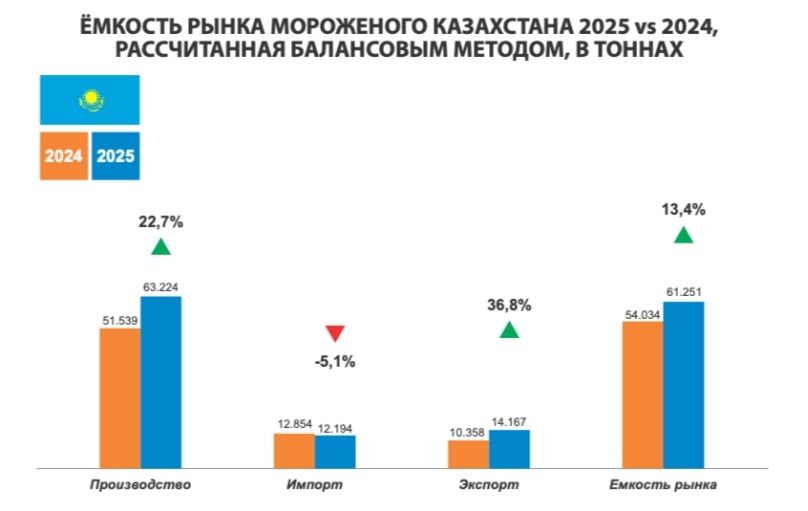
The ice cream industry in Kazakhstan experienced not just growth last season — it was a full-fledged market renaissance. According to the ASPiR agency, 63.2 thousand tons of ice cream were produced in 2025, a 22% increase and the highest dynamic since 2000. For the first time in history, ice cream exports from Kazakhstan exceeded imports into the country — a fundamental market shift. Local producers are already covering the basic demand. To enter the Kazakh market now, you need a strong brand, a distinctive product, and a clear position. Otherwise, you simply won't be noticed.
Imports in Kazakhstan: Competition Becomes Tougher
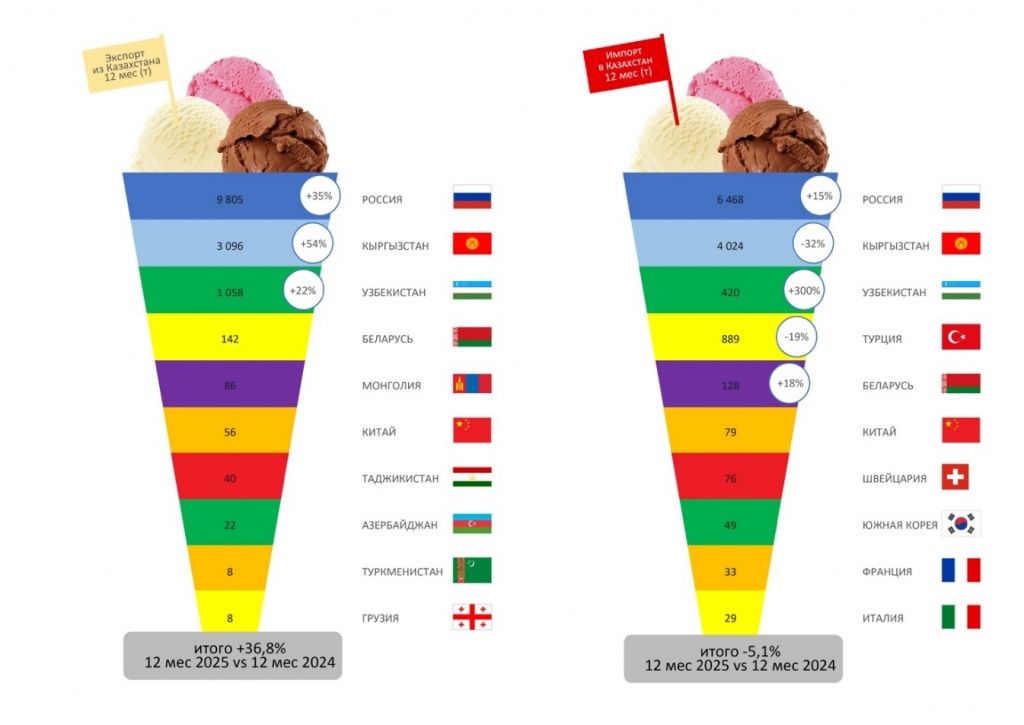
Overall import volumes decreased by 5.1% to 12.2 thousand tons. Kazakhstan is no longer a "entry" market — it has become a "selection" market for products. Imports are declining not because they are bad, but because they do not differ from others.
Deliveries from Russia even increased by 15% (to 6.5 thousand tons). But the key story is not the volumes, but the battle for shelf space.
The market remains tense with competition between Russian and Turkish manufacturers for the "Magnum" and "Golden Standard" brands.
In fact:
-
the north of Kazakhstan remains a zone of Russian manufacturer presence,
-
while the central and southern markets of Kazakhstan are controlled by Turkish Algida (Unilever),
This is no longer a competition of products — it’s a battle of distribution systems and brands.
Who Wins
Amid overall turbulence, only those who play by the new rules feel stable:
-
"Renna Group" focuses on quality,
-
"Froneri" and "Mars" have strong product collaborations,
-
"Ferrero", "London Dairy", "Mövenpick" are global premium in ice cream,
-
"Polaris" with "Prostokvashino" leverages brand strength,
-
"Lotte" and "Binggrae" offer unconventional interesting solutions.
The rest of the "standard ice creams" start losing even to local alternatives.
Imports from Kyrgyzstan: End of the Era of Cheap Advantage
Ice cream imports from "Umut" in Kyrgyzstan decreased by 30% to 4.1 thousand tons. The reason is clear: relying on low prices stopped working in the sufficiently developed Kazakh market. Moreover, with increased control and closure of "gray" channels:
- export prices rose (+70.9%),
- as a result, the key competitive advantage disappeared.
Dumping no longer saves, and it seems it will not return as a viable strategy.
Imports from Uzbekistan: Still Just Tentative Attempts
Imports from Uzbekistan are growing, yet in absolute terms, the volumes remain insignificant and do not affect the market itself. However, this figure reflects an important market trend: after changing state policies to support local producers and revising import conditions, Uzbek local producers have finally started paying more attention to product quality and competitiveness both in domestic and foreign markets.
Currently, the real barrier to entry into Kazakhstan is not the product. The main market barrier is not taste, quality, or price, but ice cream distribution. Channels are already controlled by current players, and they are not interested in new suppliers. The market is formally open, but in fact, it is already divided.
Kazakhstan Ice Cream Exports Rose by 37% in 2025
Export sales are growing annually to Russia (92%), Kyrgyzstan (30%), and Uzbekistan (50%) — in the last two markets, there is also a weak ice cream distribution system and market closure for new players: currently, in Uzbekistan, there is one Kazakh producer and four Russian ones — it will be very difficult for anyone else to "enter" these markets limited by distribution channels.
Retail Trade in Kazakhstan
According to InfoLine: the share of revenue from "traditional" stores in Kazakhstan decreased from 61% to 55% from 2023 to 2025. Although the 50 largest chains account for only 1,765 stores — against 70 thousand traditional outlets — the chains already account for a third of the money collected from customers. The rest goes to the even more rapidly growing online commerce, whose share increased from 9% to 15% over two years.
Nielsen considers the position of traditional stores even more challenging: according to their estimates, in 2019, the shares of modern and traditional retail sales in Kazakhstan were 44/56, but parity was reached by 2022, and by the end of 2024, the ratio changed to 55/45.
According to independent experts, Modern trade is now about 30% in both capitals and only 12-17% on average across the country.
For Reference – The First 3 Months of 2026 in the Ice Cream Market in Russia
The first quarter of 2026 showed disappointing results: ice cream production in the Russian Federation decreased by 12.3% in the first quarter compared to the previous year — from 123,688 tons in 2025 to 108,423 tons in 2026, with a decline of 11.9% in January, 20.5% in February, but only 6.1% in March. Hopefully, production will stabilize further. The dynamics of the Russian ice cream market for the first four months will be thoroughly analyzed in June 2026.
The market is clearly entering a phase of pressure, which may directly affect the export strategy.