Argentina Leads Dairy Production Competitiveness in Latin America
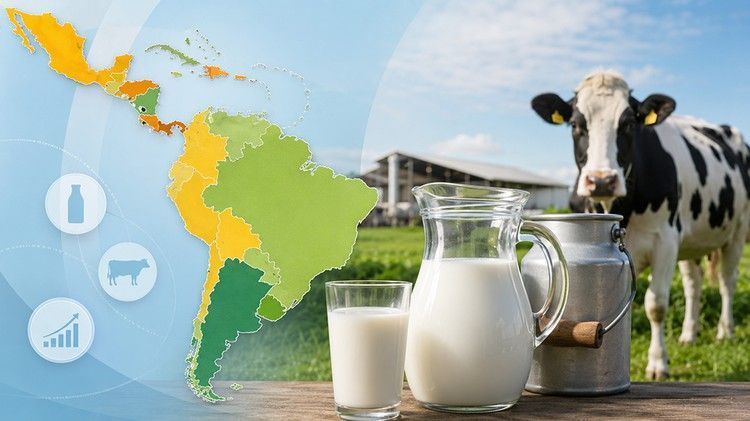
Argentina has positioned itself at the forefront of dairy production competitiveness in Latin America, largely due to its low production costs. According to a regional survey based on data from OCLA, FEPALE, and the USDA, Argentine dairy production costs range from 0.31 to 0.36 USD per liter. This efficiency is primarily attributed to the cost of feed, which constitutes up to 65% of the total production expenses.
Other countries in the Southern Cone, such as Uruguay and Paraguay, also demonstrate competitive production costs, with Uruguayan costs ranging from 0.34 to 0.39 USD per liter and Paraguayan costs from 0.35 to 0.40 USD per liter. These countries form a competitive bloc in the continent. In contrast, Nicaragua and Brazil have intermediate costs ranging from 0.39 to 0.46 USD per liter. Chile, with production costs between 0.41 and 0.47 USD per liter, follows closely.
Further up the cost scale are the Andean and Central American countries. Colombia and Ecuador report costs between 0.42 and 0.49 USD per liter, while Peru, Bolivia, and Guatemala have costs reaching up to 0.50, 0.52, and 0.53 USD per liter, respectively. Mexico and Honduras face higher costs of 0.45 to 0.54 USD per liter, with Panama having the highest costs in the region, between 0.50 and 0.60 USD per liter.
The report also highlights key macroeconomic parameters for the regional dairy sector, noting an average price paid to producers of approximately 0.46 USD per liter and an average yield per cow of about 2,150 liters annually. The composition of production costs underscores the significant role of feed, which accounts for between 52% and 65% of total expenses across all regional systems.
While the survey cautions that methodological and macroeconomic differences between countries require careful interpretation of the data, it provides a comprehensive overview of regional disparities. Countries with higher production costs face challenges in maintaining profitability amidst fluctuating international markets by optimizing feed conversion and reducing the impact of concentrated inputs.