U.S. Cheese Market Could Reach $87.5 Billion by 2034
The U.S. cheese market is projected to grow from $53.97 billion in 2026 to $87.49 billion by 2034. The market is expected to expand at a compound annual growth rate of 6.23% during the forecast period, according to a study by Fortune Business Insights.
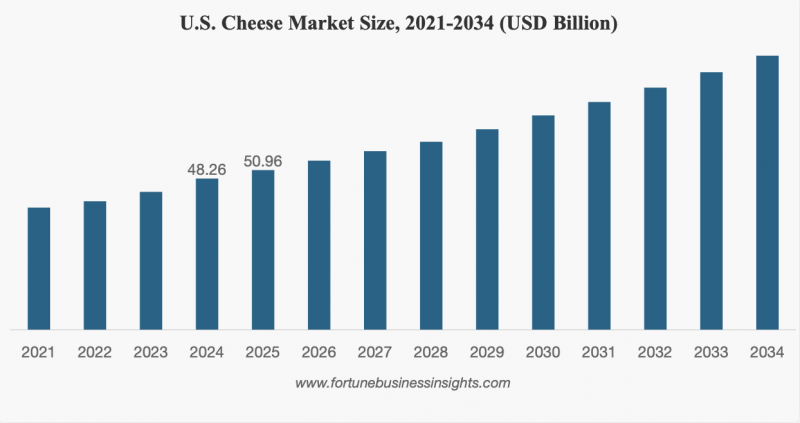
In 2025, the market was valued at $50.96 billion. The study covers natural and processed cheeses, products made from cow’s, goat’s, and sheep’s milk, as well as plant-based alternatives made from soy, almonds, cashews, and other ingredients. The analysis includes retail sales through supermarkets, specialty and convenience stores, and online channels.
U.S. Cheese Production Increased by 4%
Data from the United States Department of Agriculture confirm an increase in physical production volumes. In 2025, the country produced 14.8 billion pounds of cheese, excluding cottage cheese. This is approximately 6.71 million metric tons and 4% more than in 2024.
Italian-type cheeses remained the largest production category. Output reached 6.33 billion pounds in 2025, an increase of 5.1%. This group accounted for 42.8% of all cheese produced in the country.
Production of American-type cheeses increased by 4.6% to 5.83 billion pounds. Their share of national cheese output reached 39.4%. The category includes Cheddar, Colby, Monterey Jack, washed-curd, stirred-curd, and other varieties.
Wisconsin retained its position as the leading cheese-producing state, accounting for 24.6% of total output. The state also produced 28.4% of Italian-type cheeses and 18.2% of American-type cheeses.
Mozzarella Remains the Largest Category
Mozzarella leads the market by individual product type. Fortune Business Insights valued the segment at $13.98 billion in 2025.
Demand for mozzarella is driven by pizzerias, restaurant chains, ready-meal manufacturers, and retail consumers. The product is widely used in Italian-American cuisine because of its mild flavor, melting properties, and suitability for a variety of dishes.
Analysts project the Parmesan and Parmigiano-Reggiano segment to grow at an average annual rate of 7.33%. The study links this growth to the popularity of Italian cuisine, the use of hard cheeses in restaurants and home cooking, and the expansion of portioned formats.
The study also identifies blue cheeses, including Gorgonzola, Stilton, and Roquefort, as a separate category. These products are mainly represented in the premium segment of the natural cheese market.
Natural Cheese Accounts for More Than 90% of the Market
The U.S. natural cheese segment was valued at $46.7 billion in 2025. This represented approximately 91.6% of the total market estimated by Fortune Business Insights.
The research company defines natural cheese as products manufactured by fermenting milk ingredients using starter microorganisms. The category includes mass-market varieties such as Cheddar and mozzarella, as well as Swiss, Hispanic, Muenster, Parmesan, Ricotta, and other cheeses.
Market trends include a wider range of cheese snacks, slices, cubes, sticks, shredded products, and portion packs. Manufacturers are also introducing products with higher protein content, reduced fat, organic certification, and additional nutritional attributes.
Processed cheese is identified as a separate category. Its compound annual growth rate for 2026–2034 is projected at 4.27%.
Foodservice Supports Demand
Analysts identify rising sales through foodservice establishments as one of the main drivers of market development. Cheese is widely used by quick-service restaurants, cafés, pizzerias, and bakeries, as well as by ready-meal manufacturers.
Its main applications include pizza, burgers, sandwiches, bagels, wraps, baked goods, sauces, dips, and desserts. Foodservice businesses purchase large volumes of mozzarella, Cheddar, cream cheese, and processed cheese for these products.
Total U.S. food expenditure reached $2.51 trillion in 2025. Spending on food away from home accounted for $1.41 trillion. The share of disposable personal income spent on food away from home increased from 4.3% in 1997 to 4.9% in 2025.
According to USDA data for 2024, food-away-from-home spending reached $1.27 trillion, rising by 4.2% from the previous year. Spending on food for consumption at home increased by 1.4% to $901 billion.
Supermarkets Represent the Largest Sales Channel
Cheese sales through supermarkets and hypermarkets were valued at $22.56 billion in 2025. This channel accounted for the largest share of the U.S. market.
The study notes that supermarkets offer a wide range of mass-market and specialty cheeses, including private-label products. Sales are supported by developed cold-chain infrastructure, regular promotions, and the availability of products in larger packages.
Online retail is projected to record the highest growth rate among distribution channels, averaging 8.3% annually. Mass-market, specialty, imported, and plant-based products are sold online. Grocery delivery services and direct-to-consumer sales by manufacturers also contribute to the channel’s development.
Block Cheese Remains the Leading Format
The block cheese segment was valued at $26.23 billion in 2025 and held the largest market share by product form.
A significant proportion of Cheddar, mozzarella, hard cheese, and soft cheese is produced in this format. Blocks are used in both retail and foodservice, where they are subsequently converted into slices, shreds, cubes, or crumbles.
The spreadable cheese segment is projected to grow at an average annual rate of 5.56%. Growth in this category is linked to demand for convenience products, baked goods, ready-to-eat breakfasts, and snacks.
Plant-Based Alternatives Account for Less Than 1% of the Market
In 2025, animal-based products accounted for $50.5 billion of the total market valuation of $50.96 billion. Plant-based alternatives therefore represented approximately $460 million, or around 0.9% of the market.
Fortune Business Insights forecasts that the plant-based segment will grow at an average annual rate of 8.65%. The category includes products made from soy, almonds, cashews, and other plant-based ingredients.
The study links the category’s development to demand from consumers following plant-based diets and those who are intolerant to certain components of milk. These products are primarily sold through specialty retailers, major supermarkets, and online stores.
Consumption Declined Slightly After a Prolonged Period of Growth
According to the USDA Economic Research Service, U.S. per capita cheese consumption increased between 2014 and 2023 but declined slightly in 2024.
USDA calculates consumption using the domestic disappearance measure. The calculation takes into account production, imports, exports, changes in inventories, and population. The data represent the volume of products available for consumption but do not account for losses at every stage of distribution or within households.
Fortune Business Insights associates further demand growth with the popularity of ready-to-eat foods, dining out, protein-rich snacks, and portioned cheese products.
Cheese Exports Set a New Record
In 2025, the U.S. exported approximately 613,000 metric tons of cheese, 20% more than in 2024. Monthly exports exceeded 50,000 metric tons in eight of the 12 months.
A year earlier, U.S. cheese exports exceeded 500,000 metric tons for the first time. In 2024, exports increased by 17% to 508,800 metric tons.
Mexico remains the largest foreign market for U.S. dairy products. In 2025, the country accounted for 27% of the total value of U.S. dairy exports, or approximately $2.6 billion. The value of U.S. cheese shipped to Mexico reached $965 million.
Other major destinations included South Korea, Australia, Japan, Central and South American countries, and Southeast Asia.
In the first half of 2026, U.S. cheese exports increased by a further 24%. Shipments to Mexico rose by 32%, South Korea by 36%, Central America by 25%, Southeast Asia by 55%, and South America by 31%.
Growth was recorded across natural, fresh, grated, powdered, blue, and processed cheese categories.
USDA Forecast Further Export Growth
In its December global dairy market review, USDA forecast that U.S. cheese exports would exceed 620,000 metric tons in 2026. The main factors cited were increased supply and the price competitiveness of U.S. products compared with cheese from other major exporting countries.
The department expected shipments of foodservice products to increase in Asian and Western Hemisphere markets. At the time the forecast was prepared, cheese exports for 2025 were estimated at 602,000 metric tons, but subsequent data showed a higher final result.
New Cheese Production Capacity Is Coming Online in the U.S.
Investment in manufacturing remains one of the factors increasing cheese supply. In March 2025, Hilmar Cheese opened a cheese and whey protein production facility in Dodge City, Kansas.
Capital investment in the project exceeded $600 million. The facility created approximately 250 jobs and combines cheese manufacturing with the processing of whey into protein ingredients.
According to the U.S. Dairy Export Council, U.S. cheesemakers added more than 500,000 metric tons of production capacity over five years. The expansion of cheese production was accompanied by greater volumes of whey available for the manufacture of protein concentrates and other dairy ingredients.
In 2025, U.S. whey protein concentrate production reached 502 million pounds, an increase of 2.1%. Production of lactose for human and animal use rose by 2.6% to 1.14 billion pounds. Dry whey production declined by 1% to 845 million pounds.
Major Market Participants
Fortune Business Insights identifies Dairy Farmers of America, Saputo, Kraft Heinz, FrieslandCampina, and Arla Foods as leading participants in the U.S. cheese market.
Other manufacturers covered by the study include Fonterra, Glanbia, Hilmar Cheese, Lactalis, Organic Valley, and several regional companies.
In August 2025, Dairy Farmers of America acquired W&W Dairy, a manufacturer of Hispanic-style cheeses, including queso fresco, Cotija, queso blanco, panela, and queso para freír. The transaction expanded the cooperative’s presence in the Hispanic cheese category.
Companies are also expanding their ranges with new flavors and formats. Product development areas include hot and spicy cheeses, portioned snacks, reduced-fat products, organic lines, and combined snack packs containing cheese and other products.
Full study: https://www.fortunebusinessinsights.com/u-s-cheese-market-106630
U.S. Cheese Production Increased by 4%
Data from the United States Department of Agriculture confirm an increase in physical production volumes. In 2025, the country produced 14.8 billion pounds of cheese, excluding cottage cheese. This is approximately 6.71 million metric tons and 4% more than in 2024.
Italian-type cheeses remained the largest production category. Output reached 6.33 billion pounds in 2025, an increase of 5.1%. This group accounted for 42.8% of all cheese produced in the country.
Mozzarella represented 79.1% of Italian-type cheese production. Parmesan accounted for 8.3%, while Provolone represented 6.2%.
Production of American-type cheeses increased by 4.6% to 5.83 billion pounds. Their share of national cheese output reached 39.4%. The category includes Cheddar, Colby, Monterey Jack, washed-curd, stirred-curd, and other varieties.
Wisconsin retained its position as the leading cheese-producing state, accounting for 24.6% of total output. The state also produced 28.4% of Italian-type cheeses and 18.2% of American-type cheeses.
Mozzarella Remains the Largest Category
Mozzarella leads the market by individual product type. Fortune Business Insights valued the segment at $13.98 billion in 2025.
Demand for mozzarella is driven by pizzerias, restaurant chains, ready-meal manufacturers, and retail consumers. The product is widely used in Italian-American cuisine because of its mild flavor, melting properties, and suitability for a variety of dishes.
Analysts project the Parmesan and Parmigiano-Reggiano segment to grow at an average annual rate of 7.33%. The study links this growth to the popularity of Italian cuisine, the use of hard cheeses in restaurants and home cooking, and the expansion of portioned formats.
The study also identifies blue cheeses, including Gorgonzola, Stilton, and Roquefort, as a separate category. These products are mainly represented in the premium segment of the natural cheese market.
Natural Cheese Accounts for More Than 90% of the Market
The U.S. natural cheese segment was valued at $46.7 billion in 2025. This represented approximately 91.6% of the total market estimated by Fortune Business Insights.
The research company defines natural cheese as products manufactured by fermenting milk ingredients using starter microorganisms. The category includes mass-market varieties such as Cheddar and mozzarella, as well as Swiss, Hispanic, Muenster, Parmesan, Ricotta, and other cheeses.
Market trends include a wider range of cheese snacks, slices, cubes, sticks, shredded products, and portion packs. Manufacturers are also introducing products with higher protein content, reduced fat, organic certification, and additional nutritional attributes.
Processed cheese is identified as a separate category. Its compound annual growth rate for 2026–2034 is projected at 4.27%.
Foodservice Supports Demand
Analysts identify rising sales through foodservice establishments as one of the main drivers of market development. Cheese is widely used by quick-service restaurants, cafés, pizzerias, and bakeries, as well as by ready-meal manufacturers.
Its main applications include pizza, burgers, sandwiches, bagels, wraps, baked goods, sauces, dips, and desserts. Foodservice businesses purchase large volumes of mozzarella, Cheddar, cream cheese, and processed cheese for these products.
Total U.S. food expenditure reached $2.51 trillion in 2025. Spending on food away from home accounted for $1.41 trillion. The share of disposable personal income spent on food away from home increased from 4.3% in 1997 to 4.9% in 2025.
According to USDA data for 2024, food-away-from-home spending reached $1.27 trillion, rising by 4.2% from the previous year. Spending on food for consumption at home increased by 1.4% to $901 billion.
Supermarkets Represent the Largest Sales Channel
Cheese sales through supermarkets and hypermarkets were valued at $22.56 billion in 2025. This channel accounted for the largest share of the U.S. market.
The study notes that supermarkets offer a wide range of mass-market and specialty cheeses, including private-label products. Sales are supported by developed cold-chain infrastructure, regular promotions, and the availability of products in larger packages.
Online retail is projected to record the highest growth rate among distribution channels, averaging 8.3% annually. Mass-market, specialty, imported, and plant-based products are sold online. Grocery delivery services and direct-to-consumer sales by manufacturers also contribute to the channel’s development.
Block Cheese Remains the Leading Format
The block cheese segment was valued at $26.23 billion in 2025 and held the largest market share by product form.
A significant proportion of Cheddar, mozzarella, hard cheese, and soft cheese is produced in this format. Blocks are used in both retail and foodservice, where they are subsequently converted into slices, shreds, cubes, or crumbles.
The spreadable cheese segment is projected to grow at an average annual rate of 5.56%. Growth in this category is linked to demand for convenience products, baked goods, ready-to-eat breakfasts, and snacks.
Plant-Based Alternatives Account for Less Than 1% of the Market
In 2025, animal-based products accounted for $50.5 billion of the total market valuation of $50.96 billion. Plant-based alternatives therefore represented approximately $460 million, or around 0.9% of the market.
Fortune Business Insights forecasts that the plant-based segment will grow at an average annual rate of 8.65%. The category includes products made from soy, almonds, cashews, and other plant-based ingredients.
The study links the category’s development to demand from consumers following plant-based diets and those who are intolerant to certain components of milk. These products are primarily sold through specialty retailers, major supermarkets, and online stores.
Consumption Declined Slightly After a Prolonged Period of Growth
According to the USDA Economic Research Service, U.S. per capita cheese consumption increased between 2014 and 2023 but declined slightly in 2024.
USDA calculates consumption using the domestic disappearance measure. The calculation takes into account production, imports, exports, changes in inventories, and population. The data represent the volume of products available for consumption but do not account for losses at every stage of distribution or within households.
Fortune Business Insights associates further demand growth with the popularity of ready-to-eat foods, dining out, protein-rich snacks, and portioned cheese products.
Cheese Exports Set a New Record
In 2025, the U.S. exported approximately 613,000 metric tons of cheese, 20% more than in 2024. Monthly exports exceeded 50,000 metric tons in eight of the 12 months.
A year earlier, U.S. cheese exports exceeded 500,000 metric tons for the first time. In 2024, exports increased by 17% to 508,800 metric tons.
Mexico remains the largest foreign market for U.S. dairy products. In 2025, the country accounted for 27% of the total value of U.S. dairy exports, or approximately $2.6 billion. The value of U.S. cheese shipped to Mexico reached $965 million.
Other major destinations included South Korea, Australia, Japan, Central and South American countries, and Southeast Asia.
In the first half of 2026, U.S. cheese exports increased by a further 24%. Shipments to Mexico rose by 32%, South Korea by 36%, Central America by 25%, Southeast Asia by 55%, and South America by 31%.
Growth was recorded across natural, fresh, grated, powdered, blue, and processed cheese categories.
USDA Forecast Further Export Growth
In its December global dairy market review, USDA forecast that U.S. cheese exports would exceed 620,000 metric tons in 2026. The main factors cited were increased supply and the price competitiveness of U.S. products compared with cheese from other major exporting countries.
The department expected shipments of foodservice products to increase in Asian and Western Hemisphere markets. At the time the forecast was prepared, cheese exports for 2025 were estimated at 602,000 metric tons, but subsequent data showed a higher final result.
New Cheese Production Capacity Is Coming Online in the U.S.
Investment in manufacturing remains one of the factors increasing cheese supply. In March 2025, Hilmar Cheese opened a cheese and whey protein production facility in Dodge City, Kansas.
Capital investment in the project exceeded $600 million. The facility created approximately 250 jobs and combines cheese manufacturing with the processing of whey into protein ingredients.
According to the U.S. Dairy Export Council, U.S. cheesemakers added more than 500,000 metric tons of production capacity over five years. The expansion of cheese production was accompanied by greater volumes of whey available for the manufacture of protein concentrates and other dairy ingredients.
In 2025, U.S. whey protein concentrate production reached 502 million pounds, an increase of 2.1%. Production of lactose for human and animal use rose by 2.6% to 1.14 billion pounds. Dry whey production declined by 1% to 845 million pounds.
Major Market Participants
Fortune Business Insights identifies Dairy Farmers of America, Saputo, Kraft Heinz, FrieslandCampina, and Arla Foods as leading participants in the U.S. cheese market.
Other manufacturers covered by the study include Fonterra, Glanbia, Hilmar Cheese, Lactalis, Organic Valley, and several regional companies.
In August 2025, Dairy Farmers of America acquired W&W Dairy, a manufacturer of Hispanic-style cheeses, including queso fresco, Cotija, queso blanco, panela, and queso para freír. The transaction expanded the cooperative’s presence in the Hispanic cheese category.
Companies are also expanding their ranges with new flavors and formats. Product development areas include hot and spicy cheeses, portioned snacks, reduced-fat products, organic lines, and combined snack packs containing cheese and other products.
Full study: https://www.fortunebusinessinsights.com/u-s-cheese-market-106630