Good Roughage in Goat Farming Increases Milk Production

International expert in dairy goat nutrition and management
Grass Cover and Sod
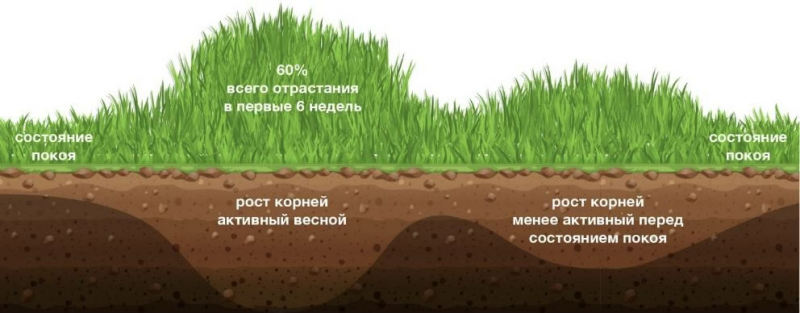
The growth cycle of forage perennial grasses is related to a constant change in the ratio between above-ground and underground biomass. After mowing, the plant uses the reserves accumulated in the root system to restore the leaf mass. During this period, root growth temporarily slows, and some root mass may die off.
About three days after cutting or grazing, the grass begins to noticeably regrow. The newly growing plant has a small leaf area, so it actively uses the carbohydrate reserves stored in the roots. At this moment, the grass grows slowly. As the leaf area increases, photosynthesis strengthens, and the growth rate increases. Some of the carbohydrates formed are again directed towards growth and replenishing the root system reserves.
Once sufficient leaf mass is restored, the plant actively forms reserves in the root system again. This cycle repeats after each cut or grazing until active vegetation ends and winter dormancy starts.
Figure 1. Seasonal dynamics of grass cover and root system growth.
Vegetation and Harvesting Goal
The chemical composition and nutritional value of cereal grasses and alfalfa change as they mature. Young plants have cell wall content representing about one-third, while in more mature plants, it can reach 60%. Additionally, more mature plant cells contain more sugars but less protein. Therefore, if your goal is to obtain as much protein from the harvested silage as possible, it's recommended to mow the grass on time.
However, if you need higher structural value or intend to feed more grass silage in the diet, it's better to mow slightly later, but not at the final maturity stage.
The mowing period of cereal grass mixtures arrives when about half of the plants have developed three secondary spikes. There are early, mid, and late varieties of cereal forage grasses. Early varieties reach the generative phase sooner; late varieties maintain palatability and forage value longer because they mature later. Thus, late varieties provide a wider technical window for mowing and allow maintaining high forage value longer.
Good Grass
Goats are picky and sensitive to feed quality. The absence of off-flavors and mold is essential for good feed intake. For taste and fermentation processes, sugar levels are also important.
For the good preservation of cereal grass silage, it's vital that sugar content in dry matter is between 11% and 20%. More sugars accumulate in grass on sunny days. Each sunny day can increase sugar content by 2–3%. Sugar levels are also influenced by the growth phase, temperature, and time of day.
Cool nights are also important: at temperatures below 5 °C, grass growth nearly stops, and respiration significantly decreases. As a result, the plant uses less stored carbohydrates, and the concentration of non-structural carbohydrates (NSC) in plant mass can be higher.
Grass mixtures with high contents of ryegrass, timothy, and clover can also provide a good basis for obtaining quality and well-palatable grass silage.
Mineral nutrition affects yield and chemical composition. Sodium application can improve grass palatability. Balanced nitrogen nutrition generally increases crude protein content, while lower fertilizer application often leads to higher sugar accumulation in grass.
Goat farmers frequently highlight ryegrass: it is widespread and grows well. Timothy is used in mixtures for its good palatability and forage qualities. Reed fescue can produce high yields and has a developed root system. Mixed meadows are tolerated, but it is necessary to control for toxic, poorly palatable, and undesirable plants.
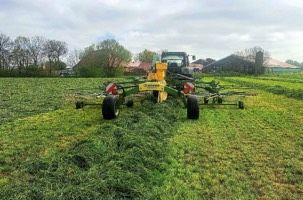
Photo 1. Turning mowed grass during wilting before silage preparation.
|
Silage Harvest 2026 Report. Goat Farmer K.M. Meekma. 1,000 dairy goats. Top-5 goat farmers in the Netherlands. "We started the first cut. In the first part of the first cut, we had over 4 tons DM/hectare, now it's 3.5 tons DM. Still glad to have mowed a bit sooner; the quality is incredible now. Lots of sun and wind, sugar and protein in the grass, and feeding stability thanks to nearly 60% dry matter — it means that likely won't attain the same quality in subsequent cuts this year. April 25, 2026 Today, contrary to the habit, I postponed silage preparation for a day. I was aiming for 45% dry matter to ensure feed with good preservation, but the levels were closer to 35% DM. It was overcast all day, barely ten degrees, and the grass wasn't drying out. Especially sections with the highest grass yield were still heavy as lead, and windrowing wasn't progressing. So, I detached the rake and attached the tedder. The plus is that with such cold weather, the grass quality remains good. Hoping for better tomorrow. April 26, 2026 Today, finally, silage grass was baled. This time in sunlight, which makes a big difference. Excellent feed. However, the bales are still heavy, ranging from 900 kg to a ton. Today it was also cold here: the temperature barely rose above ten degrees, and the effective temperature now is three degrees. |
Grassland Maintenance
The duration of productive grassland use largely depends on its management and maintenance. It's necessary to remember that after five or ten years, some initially sown components of the mixture may disappear. On sandy soil, the likelihood of weed emergence is higher than on clay soil. On dry sandy soils, grass mixtures can remain productive for about 4–5 years, after which complete reseeding may be needed.
Sometimes it may be necessary to overseed or reseed sections. If a field retains 70–75% good cereal grasses, and there are no structural soil issues, overseeding can quickly pay off. Complete reseeding is recommended when good cereal grass content drops below 60–65% and weed content becomes high. Preparing for reseeding must consider soil condition and measures for weed and couch grass control.
In such cases, registered herbicides are used, following guidelines, after which reseeding without plowing is possible. Minimizing soil treatment under appropriate conditions helps reduce mechanical soil disturbance and compaction.
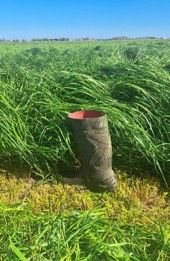
Photo 2. Grassland in the field. Mixture: tetraploid and diploid perennial ryegrass, timothy, hybrid ryegrass, clover, and forage herbs.
Silage Preparation and Storage
Quality grass cover is just the first step. It's equally important to wilt, compact, and seal the plant mass correctly. It is recommended to minimize the time cut green mass remains in the field. You can lose about 50 VEM (VEM — unit of energy feed value in the Netherlands) for each extra day cut mass is left in the field.
The field surface should be as even as possible to prevent soil from contaminating the harvested mass. Dense compaction is necessary for the rapid removal of air from the mass and the creation of anaerobic conditions. For stable ensiling, quality film, airtight cover, and sufficient pressure across the entire trench surface are also required. The integrity of the film must be regularly checked and promptly repaired to prevent air and rainwater entry.
Good silage conservation is crucial for preventing mold development, aerobic heating, and reheating of the stored mass. With proper moisture content, one indicator of proper fermentation is a rapid decrease in pH. For silage with high dry matter content, density and airtight storage are as important as fermentation. High water-soluble sugar content promotes the formation of organic acids and pH reduction. A high buffering capacity, characteristic of protein-rich masses, complicates rapid acidification.
A low pH suppresses many undesirable microorganisms, including Listeria, but it is also critical to eliminate oxygen access to control mold. With an increased risk of unwanted fermentation or reheating, a preservative selected based on dry matter content, raw material type, and conservation goal is applied.
Results of laboratory studies on roughage in goat farming: Netherlands and Russia
Laboratory analysis results are presented in tables 1–2.
Table 1. Laboratory analysis of roughage, Netherlands.
|
Indicator |
Description |
Result |
Target values |
|
DS |
Dry matter, g/kg product |
352 |
300–500 |
|
RE |
Crude protein |
176 |
160–190 |
|
RC |
Crude fiber |
195 |
230–280 |
|
RAS |
Crude ash |
113 |
90–120 |
|
Suiker |
Sugar |
161 |
40–100 |
|
RVet |
Crude fat |
38 |
30–50 |
|
pH |
pH |
5.5 |
4.1–4.9 |
|
NH3-fractie |
Ammonia fraction |
7 |
< 9 |
|
Melkzuur |
Lactic acid |
28 |
30–70 |
|
Azijnzuur |
Acetic acid |
7 |
10–20 |
|
Boterzuur |
Butyric acid |
2.1 |
< 3.0 |
|
VC-OS |
Digestibility of organic matter, % |
83.7 |
76–80 |
|
NO3 |
Nitrates |
1.0 |
< 7.5 |
|
Cl |
Chlorine |
11.5 |
5–20 |
|
NDF |
NDF |
377 |
420–500 |
|
ADF |
ADF |
223 |
240–290 |
|
ADL |
Acid detergent lignin |
13 |
20–30 |
|
NDF verteerbaar |
NDF digestibility, % |
72.9 |
— |
|
% Oplosbaar RE |
Soluble crude protein, % |
64 |
— |
|
Verzadigingswaarde |
Saturation value |
0.95 |
0.95–1.10 |
|
Structuurwaarde |
Structural value |
2.24 |
2.6–3.0 |
|
DVLy |
— |
4.2 |
— |
|
DVMe |
— |
1.5 |
— |
|
RE totaal |
Total protein |
189 |
— |
|
FOS-2/FOS |
Fermentable organic matter |
0.58 |
— |
The studied sample, Russia: No. ANTV2405302; mowing date — 09/10/2024; cut number — 1; sample registration date — 01/10/2024; report date — 02/10/2024.
Table 2. Laboratory analysis of roughage, Russia.
|
Indicator |
Result |
Control value |
Average value |
|
Dry matter, g/kg product |
920 |
800–900 |
872 |
|
VEM/kg, milk |
647 |
860–920 |
619 |
|
VEVI/kg, fattening |
605 |
880–960 |
574 |
|
DVE |
47 |
80–105 |
46 |
|
OEB |
–24 |
–45…+15 |
–29 |
|
Digestible organic matter |
555 |
670–710 |
529 |
|
FOSp / fermentable OM |
491 |
560–600 |
462 |
|
NEL, MJ |
4.5 |
5.5–6.5 |
4.8 |
|
NEL-VC, MJ |
4.7 |
5.5–6.5 |
4.5 |
|
OE, MJ |
8.0 |
9.4–10.3 |
8.3 |
|
Structural value |
4.6 |
2.6–3.2 |
4.1 |
|
nXP |
106 |
125–145 |
108 |
|
RNB |
–0.8 |
–3.0…+7.0 |
–1.7 |
|
UDP |
20 |
22–38 |
20 |
|
Crude ash |
78 |
80–120 |
79 |
|
Digestibility of organic matter, % |
60.2 |
75–79 |
57.5 |
|
Crude protein |
100 |
110–190 |
94 |
|
Crude fat |
19 |
20–35 |
19 |
|
Crude fiber |
362 |
210–260 |
323 |
|
Sugar |
81 |
70–150 |
72 |
|
NDF |
586 |
450–575 |
637 |
|
NDF without nitrogen |
579 |
— |
— |
Conclusion
Quality roughage is the result of the entire technological chain: from grass composition and optimal cutting phase to wilting, preventing soil contamination, densification, and airtight storage.
For dairy goats, it's especially important not only the protein or energy content itself but also how much feed the animal can actually consume. Good palatability, high digestibility, and stable silage help to increase the intake of nutrients from the basic diet portion and sustain high milk productivity.
Therefore, silage should be evaluated comprehensively: by dry matter content, crude protein, fiber, and NDF levels, sugar levels, digestibility, fermentation indicators, and sanitary status. One high indicator does not compensate for harvesting and storage mistakes.
Good silage starts in the field. A full grass stand, a timely cut, and careful conservation lay the foundation for stable feed consumption, animal health, and high milk productivity in goats.