The Global Cheese Market Is Projected to Reach $328.71bn

The market study divides cheese demand among established staples, speciality products and newer plant-based alternatives. Mozzarella holds the largest share by product type in 2026, at 37.19%. Its use in pizza, pasta, enchiladas and risottos contributes to its presence across markets, including parts of Asia-Pacific and the Middle East where Western-style food consumption has expanded.
Natural and processed cheese occupy different positions. Natural products are associated with demand for limited or no preservatives, as well as particular flavours and textures. Processed cheese remains widely used in Asia-Pacific, South America, and the Middle East and Africa, with attributes including longer shelf life, cooking stability and consistent composition. Parmesan, one of the speciality varieties, is valued for its firm texture and fruity, nutty flavour and can require two to four years of processing.
Demand is also broadening within the natural and artisanal segments. The American Cheese Society counted 980 artisanal producers in the United States in 2020, including makers of handmade, naturally flavoured and farm-fresh products. Cheeses containing herbs, spices, fruit and nuts have entered the offerings of natural and craft producers. The category includes industrial products designed for extended storage, as well as premium varieties and speciality formats.
Format and distribution are changing alongside product choice. The market includes block, spreadable and other forms, with spreadable cheese expected to record the fastest growth during the period covered by the study. Supermarkets and hypermarkets are forecast to account for 42.94% of the market in 2026. Specialist shops are also expanding their range of local, imported, artisanal and speciality cheeses, and some combine cheese sales with limited offerings such as sandwiches and wine.
Plant-based cheese is made mainly from soy, almonds, cashews and other ingredients. In November 2022, India’s Plan B Foods introduced a vegan range that included cheddar and classic versions, along with cheddar, mozzarella and Parmesan blocks and grated products. Animal-derived cheese remains the largest segment globally and includes products made from cow, sheep, goat and camel milk. The plant-based segment, however, is projected to grow faster during the period examined.
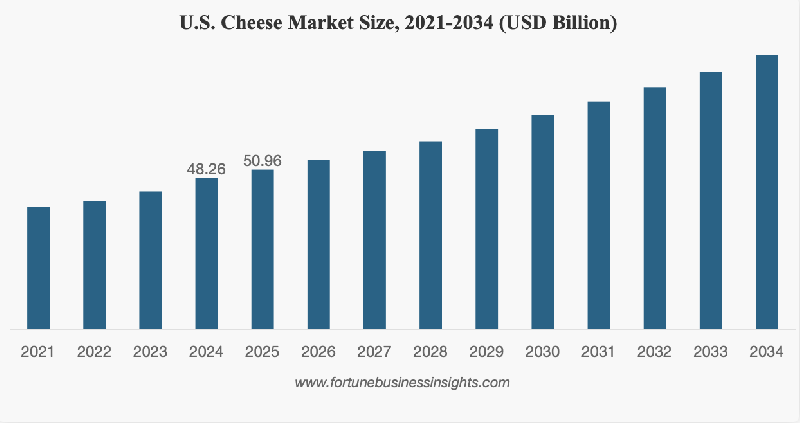
Europe represented 48.43% of the global market in 2025, with revenue of $96.44bn; its projected figure for 2026 is $100.32bn. Germany and the United Kingdom are forecast to reach $24.01bn and $10.37bn respectively in 2026. North America held 29.50% of the market in 2025, or $58.75bn, and is projected to reach $61.63bn in 2026. The United States alone is forecast at $46.58bn. Asia-Pacific generated about $16.44bn in 2025, or 8.26% of the global market, and is projected at $17.32bn in 2026; China, India and Japan are forecast at $2.41bn, $5.05bn and $3.93bn.
Brazil, Argentina and Uruguay are identified as important dairy-producing countries in South America, where the study points to scope for locally made cheese. It attributes this opportunity to the high cost of imported cheese from Europe and North America. The report also lists concerns about excessive consumption, particularly because of saturated fat and sodium, and volatility in raw-material prices. Companies cited in connection with product, capacity and distribution activity include Emmi Roth, Agropur, Lactalis and Lactalis Canada. Other named participants are The Kraft Heinz Company, Fonterra, Arla Foods, FrieslandCampina, Saputo, Lactalis Ingredients, Wensleydale Creamery, Dairy Farmers of America, SAVENCIA and Norseland.