Strait of Hormuz Crisis Threatens Billions in Global Dairy Trade
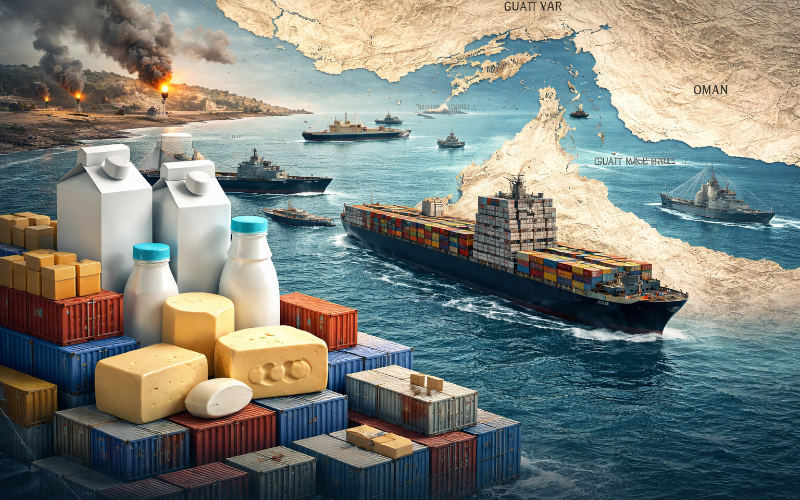
Although Iran itself is not a major importer of European dairy products, the strategic location of the strait makes it a critical gateway for shipments to several key dairy-importing countries.
A Multi-Billion-Dollar Dairy Import Market
The Gulf region is one of the most import-dependent dairy markets in the world. In 2024 alone, Middle Eastern countries imported around 1.3 million tonnes of dairy products worth approximately $4.2 billion.
Among the largest importers:
-
Saudi Arabia – about $2.1 billion in dairy imports annually
-
United Arab Emirates – about $1.5 billion
-
Iraq – about $763 million
-
Kuwait, Oman, Bahrain and Qatar together represent hundreds of millions more in annual imports.
In the Gulf Cooperation Council (GCC) alone, dairy imports reached $2.7 billion in 2024, with the UAE accounting for 43% of total import volumes.
The UAE is particularly dependent on international dairy supply. The country imports roughly $170 worth of dairy products per capita annually, making it one of the most import-reliant dairy markets globally.
Hormuz: The Key Shipping Corridor
The Strait of Hormuz is the primary maritime gateway for shipments into the Persian Gulf. If access through the strait becomes restricted, maritime deliveries to Iraq, Kuwait, Bahrain, Qatar, the UAE and eastern Saudi Arabia would be severely affected.
These markets rely heavily on imported dairy ingredients such as:
-
whole milk powder
-
cheese
-
evaporated and condensed milk
Together, these three categories account for about 68% of total dairy imports in the Middle East.
The disruption would therefore affect some of the most traded dairy commodities globally.
Exporters Most Exposed
The countries most exposed to disruptions in Gulf shipping routes include:
-
European Union
-
United States
These exporters supply a significant share of cheese, milk powder, butter and evaporated milk to Gulf markets.
The UAE alone imports up to 200,000 tonnes of whole milk powder annually, while cheese represents about 28% of the country's dairy import value.
Such volumes make the region strategically important for global dairy exporters.
Additional Risk from the Red Sea
The situation is further complicated by potential disruptions in the Bab el-Mandeb Strait, another key shipping corridor connecting the Red Sea with the Indian Ocean.
If both Hormuz and the Red Sea routes become unstable, exporters may be forced to reroute vessels around the Cape of Good Hope, significantly increasing transit times and freight costs for refrigerated dairy cargo.
Strategic Importance for Global Dairy Trade
The Middle East remains one of the fastest-growing dairy markets due to population growth, urbanization and limited local production capacity.
For exporters, the region is not only a major sales destination but also a critical outlet for surplus dairy ingredients and value-added products.
Any prolonged disruption of shipping through Hormuz could therefore reshape global dairy trade flows, forcing exporters to redirect supply and potentially increasing price volatility across international dairy markets.