Uzbekistan's Ice Cream Market Grew by an Average of 15% in Physical Terms from 2021 to 2025
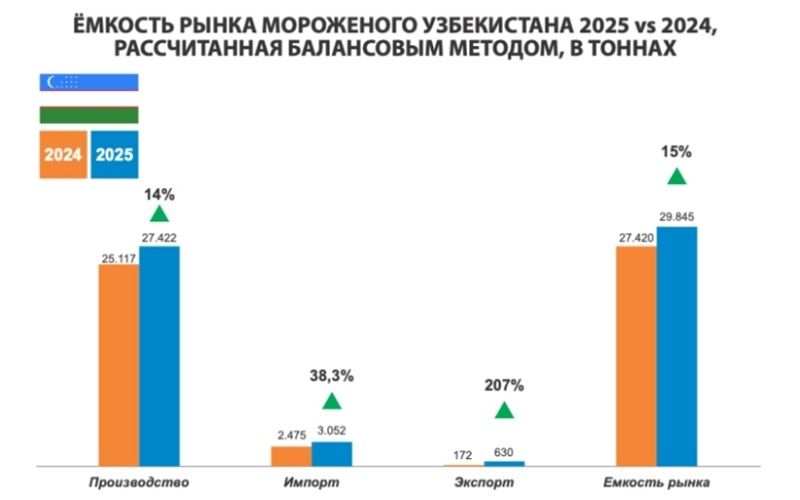
The market's development is supported by the growth of the raw material base, notes Dairynews.today, citing data from Dmitry Dokin, Chairman of the Board of Directors of "Shin-Line". Read more.
Thanks to government programs for the development of dairy farming, the production volume of raw cow's milk in the country increased from 4 million tons in 2003 to 13.1 million tons in 2025. However, only 4.3 million tons of raw material are actually processed, while the rest is processed within households into traditional products such as kaymak, sour cream, chakka, cottage cheese, and butter.
The state actively supports the implementation of investment projects in the field of milk processing, creating prerequisites for further development of the ice cream market.
However, the market capacity is still relatively low — less than 1 kg per capita per year. Experts estimate that considering production in rural areas, which is not included in government statistics, actual consumption could be about 1.5 kg per capita.
The share of imports in physical and value terms varied from 5–10% of consumption in different years. However, in the retail networks of Tashkent, imports account for 40–50%, due to the more developed modern retail in the capital. In most regions of Uzbekistan, network retail is still underdeveloped.
In 2021, the country purchased 835 tons of ice cream, but by 2025, the volume of supplies increased almost fourfold to 3052 tons.
The growth in import purchases indicates a demand for quality and premium ice cream. At the same time, customs conditions remain an important factor of competition in the Uzbek market.
Within the CIS free trade zone, Kazakhstan, Russia, Belarus, and other countries can supply dairy products, including ice cream, to the Uzbek market duty-free. Producers from Iran, Turkey, and EU countries are at a less advantageous position: their products are subject to the WTO most-favored-nation tariff, with a customs duty of 30%.
In 2025, Russia and Kazakhstan controlled about 84% of the import ice cream trade. Despite the 30% customs duty, Korean and Chinese manufacturers are gradually increasing their presence in the Uzbek market. In 2025, they started working with Uzbek trade partners and supplied 282 tons of frozen dessert.
Among EU countries, French companies achieved noticeable results. In 2023, their supplies to Uzbekistan increased to 75 tons, but in 2025 they decreased to 49 tons.
Turkish and Iranian manufacturers also produce quality and inexpensive ice cream, but they have not yet managed to establish themselves in the Uzbek market. One reason may be the need to pay a 30% customs duty.
The weak distribution network also hinders the active development of imported ice cream in Uzbekistan. The "Renna" group signed a contract with the largest supplier of the Korzinka network, effectively closing the entrance for the rest of the Russian ice cream group. The "Shin-Line" group opened two branches in Uzbekistan. These two suppliers currently occupy more than 80% of the imported ice cream market.
Other foreign players face a choice: develop small distributors or open their own branches. The first option is problematic, the second is costly and risky, comments Dmitry Dokin.