Kyrgyzstan's Ice Cream Market Grows by 29.5% in 2025 Despite Production Decline
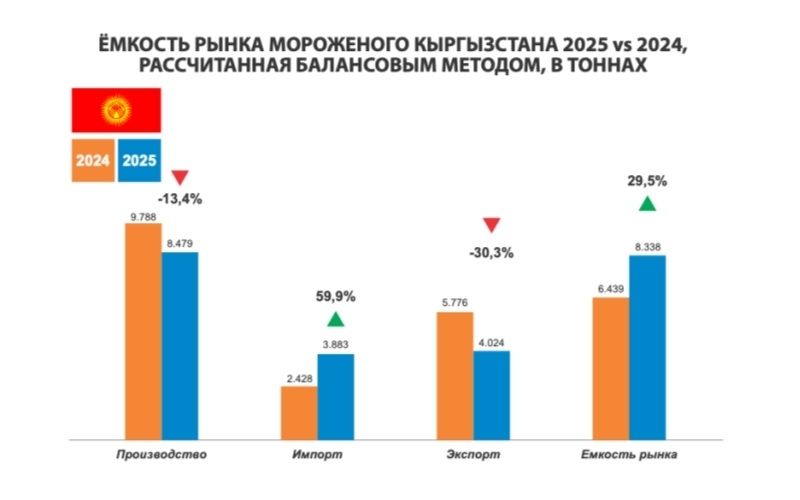
At the same time, ice cream production in Kyrgyzstan decreased by 13.4% year-on-year as of the end of 2025, dropping from 9,788 to 8,479 tons. During the peak season, from May to September, there was a noticeable decline in production. The most significant drop was recorded in August — down 34.1% year-on-year.
Later, the situation began to improve: in October, production increased by 20.1% compared to October 2024, and in November, there was a 122.1% year-on-year growth. However, in December, there was another decline — down 19.1%.
The market growth was driven by both local and foreign producers actively expanding their supply to the Kyrgyz market. Ice cream imports increased by 59.9% in January–December 2025, from 2,428 to 3,883 tons. Supplies of Kyrgyz ice cream to the domestic market grew by only 11.1% — from 4,011 to 4,455 tons.
As a result, imported ice cream became very noticeable on the shelves of Kyrgyz stores. By the end of 2025, its share in the local market in volume terms was about 47%.
Exports of Kyrgyz ice cream continued to decline. In 2025, they fell by 30.3%, totaling 4,024 tons. The entire export volume was directed to Kazakhstan.
The average export price of Kyrgyz ice cream in 2024–2025 sharply increased — by 70.9%, from $0.96 to $1.65 per kg. This is largely due to improved administration of customs and tax procedures in Kazakhstan, which has intensified efforts to collect VAT.
As noted by Dmitry Dokin, with the closure of "unofficial" ice cream supply channels from Kyrgyzstan to Kazakhstan, the price increased, dumping began to cease, and the only advantage of local ice cream — low price — started to disappear.