Oil, Markets, and Risk Premiums: Financial Fallout from the Gulf Escalation
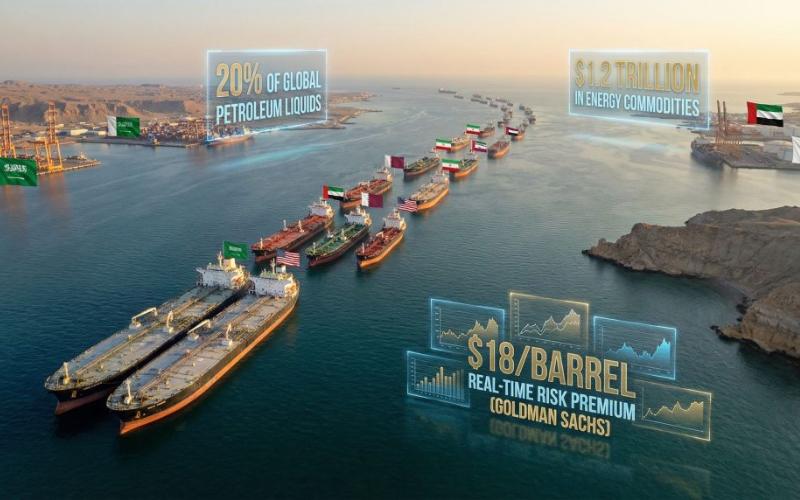
Oil markets were the first to respond. Brent Crude surged more than 10% intraday, briefly touching the $82–83 per barrel range before stabilizing near $77–78. Meanwhile, West Texas Intermediate (WTI) climbed roughly 6–8%, trading around $71–72 per barrel. The immediate price movement reflects not confirmed large-scale supply loss, but the rapid expansion of a geopolitical “risk premium” tied to fears of disruption in the Strait of Hormuz.
The numbers explain the sensitivity. Roughly 20% of global oil consumption — about 20–21 million barrels per day — passes through the Strait of Hormuz. Of that, around 15–17 million barrels per day are crude oil and condensates, with additional volumes of liquefied natural gas (LNG), particularly from Qatar. Even a temporary slowdown of tanker traffic can remove several million barrels per day from prompt physical markets, tightening supply-demand balances almost instantly.
To contextualize the reaction: global oil demand currently stands near 102–103 million barrels per day. A disruption of even 2–3 million barrels daily would represent roughly 2–3% of total global supply — enough to move prices sharply in already balanced markets.
Historically, every major escalation involving Iran has triggered volatility in crude benchmarks. During the 2019 tanker incidents, war-risk insurance premiums for vessels transiting the Gulf increased by more than 300% within weeks. In extreme cases, insurance costs per voyage rose from approximately $30,000–40,000 to over $150,000–200,000 depending on vessel size and route. Such costs feed directly into delivered oil prices and downstream commodities.
For oil-exporting economies such as the UAE, higher oil prices create a measurable fiscal effect. Every $10 increase in Brent can translate into billions in additional annual export revenue. The UAE produces approximately 3–3.2 million barrels per day. A sustained $10 price increase implies roughly $30 million additional revenue per day, or close to $11 billion annually, before adjustments for production quotas or hedging.
However, elevated oil prices also increase imported inflation globally. Energy typically accounts for 7–10% of consumer price baskets in advanced economies, but indirectly affects transport, food, manufacturing, and logistics. A sustained 10–15% oil price rise can add 0.3–0.5 percentage points to global inflation, depending on duration and pass-through speed.
Equity markets in the Gulf reacted defensively. Temporary trading halts and reduced liquidity reflected precaution rather than systemic stress. Historically, Gulf stock indices show mixed reactions to oil spikes: energy-linked stocks benefit, while aviation, logistics, and consumer sectors face margin pressure. Tourism and air transit are especially vulnerable; Dubai International Airport typically handles over 85 million passengers annually, making even short-term airspace disruption economically meaningful.
Safe-haven flows also intensified. Gold prices rose nearly 3% in a single session, briefly exceeding $2,300 per ounce in global trading. In periods of acute geopolitical uncertainty, gold can attract billions in ETF inflows within days as institutional investors rebalance portfolios.
Currency markets are closely monitoring capital flows. The UAE dirham remains pegged to the U.S. dollar at approximately 3.6725 AED per USD, limiting exchange-rate volatility. However, foreign direct investment and portfolio flows are more sentiment-driven. The UAE attracted roughly $23–25 billion in FDI annually in recent years; prolonged instability could delay project pipelines in real estate, infrastructure, and technology.
Shipping insurance premiums remain a critical transmission channel. If war-risk surcharges add even $1–2 per barrel to transportation costs, global oil benchmarks can structurally shift upward. LNG markets are similarly exposed: Qatar exports roughly 77 million tonnes of LNG annually, much of it through Hormuz. Disruption would ripple into European and Asian gas prices, especially ahead of winter inventory cycles.
Experts outline three quantified scenarios:
1. Contained Escalation (Short-Term Shock)
Oil retreats to the $70–75 range within weeks. Insurance premiums normalize. Inflation impact limited to <0.2 percentage points globally.
2. Prolonged Standoff
Brent stabilizes between $85–95 per barrel. War-risk premiums remain elevated. Global inflation rises 0.5 percentage points. Emerging markets face currency pressure.
3. Regional Expansion
Partial closure of Hormuz or infrastructure strikes remove 3–5 million barrels per day temporarily. Oil exceeds $100–120 per barrel. Global GDP growth could fall by 0.5–1 percentage point, with recession risk in import-dependent economies.
For financial markets, uncertainty is often more damaging than confirmed disruption. Volatility indices, shipping rates, and commodity futures are now moving in tandem with geopolitical headlines. The coming days will determine whether the current spike remains a short-lived geopolitical premium — or evolves into a structural energy shock with broader macroeconomic consequences.