From Desert Milk to Flat White: Why Camel Milk Is Struggling to Fit Into Coffee
Camel milk is no longer confined to traditional consumption in Central Asia, the Middle East or Africa. It is increasingly discussed as a premium, functional ingredient that could move up the value chain—into coffee, one of the most dynamic and competitive segments of the beverage industry.
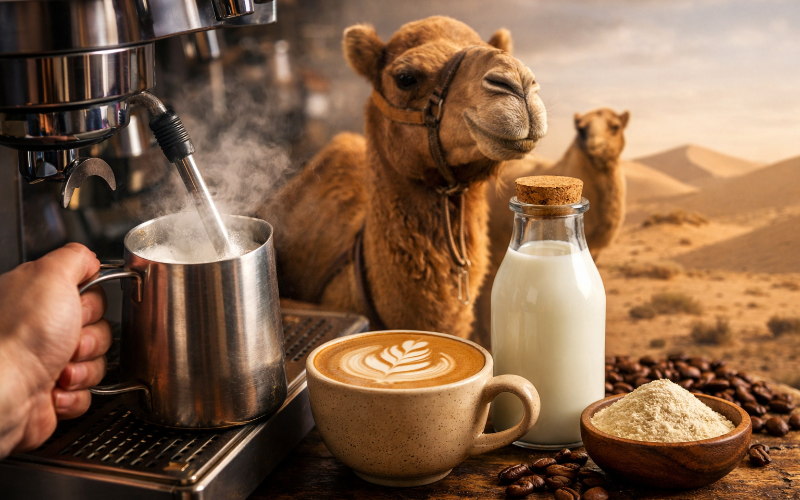
According to industry estimates, the global camel milk market was valued at around $14–15 billion in 2024, with projections suggesting it could more than double by the mid-2030s, driven largely by demand for functional and alternative dairy products. But growth in value does not automatically translate into adoption in coffee.
The physics problem behind the bar
For dairy producers looking at coffee as a growth channel, the key question is not taste or nutrition—it is functionality.
Milk in coffee is a technical ingredient. It must foam, emulsify and remain stable under heat. This is where camel milk begins to diverge fr om expectations.
Research published in the International Dairy Journal shows that camel milk proteins behave differently due to their structure, including a higher proportion of β-casein and the absence of β-lactoglobulin. These differences directly affect how the milk traps air and forms foam.
In a café, milk must perform consistently across thousands of cycles. Even small variations in fat content, temperature, or handling can affect texture. For large-scale coffee operations, wh ere a single brand may serve millions of cups per day globally, that variability becomes a serious operational risk.
Fr om raw milk to engineered ingredient
Scientific reviews consistently highlight that camel milk’s techno-functional properties—foaming, emulsification, heat stability—require adapted processing. That creates space for value-added ingredient development.
Early market signals already reflect this transition. Instead of relying on raw camel milk, producers are experimenting with:
Premium positioning is not optional
Unlike oat or soy, camel milk cannot compete on cost. Camel milk production remains limited, with much lower yields per animal compared to dairy cows. A single cow can produce several times more milk per day than a camel, and industrial-scale camel farming infrastructure is still underdeveloped in most regions.
This structural limitation places camel milk firmly in the premium segment.
In coffee, that is not necessarily a disadvantage. Specialty coffee has already demonstrated that consumers are willing to pay 30–100% more per cup for differentiated ingredients and experiences.
But premium positioning also raises expectations. The product must deliver not just novelty, but consistent quality and clear value.
Global coffee chains operate under strict standardization. Ingredient variability, supply inconsistency, and processing complexity all become critical barriers.
In practical terms, a milk that works 95% of the time is not enough. At scale, it must work 100% of the time, across thousands of locations.
Processing: the real bottleneck
If there is a single constraint that will define the future of camel milk in coffee, it is processing.
Food science literature consistently notes that camel milk is more difficult to standardize than cow’s milk due to differences in protein composition and thermal behavior. These differences affect everything from pasteurization to foam formation.
For producers, this shifts the competitive landscape. Success will depend less on animal husbandry and more on:
Camel milk is unlikely to become a mainstream coffee milk.
If even 1–2% of the global specialty coffee market adopts camel milk in premium or experimental formats, that could represent a significant high-margin segment. And that is wh ere the real opportunity lies—not in volume, but in value per liter.
The physics problem behind the bar
For dairy producers looking at coffee as a growth channel, the key question is not taste or nutrition—it is functionality.
Milk in coffee is a technical ingredient. It must foam, emulsify and remain stable under heat. This is where camel milk begins to diverge fr om expectations.
Research published in the International Dairy Journal shows that camel milk proteins behave differently due to their structure, including a higher proportion of β-casein and the absence of β-lactoglobulin. These differences directly affect how the milk traps air and forms foam.
In controlled experiments, camel milk has been shown to produce foam stability and overrun comparable to or even exceeding cow’s milk, but only under optimized conditions. The problem is that coffee service is not a lab environment.
In a café, milk must perform consistently across thousands of cycles. Even small variations in fat content, temperature, or handling can affect texture. For large-scale coffee operations, wh ere a single brand may serve millions of cups per day globally, that variability becomes a serious operational risk.
Fr om raw milk to engineered ingredient
Scientific reviews consistently highlight that camel milk’s techno-functional properties—foaming, emulsification, heat stability—require adapted processing. That creates space for value-added ingredient development.
Early market signals already reflect this transition. Instead of relying on raw camel milk, producers are experimenting with:
- heat-treated and standardized liquid formats
- powdered versions for shelf stability and export
- blended systems combining camel milk with other dairy bases
Premium positioning is not optional
Unlike oat or soy, camel milk cannot compete on cost. Camel milk production remains limited, with much lower yields per animal compared to dairy cows. A single cow can produce several times more milk per day than a camel, and industrial-scale camel farming infrastructure is still underdeveloped in most regions.
This structural limitation places camel milk firmly in the premium segment.
In coffee, that is not necessarily a disadvantage. Specialty coffee has already demonstrated that consumers are willing to pay 30–100% more per cup for differentiated ingredients and experiences.
But premium positioning also raises expectations. The product must deliver not just novelty, but consistent quality and clear value.
Global coffee chains operate under strict standardization. Ingredient variability, supply inconsistency, and processing complexity all become critical barriers.
In practical terms, a milk that works 95% of the time is not enough. At scale, it must work 100% of the time, across thousands of locations.
Processing: the real bottleneck
If there is a single constraint that will define the future of camel milk in coffee, it is processing.
Food science literature consistently notes that camel milk is more difficult to standardize than cow’s milk due to differences in protein composition and thermal behavior. These differences affect everything from pasteurization to foam formation.
For producers, this shifts the competitive landscape. Success will depend less on animal husbandry and more on:
- technological control over protein structure
- standardization of functional properties
- development of barista-grade formulations
Camel milk is unlikely to become a mainstream coffee milk.
If even 1–2% of the global specialty coffee market adopts camel milk in premium or experimental formats, that could represent a significant high-margin segment. And that is wh ere the real opportunity lies—not in volume, but in value per liter.