Vedran Lončarić, ECOLAB: "Understanding Contamination Pathways is Key to Effective Mastitis Prevention"
A two-day industry seminar by CID LINES (Ecolab) focusing on enhancing dairy production efficiency is held in Budapest on April 20-21, 2026. Vedran Lončarić, Technical Manager at ECOLAB Dairy Farm, presented a practical approach to managing mastitis through the analysis of contamination pathways — a key factor in reducing losses on farms.
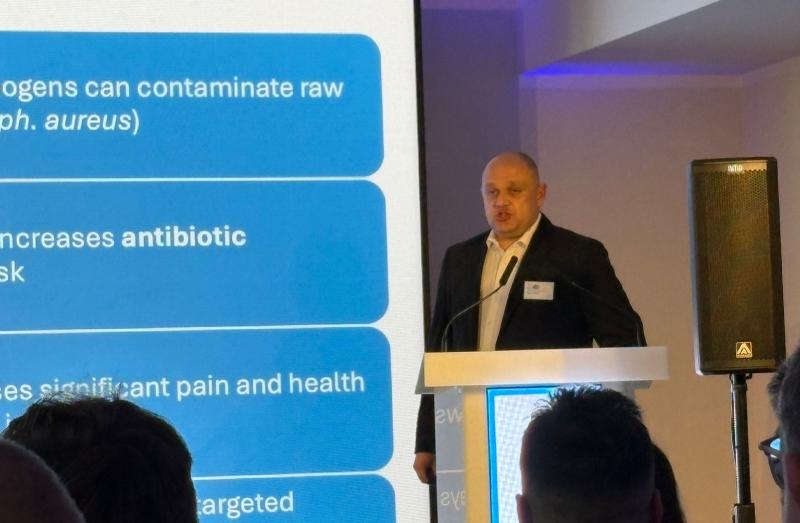
Vedran Lončarić's presentation was part of the seminar "Elevating Dairy Performance: Delivering Safety, Quality, and Profitability fr om Farm to Family", organized by CID LINES, an Ecolab company.
The event brought together dairy industry professionals and experts, focusing on sharing scientific data, practical solutions, and experiences aimed at improving safety, quality, and profitability standards in dairy production.
Learn more
"Not all mastitis is the same. Understanding contamination pathways is crucial. Identifying the dominant pathway on each farm allows for the right prevention strategy to be chosen."
It affects:
Contagious
Transmitted from cow to cow through milking equipment, staff hands, or direct contact.
Main pathogens: Staphylococcus aureus, Streptococcus agalactiae.
"These bacteria can hide inside cells, making them particularly resistant."
Control focus: milking hygiene, disinfection, culling of chronic animals.
Environmental
Originates from the environment — bedding, water, manure.
Main pathogens:
* E. coli
* Klebsiella
* environmental streptococci
"Even short-term presence of bacteria can lead to severe clinical cases."
Control focus: cleanliness, dry bedding, udder preparation and protection.
Mixed
The most common scenario in practice.
"Most farms face a combination of pathways, requiring a comprehensive approach."
Action algorithm:
1. identify the type of mastitis
2. determine the dominant transmission pathway
3. implement targeted measures
"Each pathway requires its own strategy. There are no universal solutions."
"Our task is to create conditions wh ere bacteria cannot establish and spread."
Thus, mastitis becomes not an inevitable problem, but a manageable risk — provided a systematic approach and accurate diagnosis.
The event brought together dairy industry professionals and experts, focusing on sharing scientific data, practical solutions, and experiences aimed at improving safety, quality, and profitability standards in dairy production.
Learn more
"Not All Mastitis is the Same"
The key thesis of Lončarić's speech is the need to abandon a one-size-fits-all approach to mastitis."Not all mastitis is the same. Understanding contamination pathways is crucial. Identifying the dominant pathway on each farm allows for the right prevention strategy to be chosen."
According to him, incorrect diagnosis of the disease's causes leads to inefficient expenses and the growth of chronic problems in the herd.
Mastitis as an Economic Factor
The expert emphasized that mastitis is primarily an economic issue.It affects:
- reduction in milk yields and quality
- increased treatment costs
- culling of animals
- increased use of antibiotics
Three Contamination Pathways — Three Different Strategies
The management approach is based on dividing mastitis into three types:Contagious
Transmitted from cow to cow through milking equipment, staff hands, or direct contact.
Main pathogens: Staphylococcus aureus, Streptococcus agalactiae.
"These bacteria can hide inside cells, making them particularly resistant."
Control focus: milking hygiene, disinfection, culling of chronic animals.
Environmental
Originates from the environment — bedding, water, manure.
Main pathogens:
* E. coli
* Klebsiella
* environmental streptococci
"Even short-term presence of bacteria can lead to severe clinical cases."
Control focus: cleanliness, dry bedding, udder preparation and protection.
Mixed
The most common scenario in practice.
"Most farms face a combination of pathways, requiring a comprehensive approach."
Control Begins with Understanding
Lončarić emphasizes that effective mastitis management begins not with treatment but with diagnosis.Action algorithm:
1. identify the type of mastitis
2. determine the dominant transmission pathway
3. implement targeted measures
"Each pathway requires its own strategy. There are no universal solutions."
Environment as the Main Risk Factor
The speaker paid special attention to the habitat of pathogens: in contagious mastitis — the condition of the teat skin plays a key role, in environmental — the conditions of animal housing."Our task is to create conditions wh ere bacteria cannot establish and spread."
Typical Farm Mistakes
Among the main problems:- poor milking hygiene
- contaminated equipment
- staff errors
- insufficient attention to the dry period
Transition to Prevention
The main conclusion of the presentation is the need to change the approach. "Effective protection starts with the right understanding: each contamination pathway requires its own hygiene strategy."Thus, mastitis becomes not an inevitable problem, but a manageable risk — provided a systematic approach and accurate diagnosis.