Three-Year Results: Double-Digit Growth in Ice Cream Sales in Kazakhstan Driven by Innovation and Product Differentiation

Last year was truly a record year for Shin-Line. Our dynamic growth began back in 2023 following the launch of additional production capacity at our new ice cream factory in Almaty. At that time, production volumes increased by 22% compared to 2022. In 2024, we further increased output by 24% in tonnage, and 2025 marked a new record with growth of 28% in physical volume. At the same time, ice cream sales in the Kazakhstan market grew at an even faster pace, reaching 31% and exceeding overall market growth.
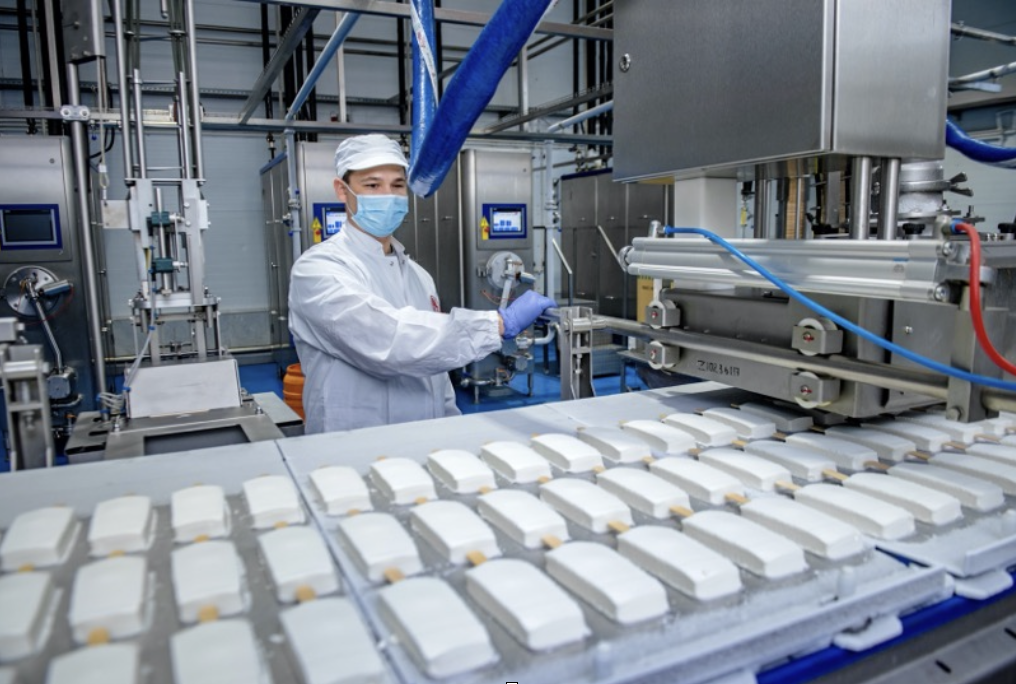
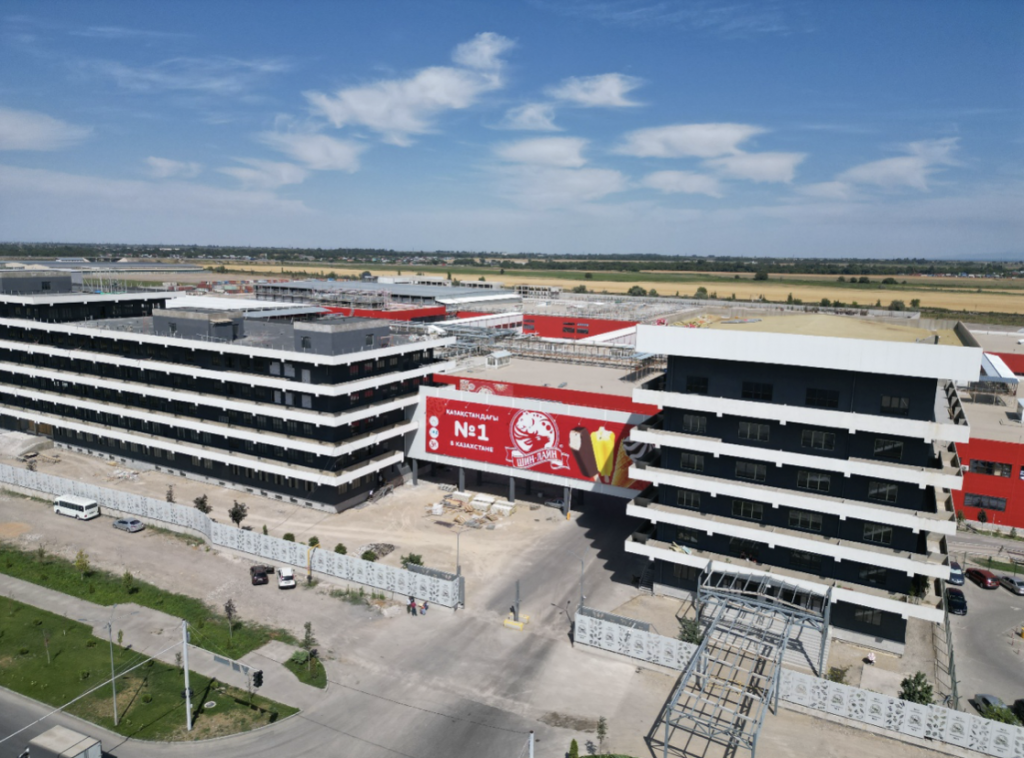
The key performance indicators we highlight are the sustained increase in physical output, higher capacity utilization, and a significant reduction in product shortages during peak demand periods. A major factor behind this success was the launch of a large, modern production complex in Almaty, equipped with innovative technological solutions and automated production lines. The plant’s design capacity reaches up to 350 tonnes of product per day, bringing Shin-Line to a fundamentally new level in terms of scalability and operational efficiency.
These record results were made possible through systematic investments in production expansion and modernization, the annual introduction of new production lines, and the launch of a high-tech manufacturing facility in Almaty. Additional growth drivers included favorable summer weather conditions and the successful launch of differentiated new products that received strong consumer response.
At the same time, volume growth is supported by a strict focus on quality. Shin-Line implements modern food safety standards, strengthens control at every stage of production, and uses innovative technologies, allowing the company to scale production while maintaining consistent product quality.
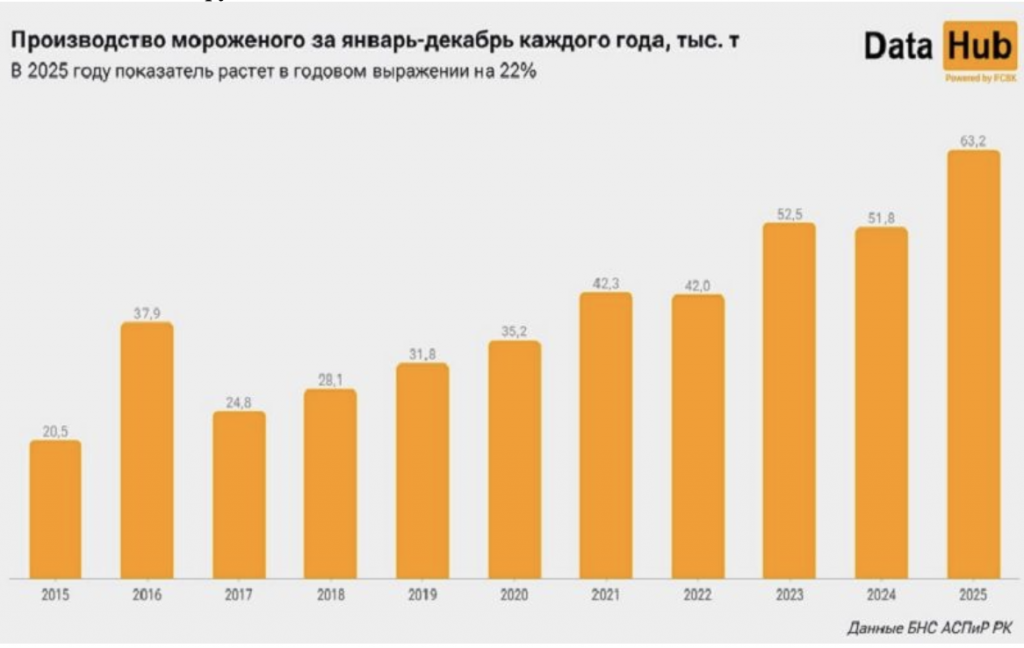
Today, Kazakhstan’s ice cream industry is experiencing a period of active growth and, in many ways, a renaissance. According to the National Statistics Bureau of the Republic of Kazakhstan (ASPiR), total ice cream production reached 63.2 thousand tonnes in 2025, an increase of 22% year-on-year. This represents the highest growth rate in the sector since 2000.
For the first time, ice cream exports exceeded imports. Between January and November 2025, exports reached 13.6 thousand tonnes, up 39% fr om the previous record, while imports declined by 6% to 11.8 thousand tonnes. The main export destinations are Russia and Kyrgyzstan, as well as Uzbekistan and Belarus.
The key growth driver is the qualitative transformation of the market. Increased competition, the emergence of innovative local and imported products, and the ambition of Kazakh producers to meet global standards have significantly expanded the product range and boosted consumer interest.
Today, Kazakhstan stands out for its strong presence of global brands and product innovations, encouraging consumers to shift from substitutes to ice cream and supporting sustained growth in consumption. Overall, this reflects a maturing market with strong export potential and a transition to a new stage of industry development.
We export to 10 different countries, and we never tire of saying that China is the most challenging market. It requires the development of special products tailored to Chinese consumers, who tend to react very negatively to overly sweet flavors.
That market has already seen an abundance of “export ice cream” featuring matryoshkas, sickles, crosses, and domes, and as a result, exports from post-Soviet producers have gradually declined to near zero. Within the EAEU, consumer tastes have been formed over decades, making exports easier. For other markets, however, we need to adjust recipes, undergo additional certification, and often change branding and packaging design.
For Shin-Line, the absolute priority is consistent and reproducible product quality, regardless of production scale or market presence. We believe that industry leadership is impossible without a strict quality control system based on modern technology, expertise, and a strong culture of responsibility at every level of the company.
In practice, product quality is ensured through a multi-level system involving more than 10 stages of control — from incoming inspection of raw materials and ingredients to laboratory testing of finished products and stability monitoring throughout the product’s shelf life.
Quality control is carried out at every critical stage of the production cycle: formulation, pasteurization, freezing, packaging, storage, and logistics. All processes comply with international food safety standards and are subject to regular internal and external audits.
Technology plays a key role as well. Shin-Line’s production facilities are equipped with modern, highly automated equipment that minimizes the human factor and ensures stable product parameters. This allows us not only to maintain high quality at large production volumes, but also to quickly implement innovations — new formats, flavors, and textures tailored to consumer demand.
For us, quality goes beyond compliance. It also means differentiation: developing product innovations, experimenting with flavors, improving recipes, and enhancing the overall consumer experience. This combination of strict quality control, advanced technology, and bold product development allows us to maintain market leadership and compete successfully with both local and international players.
All of our new products performed well, but the five-layer Bahroma pint stood out the most. In my 30 years in the ice cream industry, this was the first time I saw resellers buying up ice cream in retail chains and reselling it online at twice the price.
The “Dubai Chocolate” ice cream bar was copied by many competitors, but ours had the most complex structure and came closest to the original concept.
Producing such complex products is possible thanks to our unique equipment. Our liquid nitrogen line — the only one of its kind in the post-Soviet region — allows us to produce Double Chocolate and Solero-type ice cream bars with a thick juice-based coating. The Tetra Pak line enables us to add multiple fat-based fillings into ice cream bars, while the Extrusion Wheel line allows inclusion sizes of up to 22 mm inside the product.

Looking at pure statistics, it might seem that demand has changed little: around 80% of the market is still dominated by creamy ice cream and plombir. These remain the foundation of consumption, and nearly all players compete in this space.
But behind these numbers lies a more interesting reality. Ice cream is an emotional and impulse-driven product, and consumers increasingly seek not just something “tasty,” but something new, memorable, and distinctive — a product with character and a story. This is why real breakthroughs today come from successful innovations rather than from mass categories alone.
At the same time, classics remain essential. Our “Mishka Plombir” has long been one of our most beloved products — a taste people associate with childhood, trust, and return to again and again. We treat such products with great care, as they form the foundation of brand trust.
Looking ahead, we see the market as a balance between reliable classics and thoughtful, well-designed innovation. We will continue to develop our core products while introducing new flavors and ideas — not for the sake of novelty itself, but to ensure that ice cream remains a small source of everyday joy. And that, it seems, is exactly what today’s consumers value most.