Shifts in Global Dairy Trade Dynamics by 2026
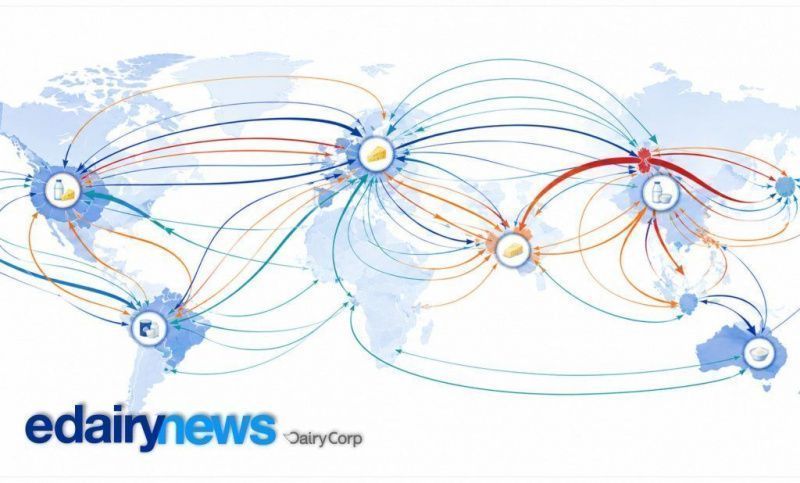
The global dairy trade is undergoing substantial changes, with the European Union (EU) maintaining its position as the largest exporter. In 2025, the EU exported 27.5 billion kilograms in liquid milk equivalent (LME), holding a 27% share of global exports. However, its dominance is slowly waning. Concurrently, the United States increased its share of global exports from 11.3% to 13.5% between 2017 and 2025. Argentina and Uruguay also saw an increase in their combined market share, from 3.0% to 4.3% during the same period.
On the import side, China continues to be the largest global importer, with imports totaling 11.7 billion kilograms LME across China, Hong Kong, and Macau. Despite this, since the peak in 2021, China's imports have decreased, particularly in categories like fluid milk, cream, and milk powder, which have halved over four years.
As exporters seek new markets, regions such as Saudi Arabia, the United Arab Emirates, and Oman are increasing their imports, especially of cheese, milk powder, and evaporated milk. Southeast Asian countries like Malaysia and Thailand are showing consistent growth in imports, while Vietnam and Indonesia exhibit moderate increases. Brazil's imports rose from 1.3 billion to 2.3 billion kilograms LME between 2022 and 2025, largely driven by demand for cheese and milk powder.
Cheese has seen the most significant changes in global dairy trade. Since 2017, international cheese trade grew by 40%, reaching 8.96 billion kilograms in 2025. The annual growth rate averaged 3.3%, accelerating between 2024 and 2025 due to increased milk availability from major exporters and stronger international demand. The U.S. and Argentina doubled their cheese exports since 2017, with the U.S. becoming the second-largest exporter after the EU and UK.
In contrast, the market for skimmed milk powder showed modest growth, with a 0.5% increase in 2025. U.S. exports in this category are declining by about 6% annually. Full cream milk powder sees New Zealand maintaining a dominant position, accounting for 53% of global exports in 2025, while the EU reduced its exports in this category.
The butter trade expanded by 9% in 2025, reaching 2.23 million tonnes, with significant contributions from the U.S., which tripled its exports within a year. This increase outpaced those of New Zealand and Argentina.
Whey remains a stable product in terms of volume, with trade close to 3.5 million tonnes annually. However, its value is rising due to the growing importance of whey proteins in sports nutrition and protein-rich diets. The U.S. expanded its cheese processing capacity by 6% in 2025, highlighting the strategic importance of whey as a byproduct.
The Rabobank assessment suggests that the future of global dairy trade will rely on the ability of regions to increase milk production rather than solely on demand. The EU faces regulatory challenges and an aging producer base, while the U.S. and Argentina are seen as capable of expanding supply. Argentina's production shifted from an 8% decline between 2022 and 2024 to a 10% increase in 2025, with continued growth in early 2026.