Kazakhstan Seeks Alternatives to Rising Brazilian Coffee Prices

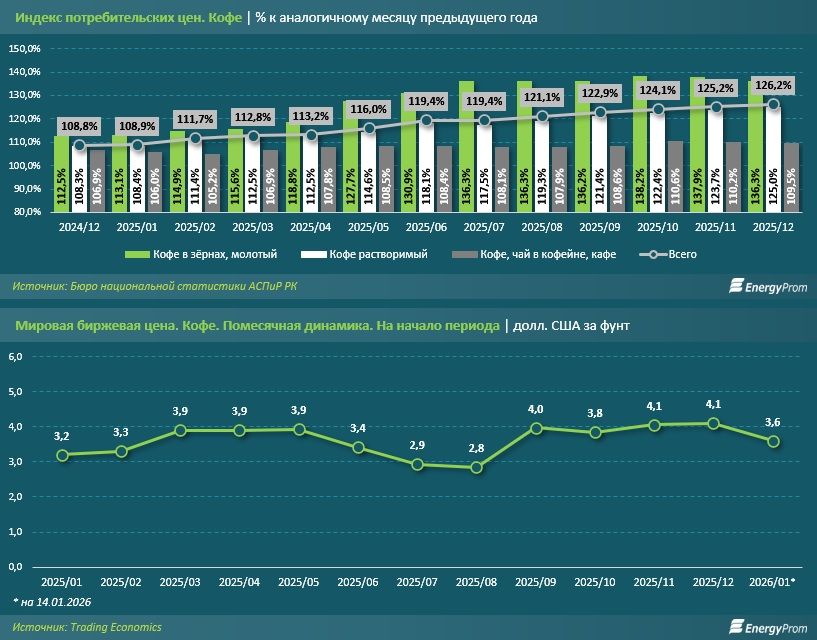
The main factor is the rising cost of coffee beans. By the end of the year, coffee beans became 36.3% more expensive, which automatically increased the prices of instant coffee and ready-to-drink coffee beverages.
The reasons for the increase are predominantly external. Coffee prices are rising worldwide: according to Trading Economics, in December 2025, a pound of coffee was valued at $4.1 on the exchange, 28.1% higher than in January of the same year.
Analysts identify climate disturbances in exporting countries as a key driver:
-
In Brazil, the largest supplier of Arabica, the past season was accompanied by drought;
-
In Vietnam, the leading producer of Robusta, the summer heat of 2025 led to a reduced harvest.
How Much Does a Cappuccino Cost in Kazakhstan and Neighboring Countries?
Despite the increase, Kazakhstan remains a relatively "cheap" market for a cup of coffee. According to Numbeo, in January 2026, Kazakhstan ranked 77th out of 103 countries in terms of cappuccino prices. The average cost is about $2.2 (≈1,100 tenge), which is several times lower than European levels (e.g., Denmark - $6.6, Switzerland - $6.2).
Among the countries in the region:
-
Russia - $2.6 per cup,
-
Belarus - $2.0,
-
Uzbekistan - $1.9.
Imports Are Growing: Brazil Leads, Asia Gains Share
Coffee remains a fully imported product for Kazakhstan: supplies come from 47 countries, but Brazil remains the key source.
According to BNS customs statistics, from January to October 2025:
-
Brazil's share in coffee imports was 39.9%,
-
The supply volume reached about 1,500 tons, 1.5 times more than the previous year.
Russia is in second place with 937.7 tons (+17.9%). However, the market assumes that a significant portion might account for re-exports.
An additional signal is the growth of imports from Asia. A comparison of supplier structures over 10 months in 2024 and 2025 shows that Kazakhstan sharply increased purchases:
-
From Vietnam - 3.4 times,
-
From China - 43.9 times.
This trend can be interpreted as an attempt to diversify supply channels and reduce dependence on the "Brazilian scenario" amid unstable harvests and high global prices.
Kazakhstanis Aren't Cutting Back on Coffee - On the Contrary, Consumption Is Growing
Despite rising prices and the global trend of seeking alternative beverages, there is no sign of reduced consumption in Kazakhstan yet. According to BNS sample surveys, Kazakhstani people have been increasing their consumption of instant coffee over the past three years.
In the third quarter of 2025, the average consumption was 77 grams per person, which is 4.1% higher than the same period in 2024.
Monetary Imports Grow Faster Than Volumes
From January to October 2025, Kazakhstan imported 3,700 tons of coffee, 26.9% more than the previous year, marking the highest volume in several years. In monetary terms, imports increased by 60.4% to $36.9 million, reflecting the overall rise in global market prices.