Industrial Cheese Cutting Determines Factory Profit
The global cheese market is projected to increase from $111.2 billion in 2026 to $188.1 billion in 2036, according to Future Market Insights, representing compound annual growth of 5.4%. Demand in Europe and North America, together with wider use of cheese in products such as pizzas and hamburgers in emerging markets, is increasing requirements for grated cheese, cubes, strips and slices.
Processors must maintain consistent appearance, weight and melting performance while dealing with higher milk and energy costs, labour shortages and narrower margins. Poor cutting can reduce the amount of saleable cheese through uneven slices, broken pieces and excess product used to compensate for inconsistent weights. The effect applies both to high-value matured cheeses and to high-volume products such as mozzarella.
Ali Sedaghat Doost, a food research and development scientist at FAM STUMABO, said that weak cutting performance can disrupt an entire production line. Soft or sticky cheeses may build up on blades and grates, causing stoppages and more frequent cleaning. Hard or brittle cheeses can create powder and small fragments that are difficult to recover. Uneven pieces may melt at different rates, while smaller particles can burn before larger pieces have melted.
Cheese varieties require different operating conditions. High-moisture mozzarella can be soft, elastic and sticky, whereas matured cheddar with lower fat content is generally firmer and more brittle. Doost said a setting that works for one product may cause accumulation, fines or blockages in another. The relevant combination includes product temperature, feed rate and cutting geometry, rather than simply increasing speed or power.
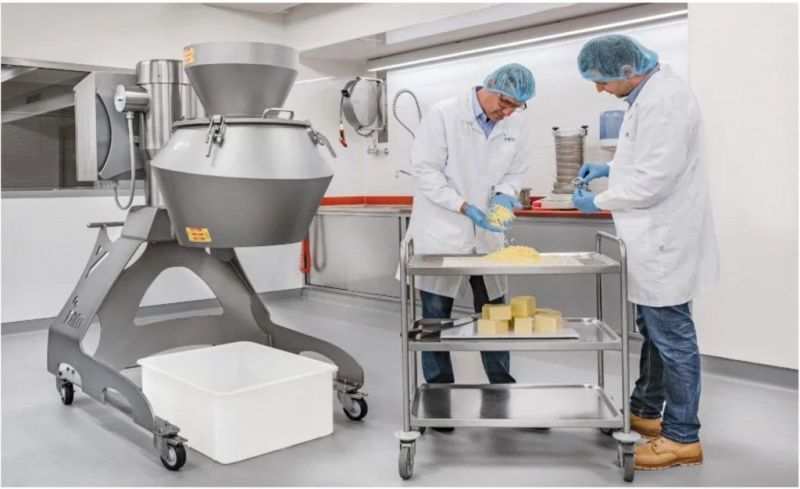
Changes in recipes add to the variability. Products with higher moisture, lower fat or higher protein, as well as dairy-plant hybrids and cheese analogues, can differ in firmness, elasticity and melting or grating behaviour. FAM STUMABO tests each customer’s actual product under representative production conditions, examining yield, fines, throughput, cut consistency, clogging and accumulation. The results are used to select the cutting head, tools, speed and feed rate. Storage conditions can also affect firmness and grating performance, including in plant-based mozzarella alternatives.
Market requirements differ by location. In Britain, plants may supply retail, pre-packed goods, prepared meals and food-service customers from the same facility while handling products ranging from Cheddar and Red Leicester to more delicate cheeses. In Mexico, formulations designed as alternatives to conventional dairy cheese have been sensitive to heat generated during cutting. Several independent processors reported substantial heat accumulation with earlier equipment, while FAM STUMABO said its Flexifam 55 produced clean, defined cubes without the same issue. The company’s commercial and food R&D teams are examining the formulations involved.
For high-moisture cheeses, hygienic equipment design and easy access for cleaning can reduce contamination risks, downtime and the use of water and chemicals. FAM STUMABO’s Doost said the company’s role was to combine food science with engineering: “The objective is not simply to show that a cheese can be cut, but to determine how it can be cut consistently, efficiently and within the required quality.” The company identifies automation, data integration, predictive maintenance, continued product differentiation and closer integration of production, cooling, cutting and packaging as developments shaping cheese processing in the next two or three years.