Global Dairy Market Faces Supply Challenges Amid Rising Costs
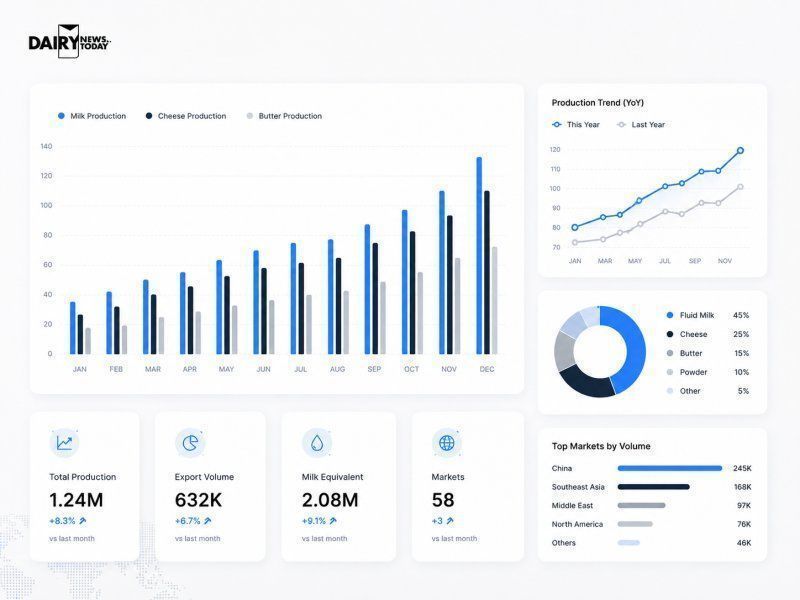
The global dairy market is encountering a pivotal moment as escalating input costs and geopolitical tensions begin to compress margins and decelerate production growth in major exporting regions. According to a RaboResearch report, milk supply growth, which peaked in late 2025, is anticipated to plateau in the third quarter of 2026 before experiencing a contraction by the year's end.
In 2025, worldwide milk production surged, achieving a year-on-year growth peak of 5.2% in the fourth quarter, marking one of the strongest increases on record. However, this expansion is now receding, with RaboResearch projecting only a 1.5% growth for the second quarter of 2026. A decline of 1.6% is expected in the fourth quarter, which would constitute the first quarterly decrease since mid-2024, indicating a rebalancing after a prolonged period of surplus supply.
Price fluctuations have been noted across the dairy spectrum. Skim milk powder has led the recent price recovery, while cheese and butter markets remain under pressure due to abundant supply. Regional variations are evident, with US nonfat dry milk prices hitting record highs, contrasting with significant declines in European milk prices, which have squeezed farm margins.
The primary constraint on dairy supply is not demand but rather the rising costs associated with production. The increase in energy, fertilizer, and financing expenses, partly driven by ongoing instability in the Middle East, is significantly impacting major dairy-producing regions. This situation is exacerbated by the unresolved disruption around the Strait of Hormuz, which is elevating uncertainty in global oil markets and, consequently, agricultural input costs.
While some areas, such as the US and New Zealand, enjoy relatively stable milk price forecasts, the general trend points towards margin compression. This trend is expected to limit future production growth. Demand for dairy continues to be bolstered by structural trends, including a sustained interest in protein-rich products. However, rising food price inflation and weakened consumer purchasing power are beginning to alter purchasing behaviors, creating a divide between higher- and lower-income consumers in both retail and foodservice sectors.
Global dairy trade faces increasing uncertainty due to disruptions in the Middle East and shifting consumer demand patterns, raising risks for the remainder of the year. RaboResearch anticipates a significant slowdown in global milk production growth in the coming months and into 2027, contingent on persistent input cost pressures and uncertain developments in energy markets and geopolitical conditions.
Weather risks, particularly with a strong El Niño event likely, could further disrupt supply, especially in the Southern Hemisphere. Changes in consumer demand driven by inflation and health trends will also play a crucial role in shaping future price movements.