HOMMAK’s New G Series: A Lower-RPM Approach to High-Pressure Homogenization
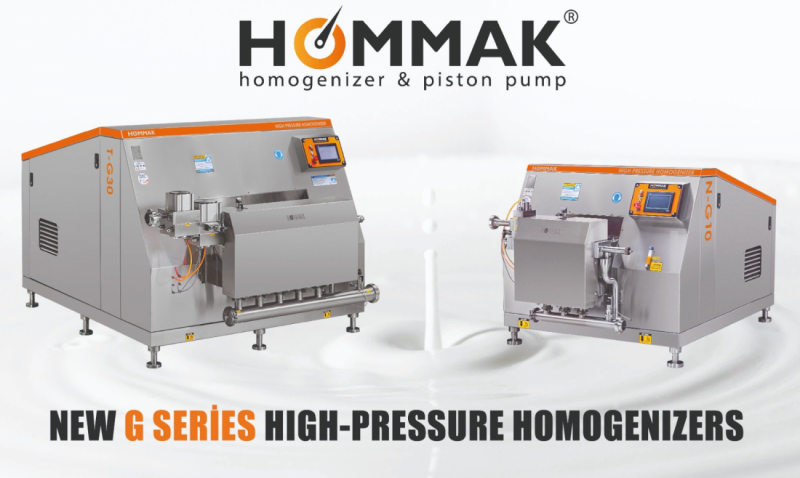
Every dairy or beverage processor knows the homogenizer is one of those machines nobody thinks about until it stops. When it runs, milk stays white and stable, yogurt holds its texture, and juice doesn’t separate on the shelf. When it doesn’t, the whole line waits. HOMMAK, the Turkish manufacturer with more than 3,000 high-pressure homogenizers operating in over 100 countries, has now started series production of a new patented generation: the G Series. The design brief was easy to state and hard to execute — run slower, last longer, homogenize better.
Why piston speed matters more than horsepower
A high-pressure homogenizer does its real work in microseconds. A positive-displacement piston pump raises the product to pressures typically between 200 and 1,500 bar, then forces it through a narrow valve gap where cavitation, impact, and shear break fat globules and suspended particles down below one micron. That part of the physics hasn’t changed in a century.
What separates machines is how they generate the pressure. Two homogenizers can deliver identical flow and pressure at very different piston speeds. A machine that reaches its rated capacity at high RPM makes many short, fast strokes per minute. One that reaches the same capacity at low RPM makes fewer, longer strokes. The second machine puts far less frictional load on every component in the drive train and the product path: pistons, seals, check valves, and crankshaft bearings all wear in proportion to how often they move.
HOMMAK built its engineering identity on this principle. Its homogenizers already operate at the lowest piston travel speed among comparable machines worldwide. The G Series takes the same logic further.
What the G Series changes
The G Series is a patented HOMMAK design, developed in-house at the company’s R&D center in İzmir. Compared with the previous generation, the new machines are built around four measurable outcomes:
- Lower operating RPM. Reduced piston speed means less friction and vibration, so seals, pistons, and check valves reach service intervals with less wear. In practice, that translates into longer trouble-free running time between interventions.
- Lower service costs. Fewer wear-part replacements per year, faster seal and check-valve changes, and a design that lets maintenance teams reach critical components without dismantling half the machine.
- More efficient homogenization. Optimized valve geometry and drive configuration deliver the target particle size distribution with lower energy consumption per liter processed.
- A 10-year MonoBlok warranty. HOMMAK warrants its forged stainless MonoBlok pump head against cracking for ten years — a component that, on many competing machines, is a known long-term failure point.
The machines carry CE marking and are engineered, manufactured, and tested under ISO 9001:2015. For processors supplying retail chains that audit equipment provenance, that documentation trail matters as much as the specification sheet.
High Pressure Homogenizers
Inside the machine
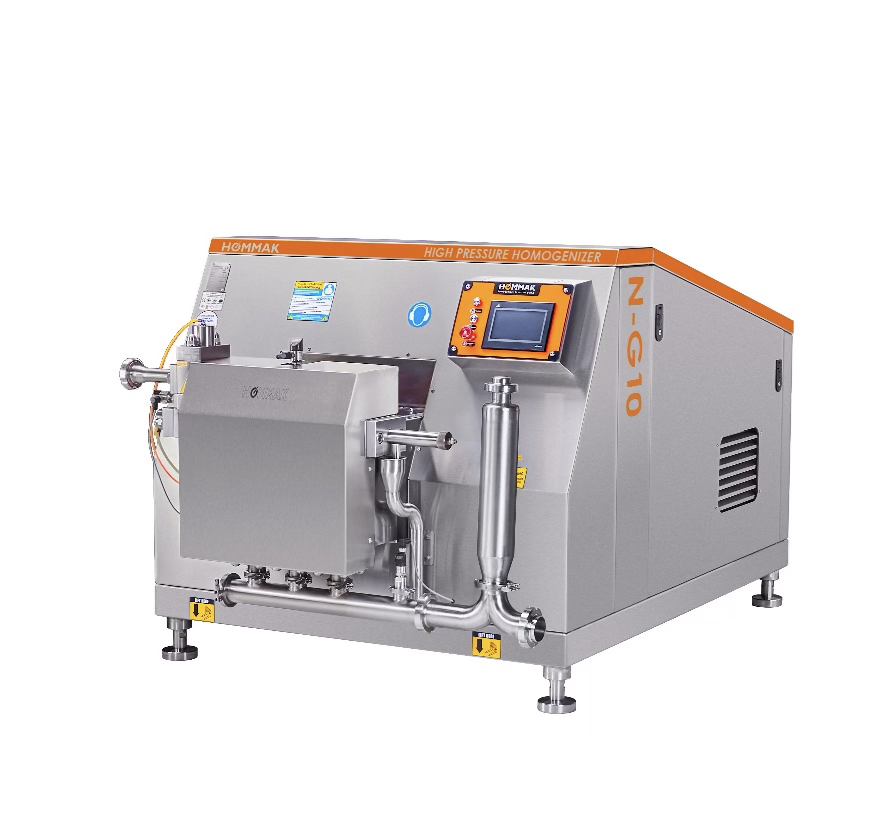
The specification details show where the service-life claims come from. The pump head uses HOMMAK’s MonoBlok and MultiBlok architecture with a dead-zone-free product path, which reduces the surface area where microorganisms can attach. Wetted surfaces are finished to Ra values below 1.6, 0.8, or 0.5 µm (electropolished), depending on the hygiene class the application requires, and the block design is verified with FEM stress analysis before production.
Material selection follows the product, not a universal template. Homogenization valves are available in zirconium ceramic, silicon nitride ceramic, tungsten carbide, and cobalt carbide. Piston shafts combine high-strength stainless steel with zirconium ceramic, with chrome, cobalt carbide, tungsten carbide, or ceramic coatings matched to the abrasiveness of the fluid. Sealing packages use food-grade hygienic materials — Kevlar, PEEK, PTFE, FKM, and engineered polymers — rated for the lower-RPM duty cycle. Suction and discharge check valves come in mushroom and ball configurations with double-sided seats, so a seat can be reversed instead of replaced at its first service.
For dairy and beverage plants, the hygienic details carry equal weight: the G Series is designed for CIP and SIP cleaning, with pneumatic automatic homogenization pressure control and optional PLC integration into existing line automation.
The G Series lineup
Five models cover the range from mid-size dairies to large continuous UHT and beverage lines:
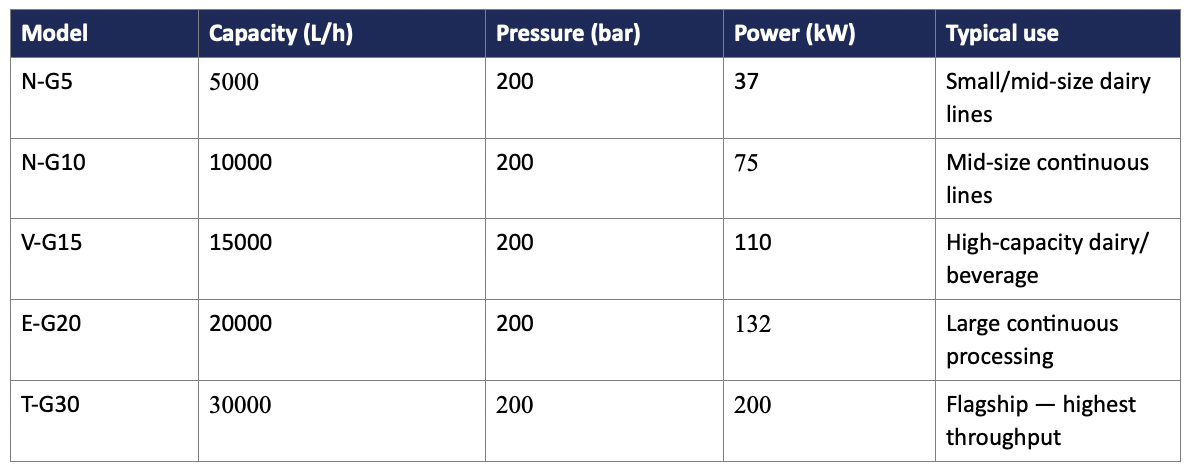
Standard pressures and capacities are shown; HOMMAK engineers custom pressure and capacity configurations on request.
As with the previous generation, each machine is configured for its sector: valve design, wetted materials, and pressure stage are selected against the actual product — whole milk behaves differently from fruit concentrate, and both differ from plant-based drinks.
What lower service cost looks like in practice
Total cost of ownership on a homogenizer is dominated by two lines: energy and maintenance. The G Series addresses both. Lower RPM cuts the frictional losses that show up on the electricity bill, and the reduced wear rate stretches the interval between seal and valve replacements. HOMMAK backs this with stocked spare parts and series production at its plant — the company builds up to 250 homogenizers a year, which keeps delivery times short for both machines and components. For a plant manager, the relevant number isn’t the purchase price. It’s cost per thousand liters homogenized over ten years, and that is the number the G Series was designed around.
The company behind it
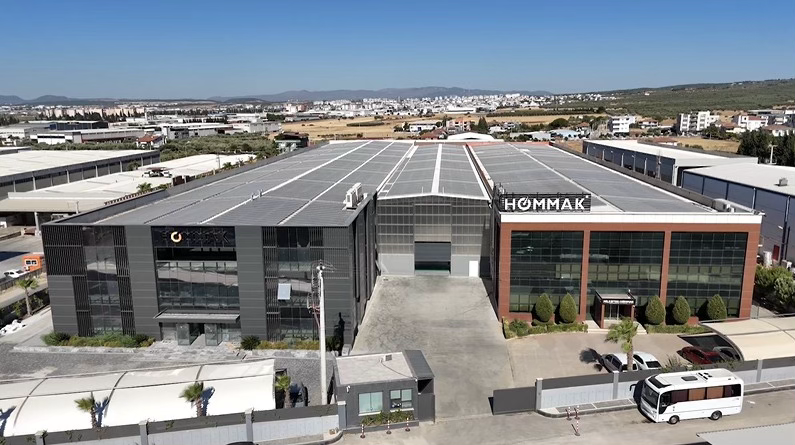
HOMMAK is Turkey’s first domestic manufacturer of high-pressure homogenizers and piston pumps, and it produces the broadest product range in this category under a single roof — from a 20 L/h laboratory unit to 30,000 L/h industrial machines. Production runs in a 20,000 m² indoor facility in Torbalı, İzmir, where R&D, machining, assembly, and testing sit on one site. The management system covers ISO 9001:2015 (quality), ISO 14001:2015 (environment), and ISO 45001:2018 (occupational health and safety), alongside CE conformity.
The customer base reflects the machine’s range of duty: dairies, juice and beverage producers, and food processors make up the core, with the same platforms serving cosmetics, pharmaceutical, chemical, and biotechnology plants. More than 3,000 partners in over 100 countries run HOMMAK equipment today.
Frequently asked questions
What makes the G Series different from earlier HOMMAK homogenizers?
The G Series is a patented new platform that runs at an even lower piston RPM than HOMMAK’s previous machines. The result is less wear on pistons, seals, and valves, lower service costs, reduced energy consumption, and more efficient homogenization, all covered by a 10-year MonoBlok warranty.
Which applications is the G Series designed for?
The primary applications are dairy, food, and beverage processing: milk, yogurt, cream, ice cream mix, juices, sauces, and plant-based drinks. The same platform is configured for cosmetics, pharmaceutical, chemical, and biotechnology products through application-specific valve and material selection.
What does the 10-year MonoBlok warranty cover?
HOMMAK warrants the forged stainless steel MonoBlok pump head against cracking for ten years. The pump head is the highest-stressed component in a high-pressure homogenizer, so the warranty reflects the FEM-verified block design and the reduced fatigue load of low-RPM operation.
Detailed specifications and application references for the G Series are available at hommak.com, where processors can also request a product trial or a configuration study for an existing line.
Sponsored Content