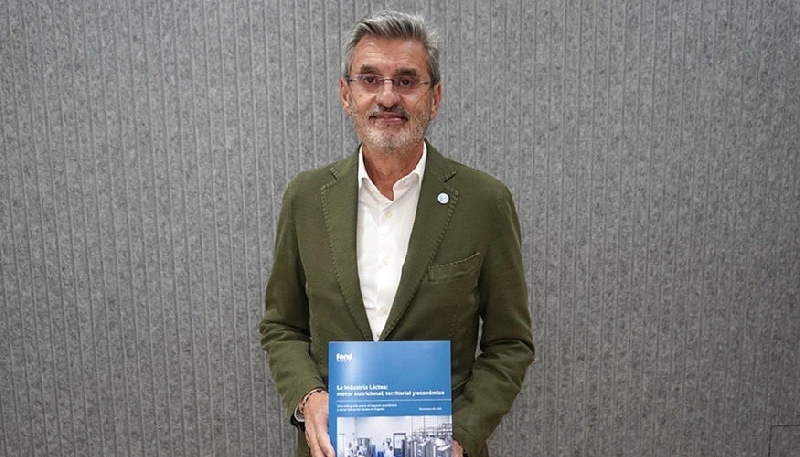
From the Boardroom to the Milking Parlour: Women in Dairy in IDF Figures and Case Studies
Dairy Company Leadership: Four Central European Countries
Researchers Maha Al-Dalahmeh and Adrian Csordas analysed ORBIS data on more than 500 dairy companies in the Czech Republic, Hungary, Poland and Slovakia. They examined the composition of governing bodies, company size and age, employee numbers, the number of subsidiaries and shareholders, and financial indicators. The research began in 2024; the results were published in 2025.
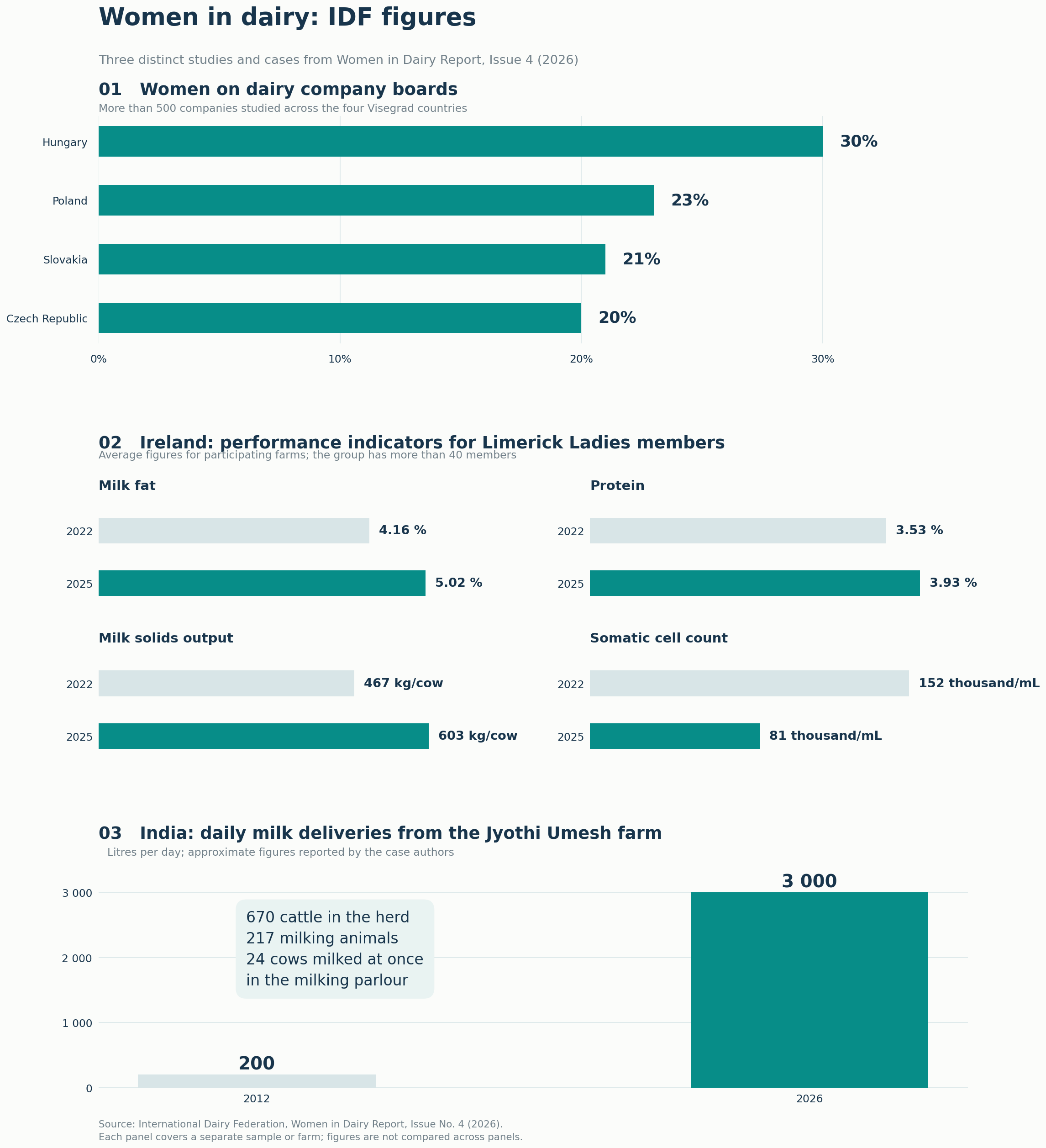
Women accounted for 30% of board members in Hungary, 23% in Poland, 21% in Slovakia and 20% in the Czech Republic. According to the analysis, women were more frequently represented on the boards of medium-sized companies with a larger number of shareholders. Older and larger companies with more employees and subsidiaries were more often associated with predominantly male leadership. The authors found no statistical correlation between company profitability and the gender composition of leadership. The researchers propose continuing to track the data over time and interviewing women who lead dairy companies.
Eastern Africa: Participation in Dairy Trade
A separate FAO study presented in the report covers Ethiopia, Kenya and Rwanda. It examines women’s participation in dairy value chains and regional trade. According to the authors’ account, women work on farms, process milk and sell dairy products, but are more often involved in lower-value segments and informal trade in local markets. Their access to formal sales channels and cross-border transactions remains limited.
Published in 2024, the study compares the structure of dairy businesses and national policies in the three countries. Gender issues receive more attention in agricultural and livestock policy documents but, as author Evelyne van Heck notes, are not always incorporated into trade policy and its implementation plans. The conditions considered for expanding women’s participation include access to finance, technology, market information, business services and trade infrastructure. The report does not provide a quantitative estimate of women’s share of regional dairy exports.
Argentina: 19 Women from the Dairy Sector in Córdoba’s Programme
Córdoba province’s Good Agricultural Practices Programme reaches an average of about 3,600 producers each year and has involved more than 25,000 people over ten years. Women who own farms account for approximately 10% of participants. In 2025, only 19 women dairy farmers were enrolled.
One example in the report is Luisina Bruneto, a veterinarian and fourth-generation dairy farmer. Her family business has produced milk and artisanal Escalugiu cheeses since 1927. Bruneto participates in overall production management and leads communications and marketing. The farm uses whey left over from cheesemaking as animal feed.
Ireland: Indicators from the Limerick Ladies Group
In 2021, the Irish advisory organisation Teagasc and Kerry, now Kinisla, established a discussion group for women dairy farmers. It now has more than 40 members. They meet monthly on one another’s farms, hold practical sessions and study trips, and discuss topics chosen by the members. A WhatsApp group and a buddy system maintain contact between meetings.
According to the case-study authors, average milk solids output on participating farms rose from 467 to 603 kg per cow between 2022 and 2025. Milk fat increased from 4.16% to 5.02%, and protein from 3.53% to 3.93%. The average somatic cell count fell from 152,000 to 81,000 cells per millilitre.
The report also states that all members now carry out an annual financial analysis of their farms and prepare a spring breeding plan. Similar groups operate in other parts of Ireland.
Kenya: Ten Women’s Collectives in the Dairy Region of Bomet
Since 2023, the International Livestock Research Institute (ILRI) and GROOTS Kenya have supported ten women’s collectives in Bomet County. Their work includes practical training on farms, peer learning, and financial and leadership skills. About 350 men took part in a forum addressing restrictions on women’s participation in decision-making.
At a 2025 workshop to assess priorities, 20 members representing all ten collectives discussed the results of their work. Women reported higher earnings and investment in dairy farming, poultry and kitchen gardens. Group savings and loans are used, among other things, to pay school fees, meet medical expenses and develop small businesses. The report does not quantify earnings or their increase.
India: Biogas and a Manure Processing Cooperative
In the Indian village of Zakariyapura, the National Dairy Development Board (NDDB) helped introduce household biogas systems in all 368 households that own animals. To make use of the surplus slurry produced after biogas generation, an entirely women-governed cooperative, the Zakariyapura Women Manure Cooperative Society, was established.
Members collect the slurry, test its quality, aggregate batches and sell the material for organic fertiliser production. A centralised processing facility was built in Vasna. The household units provide gas for cooking, while sales of the material create an additional source of income alongside milk sales. In 2025, the project received an Indian Biofuels360 award for village-level biogas adoption. The publication gives no annual fertiliser output or cooperative revenue figures.
India: Doctor Jyothi Umesh’s Farm Increased Milk Deliveries Fifteenfold
In the Mysuru district of Karnataka, practising gynaecologist Jyothi Umesh runs a dairy farm and supplies milk to the Pura Village Milk Producers’ Cooperative Society, part of the MYMUL system. Deliveries stood at 200 litres per day in 2012 and approximately 3,000 litres per day in 2026.
The farm has 670 cattle, including 217 milking animals. Its automated parlour can milk 24 cows simultaneously. The farm uses a total mixed ration, makes silage, and uses sexed semen and embryo transfer. About 100 acres, or roughly 40 hectares, are used to grow fodder under contract; the farm also harvests rainwater. The report gives milk fat content of 4.1% and solids-not-fat (SNF) content of 8.5%.
In 2025, the business supplied 873,000 litres of milk to MYMUL and received INR 2.99 crore from milk sales. A state incentive amounted to INR 48.32 lakh, while manure sales brought in another approximately INR 50 lakh. The authors put total receipts from these three sources at about INR 3.97 crore. These are revenue figures, not the farm’s profit. Umesh plans to expand the herd to 1,000 animals and is considering the production of ghee and paneer.
Spain: Women Led More Than 63% of ESNEKI Dairy Centre Projects
Spain’s ESNEKI Dairy Centre, established by Malen Sarasua to support artisanal dairy producers, now employs nine professionals, six of whom are women. Women have led more than 63% of the 114 research and innovation projects promoted by the centre over the past ten years.
According to the authors, between 2011 and 2026 ESNEKI launched more than 100 technology development and transfer projects and helped develop more than 70 dairy products. Since 2020, more than 590 professionals and students have received training at the centre. Its work includes technical support for cheesemakers, research, education and cooperation among European and Latin American producers.
The United States, Australia and Switzerland: Industry Networks and Education
In the United States, the International Dairy Foods Association has held its Women’s Summit since 2024. By the time the report was prepared, about 200 women from different parts of the dairy sector had participated in summit programmes. The 2026 event had a waiting list after the available places had filled.
The U.S. Dairy Export Council established a task force for the International Year of the Woman Farmer in 2025. The ACE Summit, connected with its work, attracted approximately 500 participants, while its Women in Dairy: Voices from the Barn podcast series recorded more than 19,000 impressions. These audience figures refer to different event formats.
In South Australia, dairy farmer and former teacher Narelle Zanker launched the Dairy Adventures farm-visit project in 2024. Since then, more than 2,000 people, including schoolchildren, families and industry groups, have visited the farm. The programme introduces visitors to milking, calf feeding and animal care; remote educational materials have also been prepared for schools.
Switzerland’s School Milk Day has been held since 2001. In 2025, the programme reached about 245,000 children at 2,131 venues. According to Swissmilk, members of the Swiss Women Farmers’ and Rural Women’s Association (SBLV) organised 70% of the venues. They coordinate work with schools and volunteers and explain milk production to children.
A separate historical contribution to the report concerns Lettie Ann Smith: on 23 August 1853, she received U.S. Patent No. 9,959 for a butter-working device that reduced manual labour in its production.
The International Year of the Woman Farmer was proclaimed by the UN General Assembly in May 2024 and formally launched in December 2025. According to the FAO contributor to the IDF report, more than 230 related events and initiatives had taken place in 56 countries by the time it was prepared. FAO has also opened a FAOSTAT section containing sex-disaggregated data on agrifood systems. These figures relate to agriculture as a whole, not only to the dairy sector.