Climate Change Drives Dairy Farming Adaptations in Goiás, Brazil
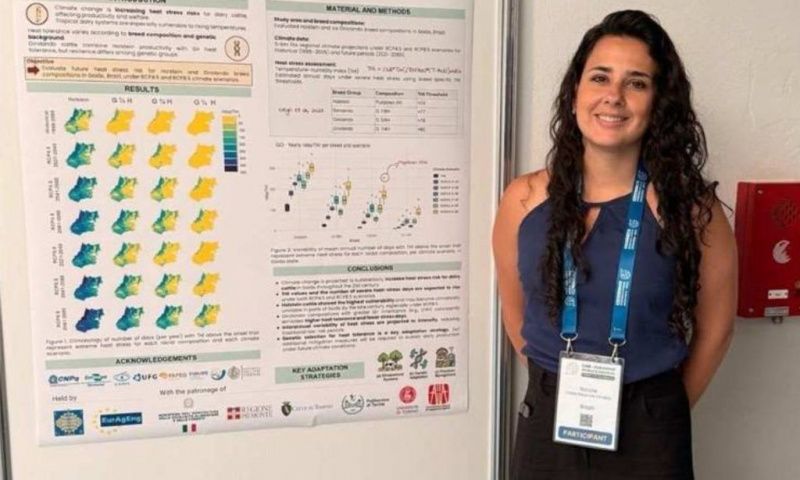
Research conducted in Goiás, Brazil, underscores the increasing influence of climate change on dairy farming, focusing on genetic, infrastructural, and sustainability adaptations. The study, presented at the Euragen World Congress in Torino, Italy, evaluates the potential stress levels that climate change may impose on dairy cattle in the region.
The investigation reveals that, starting in 2061, the number of days per year with climate-induced stress levels exceeding tolerable limits could impair the performance of Holstein cows in Goiás, even with reduced global greenhouse gas emissions. The study compares various cattle breeds, noting that Girolando cattle, a crossbreed of Holstein and Gir, exhibit better adaptability to projected climate conditions.
Despite their resilience, Girolando cattle may still face challenges in the most severe climate scenarios, particularly in Northwestern Goiás. According to researcher Nicole Costa Resende Ferreira from Embrapa Territorial, strategies such as replacing Holstein cattle with Girolando, or breeds with a higher Gir composition, could enhance productivity in some areas. However, in other locations, additional investments in infrastructure and genetic improvements are necessary to boost animal resilience.
The research assesses pure Holstein cows and Girolando cattle with genetic compositions of ⅛, ¼, and ¾, considering two levels of climate change severity across four periods: 1986-2005, 2021-2040, 2041-2060, and 2061-2080. The project, initiated in 2025 and expected to last four years, aims to expand the understanding of climate change impacts on dairy farming and support production planning under various projected scenarios.
Data from the Girolando Association's decade-long database on thermal stress limits, using the Temperature and Humidity Index, were utilized in the study. Concurrently, experiments are being conducted on a dairy farm in Goiás, employing both pasture and confinement systems. The collected data will aid in developing a more comprehensive index that considers additional factors related to animal well-being beyond temperature and humidity conditions.