Chinese quotas and shrinking cattle herds reshape the balance of the global beef market
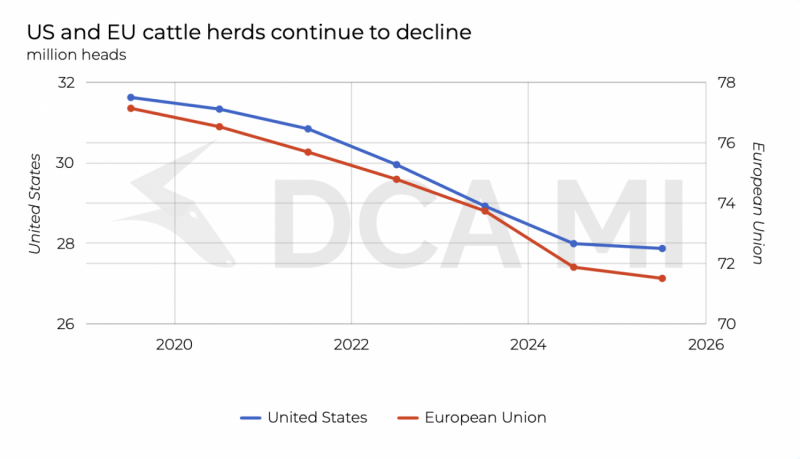
According to DCA, the shortage of cattle supply in the European Union and the United States is supporting demand for imported beef. Meanwhile, Brazil and Australia are increasing the volumes available for export. Chinese import quotas are becoming a key factor of uncertainty, as they may redistribute trade flows and alter the balance of the global market.
According to data cited by Agriland with reference to DCA Market Intelligence, the US cattle herd has declined by 9.6% over the past five years, while Europe’s herd has fallen by 5.5%. This is raising concerns about the long-term availability of beef in major consumer markets and supporting import demand.
The price situation on the international market remains uneven. According to DCA, North American prices remain significantly higher, particularly in the US and Canada, while South American beef remains more competitive. At the same time, Europe is seeing a price correction amid weaker consumer demand, especially in the northern part of the region.
China’s policy is having a significant impact on the market. From 2026, China introduced an additional 55% tariff on beef shipments exceeding annual quotas. The measure applies to key suppliers, including Brazil, Australia and the United States, and is aimed at protecting China’s domestic livestock sector.
According to S&P Global Commodity Insights, China set its 2026 quota for Brazil at 1.1 million tonnes, for Australia at 205,000 tonnes, and for the United States at 164,000 tonnes. By the end of April, Brazil had already used 55.4% of its quota, while Australia, according to China’s Ministry of Commerce, had reached 80% of its limit by mid-May.
Against the backdrop of the new restrictions, Brazilian and Australian suppliers may step up efforts to find alternative markets. According to S&P Global, Brazilian exporters are considering increasing sales to the United States, Chile and Southeast Asian countries as a way to offset a possible decline in shipments to China. US exporters, meanwhile, expect to increase supplies to China if Brazil and Australia exhaust their quotas quickly.
Another factor for Brazil was China’s decision to recognize the entire country as free from foot-and-mouth disease and lift related import restrictions. Reuters noted that this opens additional opportunities for Brazilian shipments, including beef, pork, offal and bone-in meat.
For the global livestock sector, the ongoing changes mean growing dependence on China’s trade policy and stronger competition among major exporters. The redistribution of beef flows may affect not only the meat market, but also the cattle economy as a whole, including investment in herds, processing, the feed base and the export strategies of supplier countries.