Brazil's Robotic Milking Systems Remain 93.6% Concentrated in the South
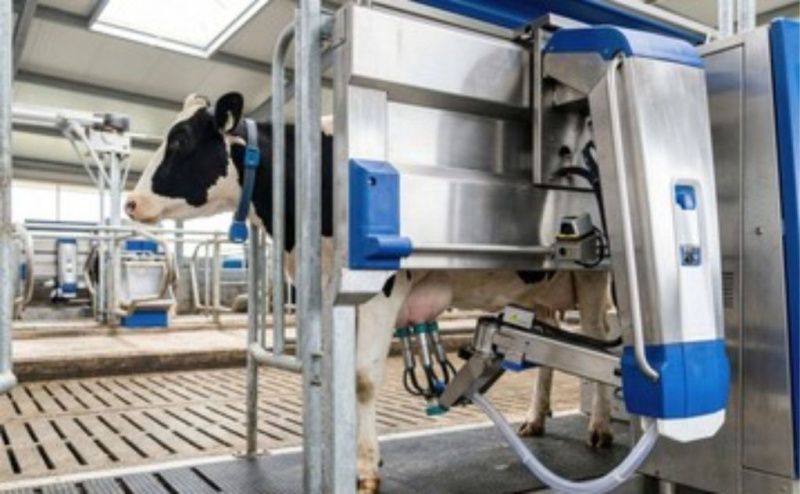
Data compiled in August 2026 by researchers at the Pontifical Catholic University of Paraná and the Federal University of Paraná covered 487 dairy units. DeLaval and Lely, which supplied the data used in the survey, account for 90% of the equipment estimated to be operating in Brazil.
The regional distribution was uneven. Rio Grande do Sul accounted for 43.9% of the units in the sample, Santa Catarina for 29.0% and Paraná for 20.7%. The remaining states represented 6.4%: Minas Gerais had 3.1%, Goiás 1.4%, São Paulo 1.0%, Bahia 0.6% and Mato Grosso do Sul 0.2%.
The typical farm in the sample was a medium-sized family operation with high output per cow. The survey also identified difficulties in hiring milkers and issues related to the succession of rural businesses among the characteristics of farms using the technology.
The median operation had two robots and 55.5 lactating cows per machine. Median output was 1,977.7 litres per robot per day, or 2,691.9 litres for the complete system. Cows produced as much as 36 litres a day, with an average of 12.9 litres per milking and 2.8 milkings daily. Paraná recorded the highest individual output, at 37 litres per cow per day, followed by Rio Grande do Sul at 36.8 litres and Santa Catarina at 34.3 litres.
Comparisons between operating profiles showed that equipment use depended on more than milking frequency. In one profile, each robot served 61 lactating cows and produced 2,200 litres a day. In another, cows were milked 3.1 times a day, but each machine served 47.3 cows and produced 1,700 litres. The systems record operating and herd indicators continuously, allowing farmers to assess changes such as adding cows or installing further robots.
A financial simulation presented by Scot Consultoria used a theoretical investment of 3 million reais for two machines. The reference price was about 1.5 million reais per robot, excluding construction work and installation. With two robots producing 2,691.9 litres a day, annual output would reach 985,500 litres. Using an average milk price of 2.83 reais per litre and a 10% margin on revenue, the simplified payback period was 10.7 years.
The calculation changed when machine utilisation increased. Two robots producing the median figure of about 2,000 litres each per day would generate approximately 1.4m litres a year, reducing the estimated payback period to about 7.3 years. By state, the estimate was 10.7 years in Minas Gerais, 10.2 years in Rio Grande do Sul and 11.3 years in Paraná, based on average milk prices collected during the 2026 Ordenha Brasil expedition. The study stated that automatic milking alone does not raise farm productivity; nutrition, animal welfare, genetics and management also remain part of the production system.