Camel Milk: Niche Exotic or the Next Growth Segment of the Global Dairy Market?
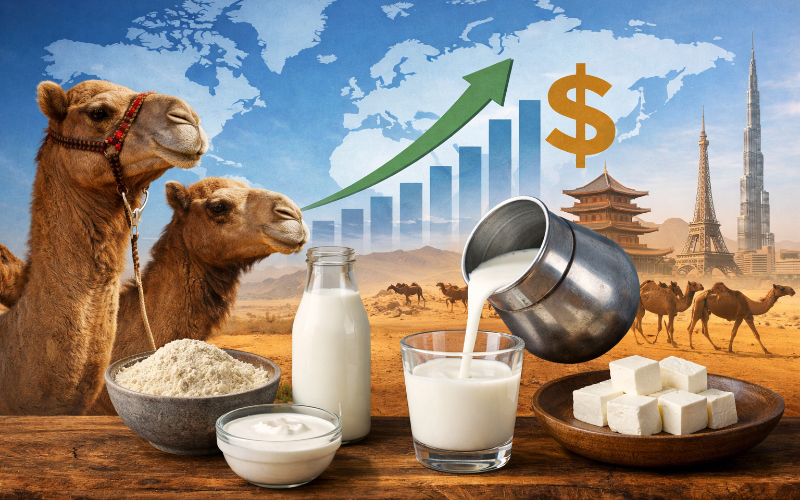
Why Interest in Camel Milk Is Growing Now
The rising global interest in camel milk is not accidental. It is driven by a convergence of nutritional, demographic, and consumer behavior trends.
Nutritional profile and functional positioning
Camel milk contains higher levels of vitamin C, iron, potassium, and calcium compared to cow’s milk, while typically having lower saturated fat content. These characteristics position it well within the functional nutrition segment, particularly among consumers focused on immune support, metabolic health, and nutrient density. Multiple market analyses note that vitamin C levels in camel milk can be several times higher than in cow’s milk, which is particularly relevant in regions with growing demand for immunity-oriented products.
Lower lactose content
Camel milk naturally contains less lactose than cow’s milk, increasing its appeal to lactose-sensitive consumers. Globally, lactose intolerance affects up to 65% of the adult population, especially in Asia, Africa, and parts of Latin America. While camel milk is not lactose-free, its reduced lactose levels and different protein structure make it more tolerable for many consumers, expanding its addressable market beyond traditional dairy users.
Alignment with functional food trends
Global dairy demand is increasingly shaped by function rather than volume. Consumers are seeking products that deliver specific health benefits, and camel milk producers are responding with diversified formats: powdered camel milk, fermented products, yogurts, nutritional drinks, infant nutrition formulations, and sports-oriented beverages. This diversification signals a shift fr om raw milk consumption toward higher-margin, value-added categories.
Market Comparison: Camel Milk vs. Cow’s Milk
Camel milk is not competing with cow’s milk as a mass-market staple. Its role is structurally different.
Production constraints
Camels produce significantly less milk—approximately 5–7 liters per day—compared to 25–30 liters for high-yield dairy cows. This limits scalability and keeps production costs high. As a result, camel milk cannot easily enter price-driven commodity markets.
Premium segmentation
Because of limited supply, higher production costs, and complex logistics, camel milk is priced well above cow’s milk in most markets. Reports consistently classify it as a premium or specialty dairy product rather than a mainstream substitute.
Consumer perception
In traditional markets, camel milk is culturally normalized. In non-traditional regions such as Europe, North America, and parts of Asia-Pacific, it is perceived as a functional or exotic alternative—often purchased for health reasons rather than everyday consumption. This perception shapes both marketing strategies and consumption frequency.
Structural Barriers to Scaling
Despite strong demand signals, the camel milk industry faces tangible constraints.
High production costs and infrastructure gaps
Camel dairying requires specialized husbandry, veterinary care, and cold-chain logistics. Many producers operate at small or medium scale and lack access to advanced processing facilities. Maintaining consistent quality, food safety standards, and shelf life remains a challenge, particularly for export markets.
Limited retail penetration
Outside the Middle East and parts of Africa, camel milk has limited shelf presence in mainstream retail. While e-commerce has improved accessibility, physical distribution remains narrow, constraining impulse purchases and trial among new consumers.
Low consumer awareness
In many markets, knowledge about camel milk’s nutritional properties remains limited. The absence of large-scale educational and evidence-based marketing campaigns slows adoption and reinforces the perception of camel milk as a niche or novelty product.
Market Size and Growth Outlook
Despite these constraints, growth projections remain strong.
Market estimates suggest the global camel milk market could reach approximately USD 15.5 billion by 2025, with longer-term projections ranging between USD 24 and 34 billion by 2030–2034, depending on methodology. Reported compound annual growth rates (CAGR) vary between 6.6% and 9.4%, signaling steady expansion rather than speculative hype.
Regionally, the Middle East and Africa continue to dominate production and consumption, but growth momentum is increasingly visible in Asia-Pacific, Europe, and North America—regions wh ere functional dairy and alternative nutrition products are expanding fastest.
Why Consumer Perception Matters
For camel milk to transition from a premium niche into a scalable growth segment, understanding consumer behavior is critical.
-
Product development: Insights into consumer priorities—digestibility, immune support, clean-label claims—enable producers to tailor formats and formulations.
-
Market positioning: Camel milk competes not with conventional milk, but with functional beverages, supplements, and specialty dairy. Clear value propositions are essential.
-
Pricing strategy: Understanding willingness to pay determines whether the category remains premium-only or gradually expands into broader segments.
-
Adoption barriers: Identifying skepticism, misinformation, or cultural resistance helps shape education-driven marketing strategies.
Camel milk is no longer merely a regional or cultural product. It is emerging as a high-value, functionally positioned dairy category with measurable global growth potential. Its expansion is driven by health-focused consumption trends, product innovation, and rising demand for differentiated nutrition. However, long-term scalability will depend on infrastructure development, logistics optimization, and consumer education. For the dairy industry, camel milk represents not a replacement for traditional milk, but a strategically important growth segment at the intersection of health, premiumization, and functional food markets.