Brazilian Rules Define “Zero Lactose” Without Absolute Absence
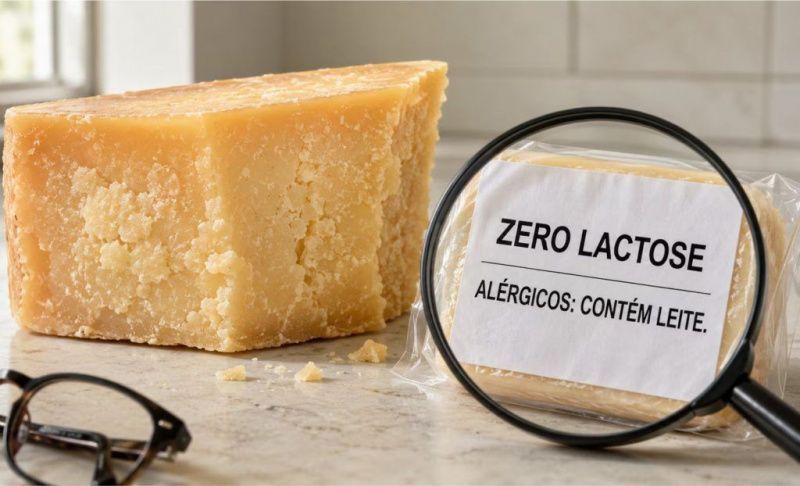
Brazil’s regulatory wording treats “zero lactose”, “lactose-free” and similar claims as a category with a defined limit. Two products can therefore carry the same claim while containing markedly different residual quantities: one may approach 100 milligrams per 100 grams, while another may contain less than 0.05 milligram. The front of the package does not by itself show where within that range a product falls.
Cheese-making removes much of the milk’s lactose with the whey. Lactose is water-soluble, so it tends to remain in the liquid fraction when the milk coagulates and the curd separates. A scientific review cited by the source estimates that about 98% of the original milk sugar is removed with the whey or converted into lactic acid. Bacteria used in production can consume part of what remains in the curd.
RAR Gastronomia’s Gran Formaggio RAR is cited as an example. The grana-style cheese is sold after 12 or 18 months of maturation, and the producer describes it as naturally lactose-free without adding the enzyme lactase. Jiovani Foiatto, the company’s director, said that selected bacterial cultures ferment lactose and produce lactic acid. The company uses semi-skimmed raw milk and cultures selected by RAR.
The residual amount depends on more than the time shown on the package. Whey removal, bacterial cultures, acidity, temperature, moisture, curd composition and batch controls can all affect the result. Maturation also changes water content, the concentration of fat and solids, flavour and aroma, and the structure of proteins through proteolysis. It does not establish that an 18-month cheese contains less lactose than a 12-month cheese, since both may have reached very low levels earlier.
A Brazilian study cited in the source found less than 0.005 gram of lactose per 100 grams in a washed-curd cheese immediately after production. Whey drainage, washing the curd and bacterial activity were central to that result. Other research found less than 0.54 milligram per kilogram in every sample of pecorino romano, and less than 0.05 milligram per 100 grams in all tested comté samples, the detection limit used by the researchers. Gruyère, emmental, jarlsberg, parmigiano reggiano, grana padano and some matured cheddars have also produced non-detectable results in studies.
These findings do not make a cheese variety a universal guarantee. Some cheddars, goudas and edams have contained lactose, with results varying by producer, batch, format, manufacturing method and analytical technique. Fresh and moist cheeses, including cream cheese, cottage cheese, ricotta, fresh mozzarella and processed cheese, tend to retain more whey and should not automatically be treated as lactose-free. Some are made with added lactase, but that property has to be confirmed for the particular product.
Lactose claims also address a different issue from milk-protein warnings. Casein follows the curd rather than the whey and remains in the cheese, even though maturation alters it through proteolysis. Lactose intolerance concerns difficulty digesting the milk sugar, while a milk allergy involves proteins such as caseins and whey proteins. Goat and sheep milk still contain lactose, and their proteins can cross-react with those in cow’s milk. Consumers therefore need to check the lactose declaration alongside allergen warnings, ingredients and, where available, the lactose level in milligrams per 100 grams, the test method and its quantification limit. “Not detected” means only that the amount was below the method’s measuring capacity; it does not prove chemical absence. Some grana-style cheeses may also use lysozyme derived from egg white, although the ingredient is not used in every cheese of that type.