The Term “Smooth” Is Reshaping Perceptions of Kefir
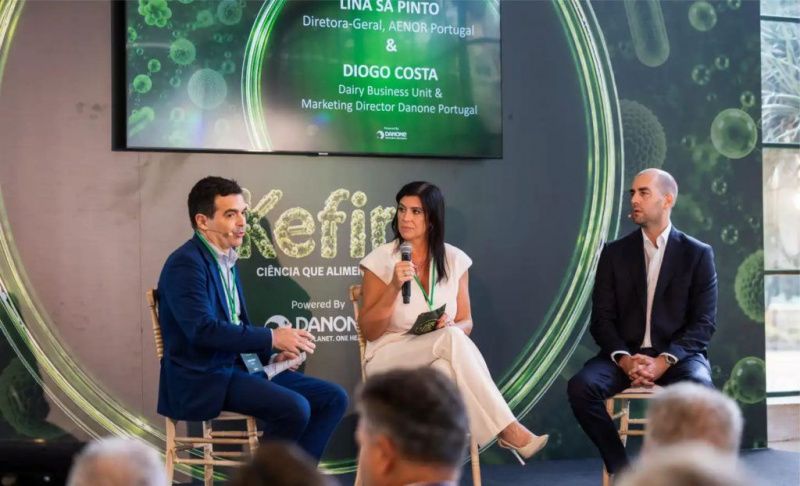
A survey presented at an industry event examined what consumers understand by the expression “smooth kefir”. Some 29.8% of respondents said it referred to kefir that was easier or more pleasant to consume. A further 28% associated the term with a softer or creamier texture, while 16% linked it to flavour. Only 18.7% interpreted the expression as describing a product whose composition differed from that of kefir. The first three interpretations together accounted for 73.8% of responses.
The discussion distinguished sensory characteristics from composition. Traditional kefir is described as the result of fermenting milk with kefir grains, a complex matrix containing bacteria and yeasts. Pedro Brogueira, a doctor and president of the Portuguese Society for Innovation in the Microbiome and Probiotics, said that similar texture or taste did not by itself make two products equivalent. He said the substances actually present in a product also formed part of the distinction.
Danone addressed the issue while developing Activia Kefir. Diogo Costa, the company’s Dairy Business Unit and Marketing Director in Portugal, said the work lasted more than 12 months. It included an effort to reduce kefir’s characteristic acidity for Portuguese consumers while retaining what Danone calls “real kefir”.
Kefir expands in Portuguese households
Household penetration of kefir in Portugal rose from 10.5% in 2023 to 13.5% in 2024 and 15.7% in 2025. It reached 21.2% in the 52 weeks ending in June 2026. Over the same period, the category moved from 13th to 10th place among the fermented dairy products tracked by Worldpanel.
Worldpanel also recorded higher purchase frequency, greater spending per shopping visit and larger quantities bought on each occasion. Liquid kefir reached more households than solid kefir. Packs weighing between 150 and 499 grams had broader household penetration than smaller or larger formats. Nestlé recorded 8.7% penetration and Danone 4.6%, with Danone up by 2.6 percentage points from the previous year. Among retailer brands, Lidl stood at 5%, Continente at 3%, Aldi at 2.8%, Mercadona at 2.5% and Pingo Doce at 2.1%.
Certification covers stated commitments
AENOR’s Israel Carvajal Torres said the certification model examines public commitments made by Danone to consumers, including double fermentation and the presence of bacteria and yeasts. The checks cover both the manufacturing process and the product sold. AENOR examined production and traceability through markets in Spain and Portugal, and collected supermarket samples for laboratory analysis.
The certification verifies the commitments assessed by the organisation. It is not presented as a comparison of all products on the market or as clinical evidence that Activia Kefir is superior to other foods. In the 40dB research, kefir consumers were more likely to associate “smooth kefir” with different composition than the overall sample, at 22.2%, but ease or pleasantness of consumption remained the most common interpretation, at 32.4%. The adjective scored better than “kefir” for attractiveness, consumer adaptation and ease of consumption; kefir held a 9.2-percentage-point advantage on quality.