Switzerland’s Gruyère d’Alpage AOP is made only in summer
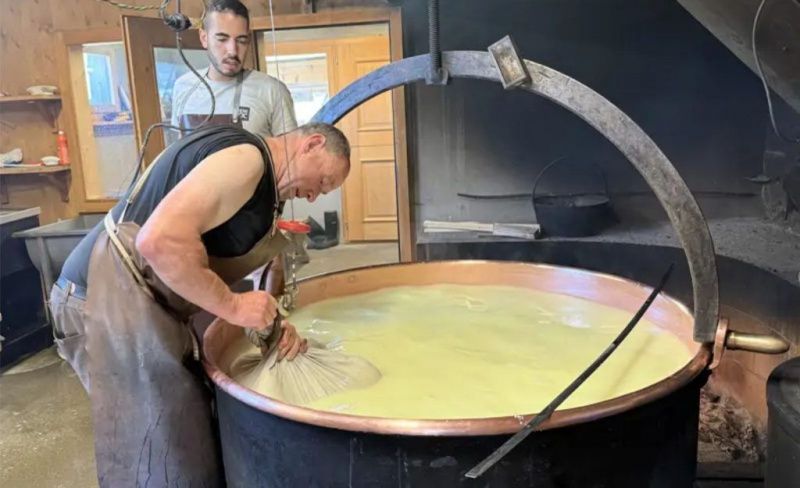
Gachet starts work at 4.30am in the canton of Fribourg. Inside the closed chalet, a wood fire heats the cheesemaking kettle, while smoke makes his eyes water. Before one stage of production, he immerses his arms in cold water and then reaches into the large black vessel. He has spent nearly two decades working on Alpine pastures and began making cheese independently in 2007. He completed vocational training but has known the chalets since childhood. “I really enjoy being up here,” he says.
The previous evening’s milk is held in a tank at between 10°C and 12°C. In the morning, it is transferred to the kettle and brought to 18°C to avoid a sudden temperature change before the next stage. Heating continues to 32°C, when bacterial cultures and rennet are added. Coagulation takes 40–42 minutes. Gachet then cuts and stirs the curd until its grains reach the required size, before gradually raising the temperature to 56°C. He judges progress by touch: “In cheesemaking, a lot comes down to feel. I touch it a lot, test it with my hand and feel everything.”
Once the curd has reached the right consistency, it goes into moulds. Gachet separates it from the whey with an étamine à fromage, a traditional muslin cloth also used in yoghurt and butter production. Pressing starts with a load of 200 kilograms and can reach 600 kilograms during the day. The wheels are turned repeatedly, with progressively longer intervals as they become firmer. Maturation follows, developing the cheese’s texture, aroma and flavour. Gruyère AOP must mature for at least five months; some varieties spend substantially longer in the cellar.
The protected designation Gruyère d’Alpage AOP applies to cheese made on Alpine pastures during summer. Across the alpages, about 400,000 animals spend May to September at elevations of 2,000–2,800 metres. The mix of herbs, flowers and grasses differs between regions and contributes to variations in the cheeses’ flavour. Alpine flora gives the product its delicate, fruity and slightly salty character. Conventional Gruyère is made in the valleys throughout the year. Fribourg, one of the main centres of production, makes approximately 420,000 wheels of Gruyère AOP annually.
The herds’ return from the mountains marks the season’s end and is celebrated through the Swiss rural tradition known as the désalpe. In Charmey, this generally takes place in late September or early October. Cows decorated with flowers descend to the sound of their bells, while the village hosts traditional music, a market and regional food products.
In Gruyères, the village that gives the cheese its name, Maison du Gruyère offers an interactive tour covering production and the product’s connection with cattle farming and mountain pastures. At scheduled times, visitors can watch cheesemakers at work from a viewing gallery. The tour ends with a tasting of Gruyère AOP matured for between six and ten months.
A local way of serving the cheeses is fondue moitié-moitié, meaning “half-and-half”, which combines equal quantities of Gruyère AOP and Vacherin Fribourgeois AOP. It is served in a caquelon, a pot kept warm over a burner. Diners dip bread into the melted cheese, preferably moving it in a figure of eight.









