EuroTier showcases milking robots, automated vaccination and calving monitoring systems
In the livestock pavilion, visitors could view beef and dairy cattle, sheep, goats and horses, as well as discuss supplies. Alexey Kitain, who is responsible for international livestock projects at Hunland Group, said the company had been working with Kazakhstan for many years. Since Russia closed its territory to the transit of European livestock, animals have been transported by air. Hunland is discussing the reopening of the overland route with the relevant authorities, hoping to reduce delivery costs. According to calculations by Jiří Křepela, owner of the Czech company AgroRoyal, a Simmental animal delivered overland from Europe to Kazakhstan costs €3,500, while air transport adds €500. He noted that Kazakh farms continue to buy European livestock; Czech Simmental cows produce 8,000–9,000 litres of milk annually. AgroRoyal plans to deliver 600 head to Uralsk next year.
For livestock transport, Italy’s Pezzaioli presented a 14-metre semi-trailer with a payload capacity of 27 tonnes. It can accommodate approximately 50 adult cows or bulls, or up to 110 calves; it can also transport sheep, goats and pigs. The metal body is equipped with ventilation and drinking systems, the floor has a non-slip surface, and the loading height is 70 cm. The model costs around €200,000. Steiner Automation presented its Mobilstall mobile poultry house, featuring automated feeding, watering and egg collection. The unit includes climate control and manure removal equipment, a feed silo and a control system located in the entrance vestibule. The poultry house can be moved between pasture plots, allowing birds outdoor access and rotation between grazing areas. The manufacturer offers four versions for conventional and organic poultry farming. A separate pavilion featured forage harvesting and feeding machinery, ranging from sowing and harvesting machines to equipment for storage, feed mixing and ration distribution, including autonomous units. Japan’s family-owned Kohshin Engineering Co., Ltd., which also operates in Kazakhstan, presented equipment for converting manure into fertiliser.
Stepan Ten, managing director of the Bek+ dairy farm in Kostanay, who has attended EuroTier since 2014, discussed European and American farms’ interest in crossbreeding. In his observations, farmers aim to combine the health of Jersey cattle, the milk yields of Holsteins and the milk fat content of Simmentals. He described the successive use of Simmental semen on Holstein cattle, followed by Jersey semen on the resulting offspring, with the cycle then repeated. In Ten’s assessment, these animals better meet farms’ requirements for health, productivity and milk composition. Damir Abitayev, director of the Experimental Oilseed Farm in East Kazakhstan Region, focused on cow housing equipment: cubicle beds, brushes, drinkers and ventilation. He was interested in stalls with plastic air ducts directing air to each animal. He said the system removes ammonia and cools cows in summer, reducing heat stress. Manufacturers claim that this type of ventilation can increase productivity by 10–15%.
Robotic milking was demonstrated at a special Barn Robot event. Sansyzbay Umirbekov, head of Westfalia Kazakhstan, the official representative of Germany’s GEA, reported the August launch of a robotic dairy farm at Enbek LLP. He said it was the largest farm of its kind in Kazakhstan and Central Asia. The farm operates 12 GEA robots designed to serve 800–850 milking cows. Umirbekov predicts that more new dairy complexes with robotic milking parlours will be built in Kazakhstan in the coming years, and that adoption of these technologies will accelerate significantly within three to five years. Another exhibit was the Hungarian-developed Ro-BooVaxx, presented as the world’s first fully automated robotic system for needle-free cattle vaccinations and injections using artificial intelligence. The development received a silver EuroTier Innovation Award 2026.
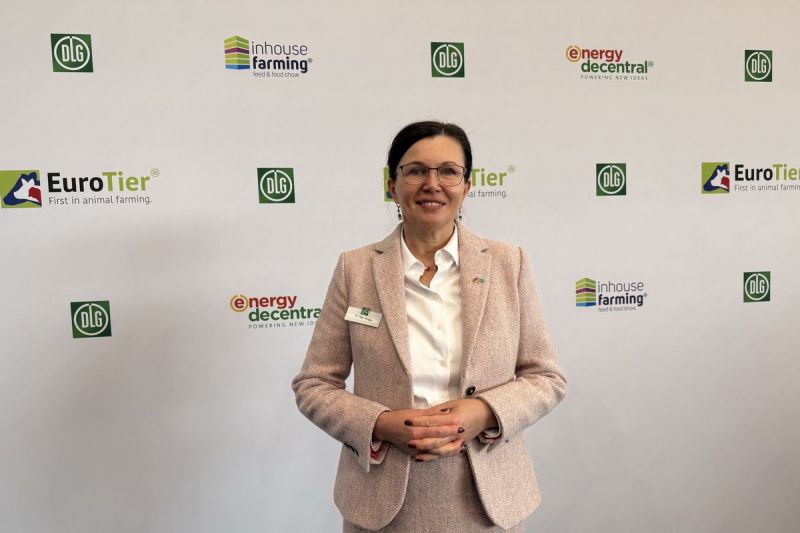
The exhibition organiser, the German Agricultural Society (DLG), accepted 175 entries for its innovation competition. Silver medals were awarded to 26 innovations and gold medals to four. The award-winning solutions were displayed in a dedicated “Innovation Alley.” Olga Hunger, DLG’s regional director for Eastern Europe and the Commonwealth of Independent States (CIS), described one of the gold medal winners: a system for monitoring impending calving. It uses a bolus that detects the onset of calving 15 hours in advance and sends a signal to the barn management system. The automated controls then adjust ventilation and lower the curtains to prevent draughts. Hunger explained that the resulting conditions reduce stress for the cow and benefit the calf’s health. She also noted that specialists have used the term “smart livestock farming” for more than ten years to describe the combined use of robotics, automation, digital tools and artificial intelligence.
Discussing the adoption of innovations in Kazakhstan, Hunger highlighted the involvement of farm owners themselves: they visit Agritechnica and EuroTier, explore the equipment and then seek to introduce it on their farms. She said financial instruments were available for such investments, including government subsidies and loans on preferential terms. In Hunger’s view, building a new complex offers more opportunities to incorporate modern technologies from the outset. She also said that many Kazakh farmers attend the exhibitions every year.
The only Kazakh exhibitor was the capital-based ZTOWN Development. The company has been manufacturing identification tags for farm animals for more than ten years. Its products are supplied to farms within Kazakhstan and in neighbouring countries. Its participation in EuroTier is linked to plans to enter the European market.