More Than 50 Years of Research Have Not Reproduced Breast Milk
Bernd Stahl has worked in biochemical research on human milk for more than 25 years and is also an associate professor at Utrecht University. His team has identified about 1,000 oligosaccharides, 1,500 proteins and 4,000 peptides in breast milk. Stahl said comparisons between breast milk and infant formula often understate the difference between the two products.
“An infant formula can come close to breast milk, but it cannot copy it,” Stahl told journalists and science communicators at Danone’s Research and Innovation Centre in Utrecht. He said the milk changes from day to day and even during one feeding. It contains relatively little fat at the beginning of a feed, while much more fat is present towards the end. Stahl said this pattern helps the baby’s intestinal enzymes adjust to fat digestion.
The mother’s diet also affects the milk. In a German cohort involving 1,000 mother-and-child pairs, researchers found that the fatty-acid profile had changed over recent years. Stahl said genetics had not changed over the decade, while diet had, citing recommendations to avoid trans fats and consume olive oil and fish. Mothers who eat substantial amounts of fish have higher levels of DHA, a fatty acid associated with brain development.
Breast milk contains bacteria including bifidobacteria and lactobacilli, and each mother passes a different bacterial profile to her child. Using proteomics, Danone’s researchers detected evidence in one mother’s milk of an infection or inflammation she had experienced during the sixth week of breastfeeding. Danone says it has conducted about 16 long-term breastfeeding cohort studies with hospitals in Europe, Asia and Africa, examining the milk’s composition and its effects on infants’ intestines, immunity, brain development and taste development. An observational study is now under way at six centres in China.
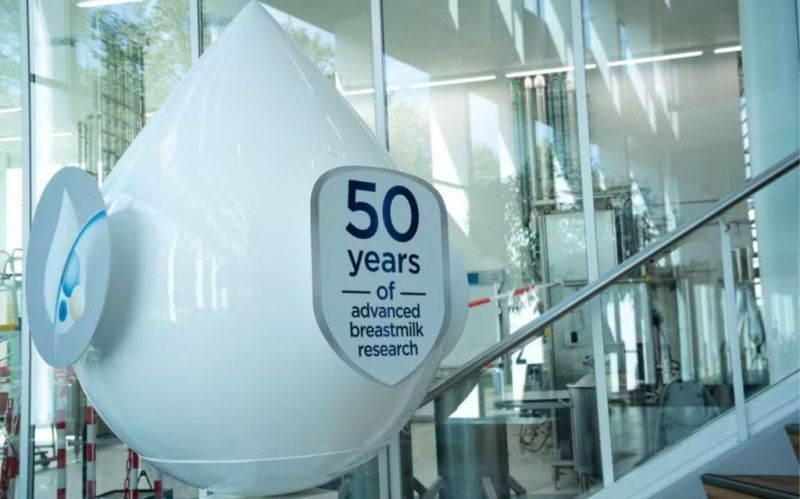
Danone has researched breast-milk composition and functions for more than 50 years. Its acquisition of Nutricia in 2007 strengthened its position in infant and medical nutrition. One area of research concerns human milk oligosaccharides, or HMOs. Babies do not digest these sugars; instead, they provide nourishment for beneficial intestinal bacteria. Danone says it identified more than 30 years ago that HMOs can contain as many as 50 different building blocks.
Because thousands of human-milk oligosaccharides are not commercially available, Danone developed a blend of the prebiotic fibres GOS and FOS to perform a similar function. Stahl said the work has been supported by 40 clinical studies and more than 90 publications. Jan Knol, Danone’s senior director for gut, immunity and microbiology, said bifidobacteria benefit particularly from HMOs because they evolved to live in an infant’s intestine and help train the immune system. Cow’s milk does not contain the same substrates, he said.
Researchers are also studying the structure of milk fat. In breast milk, fat is carried in globules, with triglycerides at the centre and polar lipids forming a coating around them. Michael Koopmans, head of Danone’s Global Research and Innovation Centre in Utrecht, said reproducing this arrangement in formula required the fat to dissolve in cold water with limited stirring and without creating much foam. Stahl said nine of Danone’s 12 infant-formula innovations during the past two or three decades had been developed by the company’s teams.
Danone sells Aptamil for children up to one year old and competes in Brazil with Nestlé’s Nestogeno. Arthur Lorenzetti, Danone Brazil’s vice-president for specialised nutrition, said formula consumption in Brazil remains relatively low compared with other countries, while exclusive breastfeeding is widespread. Brazilian rules and industry compliance standards restrict companies from encouraging consumption of formula. Danone has reformulated products after reports of constipation among infants, adding prebiotics, and has announced the Brazilian launch of Aptanutri Profutura Gold for children from one year of age. The company says it contains HMO and DHA and has the category’s highest level of prebiotics.
Stahl said cell-culture ventures, generally led by start-ups, had reproduced parts of the lipids, proteins or oligosaccharides found in milk but not the complete product. He identified production at larger scale as an unresolved difficulty. “We still have a very long way to go,” he said, adding that researchers know only “the tip of the iceberg” of human milk.