Kintal Islamov Explains the Planning of a New Dairy Farm Project with 3100 Cows
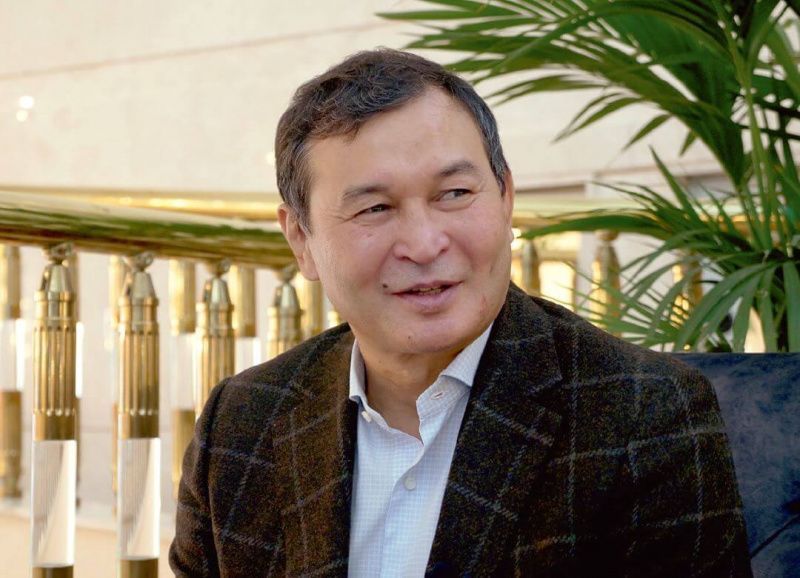
Atameken Agro is preparing a new dairy farm project for 3100 dairy cows and is considering scaling this format further. The group hopes to increase the number of cattle on modern complexes to 18,000 cows, and if all nine farms' projects are implemented, up to 27,000. At the same time, the company is exploring opportunities for deep milk processing and the construction of a plant with a capacity of 400–500 tons per day.
Kintal, you mentioned that Atameken Agro plans to build a new dairy farm for 3100 cows. What stage is the project at?
— We are already working on designing the farm and selecting equipment. The previous project was generally successful. It was expensive, but the indicators we achieved are considered satisfactory.
We essentially started the first farm from scratch. It is now in its third year of operation, and the average yield last year was 10,713 liters per cow. This is a good result for the initial period.
At the first farm, do you currently have 1400 dairy cows?
— Yes, 1400 dairy cows. The total number of cattle, including young stock, is 2,900. The new farm is already designed for 3100 dairy cows.
Are you considering the format for 3100 cows as a model to replicate later on?
— Yes. We want to test this model first. An industrial and technological approach is already needed for a farm of this size. The existing complex will probably only retain the main principle: cows need to be properly maintained, fed, and milked. The technology itself will be substantially different.
For example, on the current farm, we do not have a centralized stationary feed kitchen. In the new complex, we plan to build a large feed kitchen where the preparation of rations will be monitored and accounted for. This should significantly improve the feed preparation level.
What else will change in the design and maintenance technology?
— We currently use a standard ventilation system. On the new farm, we want to switch to tunnel ventilation. The plan includes a large barn that will accommodate 3100 dairy cows. Such livestock must be fully provided with fresh air and maintained in a comfortable microclimate.
Preliminarily, the project provides for four feed tables. However, the final configuration is still being specified.
Which milking system are you considering?
— We are looking at offers from several suppliers, including GEA, DeLaval, and Afimilk. We plan to install a 100-seat milking carousel.
A hundred-seat carousel is very large. Why choose this size?
— We understand that we lack experience operating a farm of this scale. A 100-seat carousel will give staff more time to handle each cow and organize the milking process more calmly.
On farms with similar livestock, we have seen 80-seat carousels that also cope with the workload, with some free time left. But for the first project of this scale, we want to consider a spare capacity.
There is an opinion that intensive milking on large carousels reduces the productive life of cows. Does this concern you?
— We have visited many farms and have not encountered cases where animal injuries were linked to the carousel. The other question is the level of productivity.
When a cow produces 48–50 liters of milk per day, its productive use life indeed decreases and can last 2–2.5 lactations. At productivity levels up to 39 liters, a cow can comfortably endure 3–3.5 lactations, according to experts. Therefore, I would not associate the animal's lifespan directly with the type of milking equipment.
Why did you stop at 3100 cows? Why not two or, for instance, five thousand?
— It is a question of scale effect. In our assessment, it is most noticeable with livestock of approximately 2,500 to 4,000 cows. Within this range, capital costs can be significantly reduced.
When the farm becomes significantly larger than four thousand heads, the additional scale effect starts to diminish. Moreover, this is our first project of this size. We need to consider not only the construction but also the available forage base. We are not yet ready to fully convert all crop production areas exclusively to dairy production support.
Has the first complex convinced you that dairy farming can be a profitable business?
— Yes, we are making a good income and seeing decent production results. Therefore, the decision to move to the next project has been made consciously.
But you also say that the first complex turned out to be expensive. When can it pay off?
— We invested about 13.4 billion tenge. If the cost of money is excluded, the payback period under current conditions can be about nine years. If the price of milk rises, it will shorten the time. If discounting the cash flows and considering the capital cost, the period will be longer.
Nine years is a long period. Why is business still willing to invest in such projects?
— Government support plays a significant role. If cheap financial resources are available, the project's economics become more attractive. We find an acceptable model in which the investor invests about 30% of his own funds, with the remaining 70% obtained through a government program.
This way, the cost of money and depreciation can be taken into account normally, making the project look quite effective. We will see how the second farm's construction goes. If it also shows good results, we will make decisions about further scaling.
How much might a new complex for 3100 dairy cows cost?
— We are now budgeting about 25 billion tenge, including cow acquisition. But it is difficult to name the final amount: building materials are constantly getting more expensive, construction costs are high, and the geopolitical situation remains unstable.
A significant part of the costs is directly related to buying animals. Livestock prices have noticeably increased in recent years.
What mistakes from the first project will you try not to repeat?
— The main problem was a lack of our own experience. We did not always know the real market cost of certain solutions and did not fully understand which technologies were truly necessary.
As a result, some elements turned out to be redundant — they could have been done without. Simultaneously, there were solutions we, on the contrary, lacked. For instance, the full-fledged feed kitchen or feed room.
I would not call them global mistakes. Rather, certain things could have been done better, more carefully, and cheaply.
But you worked with consultants on the first project?
— Yes, and the issue is we listened to them. Many suppliers are primarily eager to sell equipment rather than transfer the technology to the client. Equipment and the technology of its efficient use are far from the same.
Can you provide a specific example of a decision you might reconsider today?
— We installed cow mats on the first farm. Suppliers probably benefit more from selling them specifically. Later, studying other farms' experiences, we saw that deep bedding could be more comfortable and hygienic.
Recycled manure can be used as bedding. This allows part of the organic material to be reused and reduces costs. Of course, this system requires regular control and maintenance, so each option has its pros and cons.
We studied farms in Europe, the USA, and China. Many farms use deep bedding — sand, recycled manure, sometimes sawdust. Mats were much less common. Therefore, we again question whether suppliers always provide the producer with complete and objective information?
Where will the new farm be located?
— The distance between the current and new complexes will be about 120 kilometers. The site was also chosen considering the availability of building materials.
Crushed stone, sand, and gravel are expensive today, especially if they need to be transported 200–300 kilometers. In addition, there are road restrictions. Proximity to materials should help us slightly reduce the amount of capital investment.
What genetics do you use on the first farm?
— We bought Danish and German cattle. Judging by the productivity, the genetics have performed well. The first calves raised on our farm have already appeared, and we are now starting to introduce them into the replacement herd. The first results also look good.
What are the average milk quality indicators?
— The latest figures I remember are about 4.3% fat and around 3.5% protein.
To whom do you supply milk?
— The main buyers are Eurasian Milk, Milk Project. The base price per year is about 250 tenge per liter.
How important is the subsidy per liter of produced milk? Can a large modern farm operate without it?
— If there are no subsidies, milk will become more expensive. This is a direct dependency. Nobody will produce milk at a loss.
Yes, milk in Kazakhstan is expensive, but it is still cheaper than, for example, in Europe. The subsidy allows the raw material price to be maintained at a certain level. If it is removed, the costs will still have to be compensated through the sale price.
The state declares reimbursement of part of the capital costs. How much does actual support match the declared level?
— Formally, 25% is suggested, but in practice, we did not receive that much. The current norm, as far as I remember, is about 2.9 million tenge per head. Modern projects do not fit into this norm.
Comparing the compensation received with the actual capital costs for building the first farm and equipment, state support was about 8%. This is significantly less than the declared 25%.
How critical is the personnel issue for you?
— As everywhere, there is a certain turnover. The main tools are salaries and working conditions. The new farm uses modern technology, and there is no situation where a person is forced to work waist-deep in dirt or manure. Everything is quite clean and tidy, and waste is disposed of.
Absolute cleanliness on a livestock enterprise is, of course, impossible. For example, bioreactors need to be serviced, and specific waste is generated. Overall, however, conditions are much more comfortable than people usually imagine when thinking about working on a farm.
The village of Korneyevka is nearby, so the enterprise is not remote from the settlement.
Do you also find managers and technologists in the local market?
— When we launched the first farm, we invited specialists from Belarus. Our managing directors and livestock specialists were Belarussian. Now the complex is already entirely under the management of our specialists.
How do you assess the geography of Kazakhstan's dairy market? Major industrial production is developing in the north, while a significant part of consumers live in the south.
— This is one of the market's features. The main opportunities for milk production are concentrated in the north — in the North Kazakhstan and Akmola regions. At the same time, a significant part of the population lives in Almaty, Shymkent, the Zhambyl region, and other southern regions.
That is why we strive to develop several large farms and gradually increase production volumes.
What volume of milk would you like to produce in the long term?
— In the long term, we are considering producing 600-700 tons daily. The maximum target is approximately 800-900 tons.
Once we reach at least 200 tons per day, deep milk processing will already be required.
Is it about building a dairy plant?
— Yes, we are already exploring this issue. There is traditional production, like cheese, and more profound milk processing. Technologies are emerging to extract more valuable components from milk used in medicine and baby food.
After the second farm's launch, we will likely move on to expanding the first complex and then start building the third farm. By this time, a processing plant with a capacity of 400–500 tons of milk per day will need to be created.
What is the total herd size that your strategy provides for?
— We can talk about approximately 18,000 cows soon. The group has nine farms. If a farm is built at each of them for about three thousand dairy heads, the total livestock can reach 27,000.
Of course, we will not build all nine farms in five years. But if we implement at least half of the program during this period — for example, launch four complexes, — it will already be a good result.
In the next five years, once we accumulate experience and form the necessary resources, it will be possible to build two farms per year simultaneously.
Whose experience do you rely on when forming such a strategy? Have you studied the Russian EkoNiva?
— Yes, we visited EkoNiva's enterprises and observed how their production is organized. If other people can manage such scales, why can't we?
Here, a certain sporting interest arises: why are we worse?
Whom should we follow today — Russian or Chinese producers?
— I would currently focus on the Americans. This applies to animal husbandry quality, the organization of microclimates in barns, and approaches to feeding and raising young animals. These systems are well-developed in the USA.
How severe a threat do epizootic risks, including foot-and-mouth disease, pose to large dairy complexes today?
— This requires great caution. It's a major issue, and everyone needs to strictly follow veterinary and sanitary requirements.
Personal farms pose a certain threat. A small outbreak of disease can spread and cause massive damage to a large farm. With small livestock numbers, control and responsibility levels are often lower: potential losses seem insignificant, making the attitude towards biosecurity simpler.
Overall, our culture of veterinary safety has not developed enough. COVID-19 has taught people to be more responsible in spreading infections, but livestock breeders have not fully applied this lesson to production. Allah, as they say, has spared us so far. I hope it stays that way, but it's better to learn from others' mistakes.
I believe the state should systemically address veterinary safety issues.
You plan to participate in the Central Asian Dairy Congress AqAltyn. What do you expect from the event?
— Honestly, to chill with you. And, of course, to hear something interesting.
At such events, you can meet people and then build closer cooperation. We initially met Dutch specialists at AqAltyn and continued to communicate with them. Therefore, such meetings are useful not only for presentations but also for contacts that arise between participants.
General Partner - Borte Engineeringhttps://engborte.kz/
As a leading national producer of Kazakhstan, Borte Engineering creates high-tech equipment for the food industry, confirming its quality by being included in the Register of Domestic Producers. The company successfully collaborates with enterprises throughout Central Asia, strengthening the regional economy.
Other event partners include:
Dairy Union of Kazakhstanhttps://kazsut.com/
France Grouphttps://francegroup.org/ru
Qazaq Sut Associationhttps://qazaqsut.kz/
CRI Kazakhstanhttps://cri-kazakhstan.kz/