Kazakhstan’s Krestyansky Dvor processes 3.5–4 tonnes of milk daily
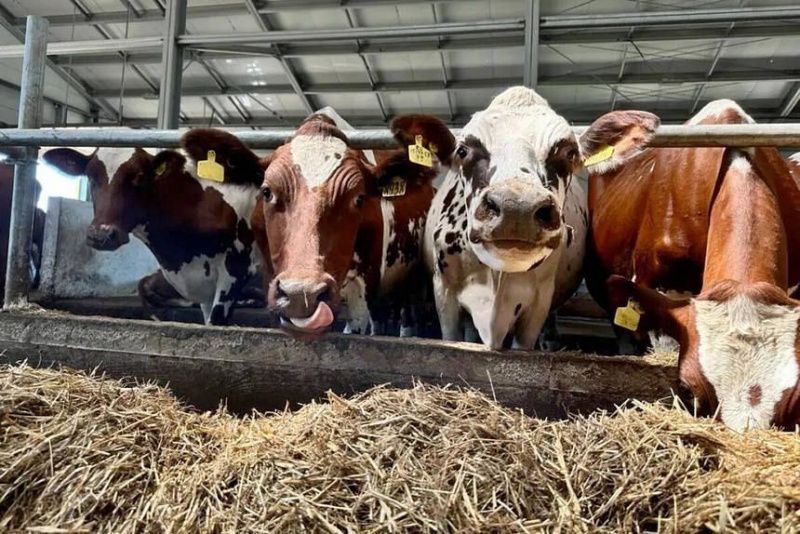
The farm financed the development of its dairy complex partly through a subsidized government loan. After applications were rejected in 2021 and 2022, the loan was approved in 2023, with the funds disbursed in May 2024. The business initially requested 1 billion tenge and sought 2.4 billion tenge in its third application. It ultimately received 1.2 billion tenge for ten years at an annual interest rate of 2.5%. The money was used to purchase 400 Ayrshire cattle, build housing and a milking block, install a Dairymaster milking parlour and replace equipment in the dairy processing facility. According to Yudina, the spring 2024 floods in North Kazakhstan Region were accompanied by shortages of construction machinery, crushed stone and sand, as these resources were being used to build housing for flood victims. Estimated costs rose two- to threefold, and the farm raised additional private investment. Some of the purchased cattle have yet to arrive.
Since September 2025, the business has focused on dairy products. Yudina aims to bring annual turnover in this segment to 500 million tenge. In 2024, dairy products generated 7 million tenge a month, or about 84 million tenge over the year; wheat remained the main source of revenue at that time. The workforce has grown from 12 employees in 2024 to 67. Wages and related taxes account for 35–40% of turnover. Yudina attributes the lack of profit to the complex operating below capacity and expects the business to become profitable after the final batch of cattle arrives and it reaches its planned capacity. She said the total herd should reach 500 head. She noted that staffing requirements are virtually the same for herds of 300 and 500 head, while milk output and revenue differ. According to her, the business model is being built from the outset without reliance on subsidies.
Cheese waffles, pancakes with various fillings, including cottage cheese and berries, and cottage cheese muffins for children lead the range in production and sales volumes. Each month, the farm produces about 3 tonnes of waffles, 1–1.5 tonnes of pancakes and a comparable volume of muffins. Milk, cheese and cottage cheese are produced in smaller quantities: Yudina attributes this to the decision to limit batches of fresh products with short shelf lives. She describes butter and cottage cheese as the core products with which production began. Its first retail partner was the Amarant gourmet grocery chain, with which it continues to work. Products are now also sold at Galmart and through Wolt. The farm turned down some offers from major chains because of their terms, including a requirement to take back unsold goods. In the early days, Yudina shared the progress of the farm’s construction on Instagram without spending money on advertising.
Yudina moved into agriculture from logistics. After studying economics at the International Kazakh-Turkish University, she worked in Almaty and later headed logistics at a branch of ASD RG Brands. From 2008, she handled raw material supplies for several factories, working with processing specialists and a laboratory. She later established a transport company with a partner. The family farm began with the purchase of a non-pedigree cow for 100,000 tenge and two bull calves for her husband’s parents in Petropavlovsk. By 2012, the family was already receiving meat from the farm, while milk, cottage cheese, cream and butter were sent to Almaty every week. Initially, the couple wanted to keep no more than 100 animals and supply themselves and their loved ones with food. They chose northern Kazakhstan for the farm, intending to grow feed there. In 2014, acquaintances of her husband’s parents who had planned to buy their cattle became partners in the project.
Krestyansky Dvor, a limited liability partnership (LLP), was registered in May 2017. The initial investment was $100,000, drawn from savings and money left after selling an apartment in Almaty and buying a detached house. The first wooden building, accommodating 30 animals, cost $15,000, while the remaining funds were spent over several years on cattle and development. Instead of a trial batch of a few dozen calves, the partners bought 100 white-headed cattle aged five to six months, which made it necessary to expand the facilities. Initially, three general labourers worked alongside the co-founders. The partners’ daughter Anastasia handled primary processing, using a separator to process 300–400 litres of milk daily. She died in autumn 2024. In 2017, Yudina sold her transport business and focused on the farm. Until 2020, all farm revenue was reinvested in development, and the first business plan was prepared for the subsidized loan application.
To establish its own feed supply, the farm purchased 2,300 hectares of land for several million tenge. It arranged leases for two combine harvesters and a Kirovets tractor through KazAgroFinance; payments are still ongoing. Several more machines were bought using the initial investment. The farm started with wheat grown for sale, using the proceeds for development. In 2019, it harvested about 2,000 tonnes and sold the grain directly from the field to a grain elevator. It had no storage facility of its own at the time, and the crop’s high moisture content resulted in a lower purchase price. The proceeds were invested in an enclosed production complex with grain storage in the village of Tashkentka. The following year, the farm sowed barley and subsequently supplied its own feed. From 2020, crop revenue was used to restore livestock buildings and a production complex where it began processing its own milk and meat. The Severnoye trademark was registered in 2022. At that time, the farm had about 130 animals, including 25 milking cows yielding 13–14 litres each.
The dairy business was developed gradually by purchasing additional milking cows; one of the co-founders trained with Russian milk-processing specialists. The first deliveries to Almaty were sent by truck, refrigerated vehicles had to be found in summer, and Yudina personally delivered orders to acquaintances. She attributes the choice of the Ayrshire breed to the taste of milk that she and her husband tried in Paris. In her estimation, an Ayrshire cow’s maximum daily yield is 28–30 litres, compared with a possible 50 litres for a Holstein. The farm does not use pesticides on its fields or processing accelerators, improvers or emulsifiers when processing its own raw materials. Yudina says avoiding pesticides reduces feed crop yields and, in some cases, doubles costs; these expenses are reflected in retail prices. She does not feel competitive pressure from cheaper Russian and Belarusian products because she targets buyers of artisanal foods. The business’s long-term plan is to produce whole Ayrshire milk in Tetra Pak packaging; first, Yudina intends to get current operations running smoothly.