Grupo Lala launches Christmas packaging with 23 collectible Snoopy comic strips
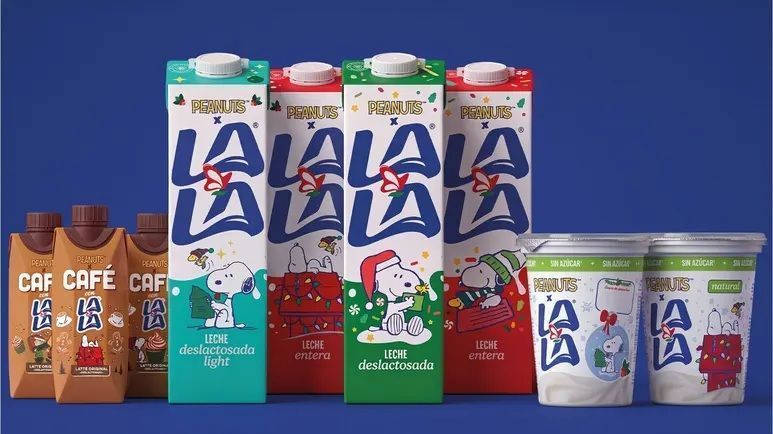
The milk collection covers Leche Lala’s whole, lactose-free and light lactose-free varieties. According to the company, the cartons feature four-panel strips created by Charles M. Schulz, intended for families to read and share during the December festivities. The seasonal designs also appear on 330ml packs of Café con Lala and 900g containers of Yogurt Lala Natural Sin Azúcar.
The yogurt container includes a reusable-packaging concept called “Stored here”, with a space where consumers can label its contents. It is intended for keeping Christmas dishes such as romeritos or apple salad, allowing households to continue using the container after finishing the yogurt.
Alongside the packaging announcement, the report describes milk-handling practices at partner and supplier farms in the Comarca Lagunera dairy region and elsewhere in Mexico. These include checking the first streams of milk and disinfecting teats before milking to help prevent environmental mastitis and control somatic-cell counts. Freshly collected raw milk is then directed into rapid-cooling tanks at 4°C to stabilise its acidity before collection. The report describes subsequent processing at certified facilities as continuous pasteurisation above 72°C or ultra-high-temperature treatment at 138°C for four seconds, combined with aseptic filling into multilayer cartons.
The report places the campaign in a Mexican retail market where milk and natural yogurt are sold alongside blended dairy preparations, milk formulas and plant-based drinks. It identifies imported dried whey, modified starches and hydrogenated palm fats among ingredients used in competing formulations. It also cites NOM-155-SCFI-2012 and NOM-181-SCFI/SAGARPA-2018 in its discussion of the composition and protein requirements applying to milk and yogurt. The article presents family-oriented seasonal marketing as a means of supporting consumption of cow’s milk and yogurt amid competition from substitutes.
On farm economics, the report states that cattle feed accounts for more than 70% of current operating costs per litre of milk on Mexico’s commercial and family dairy farms. It identifies maize silage, alfalfa hay and commercial protein concentrates as components of those feeding costs. The article links sales turnover in whole milk, lactose-free milk and natural yogurt with processors’ capacity to take in farm output and make timely payments based on total milk solids.
The report also identifies the Secretaría de Agricultura y Desarrollo Rural (SADER), the Secretaría de Economía, Cofepris and Profeco as public bodies involved in promoting milk and yogurt consumption and overseeing the market. It describes encouraging consumption throughout life and monitoring analogue products to prevent shopper confusion as priorities for these agencies.