Global Dairy Industry Adapts to Rising Whey Protein Demand
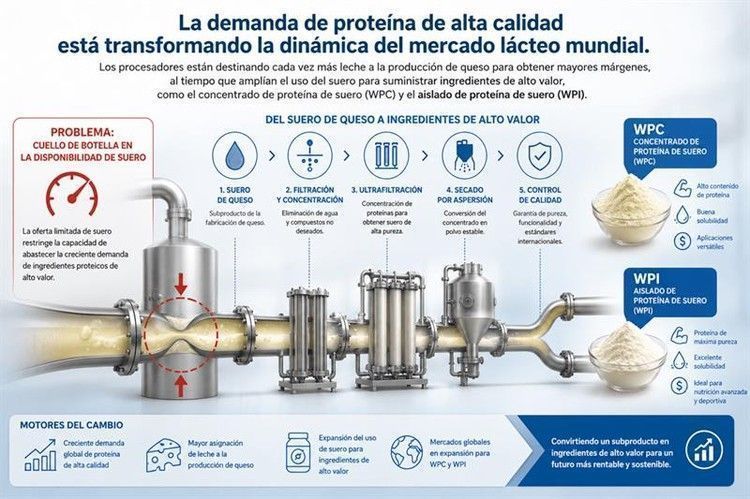
The increasing global demand for high-quality whey protein concentrates (WPC) and isolates (WPI) is reshaping the commercial and processing strategies within the dairy industry. Processors are redirecting more fluid milk towards cheese production to enhance operational margins while optimizing the use of the resulting whey. This by-product is transformed into high-value ingredients, primarily WPC and WPI, to supply a rapidly expanding end market.
The surge in consumption of these protein fractions is driven by the widespread adoption of functional diets and active lifestyles. The use of WPC and WPI has quickly expanded from high-end sports nutrition to everyday food and beverages, such as enriched yogurts and ready-to-drink shakes. This demand pressure has exceeded the available supply, creating bottlenecks in commercialization, with orders often secured months in advance amid aggressive negotiations for securing volumes.
Due to the lengthy timeframes required for establishing new industrial plants, processors are focusing on optimizing the operational efficiency of existing facilities. According to Rachel McGinness, a specialist in R&D at Ecolab, a key challenge is enhancing the efficiency of membrane filtration systems, as well as in-situ cleaning cycles (CIP), pasteurizers, and evaporators-dryers, which are operating at their installed capacity limits.
The technical gap in producing WPC80 or WPI90 goes beyond the filtration surface of membranes. Despite reducing cycle times in ultrafiltration or microfiltration modules, processing plants face critical bottlenecks in the thermal stages of pasteurization and evaporation-drying. The inability to balance these continuous processing phases jeopardizes the flow of raw materials, risking lost commercial opportunities in a market where input availability is a determining factor.
To meet this high-demand scenario, most whey processing plants operate continuously for 24 hours, subjecting membranes and key equipment to over 20 hours of daily operation. Maximizing the recovery rate of dairy solids and extending the lifespan of separation systems through advanced hygiene protocols will be crucial to sustaining profitability. The dairy industry is thus consolidating its transition from commodity sales to advanced nutritional ingredient chemistry.