Daniyar Abitaev Explains Profit Strategy in Cattle Breeding
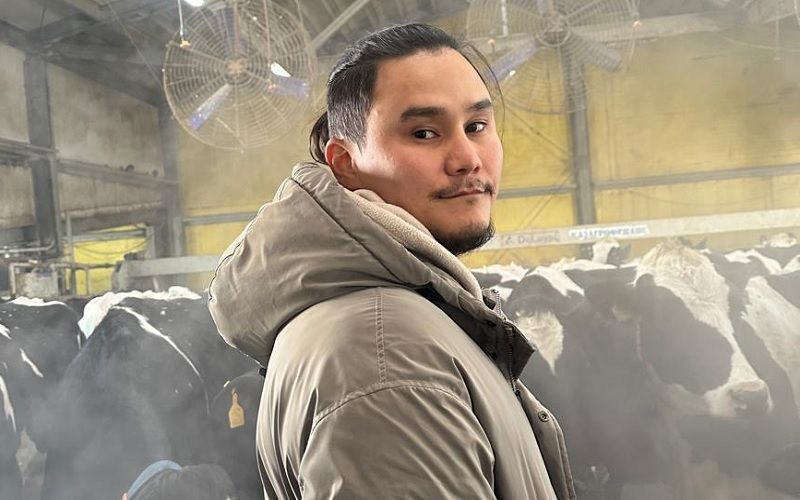
The interview took place ahead of the IV Central Asian Dairy Congress AqAltyn 2026, scheduled for November 30 - December 1 in Shymkent. Daniyar Abitaev has been invited to speak on the topic, 'From Traditional Farm to High-Tech Dairy Complex: The Experience of OHMK.'
— Daniyar, let's start from the current point. What is happening now in OHMK's dairy direction: livestock, yields, main events?
— The main event is that we have started selling heifers for the first time. We've already shipped the first batch, 250 heads. We've sold cull cows before, but this is the first year we're selling heifers. Now we can supply up to 800 heifers a year to active farms in Kazakhstan.
— So this is more important to you than the next milk yield record?
— I believe it's much more important. Selling genetics puts the entire economy of the dairy farm in place. We only make a profit from a cow when we sell her daughter.
Look, the cow calves, and then part of the money you get from the milk is invested in her calf. If you consider the cow as a separate economic unit, nearly all the profit from her milk goes into raising the next generation. Until you sell the calf, you've essentially postponed your profit.
This is especially true for farms that continue to buy heifers every year, expecting that one day the farm's economy will improve. It won't, if all you do is buy animals and don't start selling your own genetics.
— Are many farms in Kazakhstan already selling heifers?
— I know about five, maybe just a handful of farms, no more.
— Are the buyers primarily Kazakhstani?
— Yes. It's easier for us to sell to our own: subsidies, veterinary services, shipment, and logistics are clearer. I'm not against exporting for a good price, but I engage in animal husbandry somewhat more as a philosophy than a business. So, I prefer to sell animals as close as possible to reduce their stress. First of all, we look at neighboring districts and regions.
— How do you decide which heifers to keep for yourself and which to sell?
— The first indicator for me is reproduction. A cow may give good milk, but if she has problematic calvings, post-calving complications, or trouble with repeat insemination, I'm likely to sell her daughter.
Sure, there are conditions of maintenance and the work of specialists, but there is also a genetic component. Reproduction is the first thing that limits us in milk production: if the cow doesn't calve, there is no milk. It's that simple.
— So the animals you keep for yourself must be better than those you sell?
— Naturally. Although the ideal situation for me is to show the buyer all the heifers and say: choose any. Whatever you don't choose, I'll keep for myself. So there is no principal difference: both have equal-quality genetics.
— When will you achieve this?
— I think in about four years.
— What is the current livestock number?
— Recently, there were a thousand milking cows, today around 900. We've sold heifers and started selling some cows, so the milking herd has decreased.
— You also mentioned there is a strategy for the timing of heifer sales. What is it?
— There’s a little life hack: you should sell the heifers whose calving is planned from May to August.
— Why specifically at this time?
— Summer brings pasture milk from milk collection points. It's cheaper for processors, and they start to nitpick: they may claim antibiotics were found or offer to take the milk as second grade. Gradually, they try to lower the price. In autumn, they are very keen to increase volumes.
So, when the processor doesn't need your expensive farm milk as much, it's logical to reduce production. And from October to April, when milk sells well, to increase it.
In general, the rule of any business is simple: first figure out how to sell, then how to produce. If a product sells well, production is not the main issue.
— So, you want to shift seasonality intentionally rather than even it out?
— Currently, our production is roughly even over the year. But I want to get 30% more milk from October to April and 30% less from May to September. That’s how I would distribute the year as a dairyman.
— What's the current milk yield?
— We've decreased this year. It was 38 liters, now about 32 liters per cow per day. Several poor harvest years, some commodities increased in price, and we've dropped some purchases.
Nonetheless, the diet has become considerably cheaper. As a result, we earn roughly the same per cow but milk less.
— That's an important point. Usually, people talk about efficiency and milk yield growth. But, as it turns out, it's not about the maximum, but the optimum?
— Precisely. You shouldn't chase maximum but optimal milk yield.
About five kilograms of dry matter are needed just for the cow's self-maintenance. A Holstein also needs to get them. If you don't give them, it'll still channel nutrients into milk, but at the expense of its own body.
This makes it challenging to work with Holsteins. Some breeds sharply drop in milk yield with liver or digestive issues, signaling a warning right away. A Holstein's drop can be gradual and almost imperceptible. When you notice, the health has already been affected.
— How do you approach supplements and expensive diet components?
— Buy everything you can cheaply and nearby. If a product is expensive and has to be brought from afar, you need to calculate.
Let's say the livestock specialist insists: soy is essential. But if soy isn't produced in our or neighboring regions, why bring an expensive soy product from afar? It's a question of logistical feasibility.
There’s a sugar factory nearby — take beet pulp. There’s a brewery — you can use brewer's grains. Kazakhstan has many cheap organic resources, which no one has yet properly utilized. We're talking large volumes.
— Do you have a specific project in this direction?
— We're currently discussing a project with beet pulp. The sugar factory gets a lot of it in season, but it spoils quickly and doesn't handle logistics well. It can be compressed into one-ton bricks, add bacteria for preservation, and then use it as silage.
There's another project. We're growing black soldier fly larvae — I'm right at this site while speaking. It will process manure into vermicompost and become a protein product sold to fish or poultry farms.
— So the larvae for feed, vermicompost as fertilizer?
— Yes. I generally believe that one should aim to profit from everything the cow produces. It produces about twice the volume of manure as milk. If you have such an output of organic product, you can't just see it as a headache. It's a resource to be processed.
— Returning to genetics. Who are you working with now?
— We use American genetics ABS Global, working through a local representative. They have convenient packaging, and it's easy to keep track of doses and work with the Dewar vessel.
But especially important is external reproduction audit for me. An independent specialist comes, checks animals, and sees whether what's on paper matches the reality. If it does, our specialists are doing a great job.
— What if it doesn't match?
— Ultrasound specialists and inseminators might paint a rosy picture for themselves. It's worrisome if, afterward, they insist on a 'clean-up' bull — it’s easier to hide mistakes. External control is absolutely necessary.
— What criteria do you use to select semen?
— I primarily look at Net Merit. For me, this is a profitability calculator. We take Net Merit above 1000.
Then I specifically look at fat. Fat is well-heritable and earns us money. Therefore, getting an increase in fat is often easier through genetics than diet.
Everyone usually looks at leg strength — that's needed too. But its heritability is much lower. Fat will have a more noticeable impact on the farm's economy.
— How many lactations does a cow go through on average on your farm?
— Five.
— And for what reasons do you typically cull?
— First again is reproduction. If a cow doesn’t get pregnant three to four times, we cull her. Then come post-calving complications and reproductive organ problems. And only in third place — milk yield.
— What milking equipment do you use?
— DeLaval, parallel 2×18. It was installed in 2016. Over all this time, the milking parlor likely had about 12 hours of downtime when it shouldn't have been down.
— So almost no unplanned downtimes?
— Yes. And this speaks not only to the quality of the equipment but also to the service. Supplier reliability is much more important than buying cheaply. If there are people who quickly solve problems in the milking parlor, that's a quality supplier.
— What currently hinders the development of industrial dairy farming in Kazakhstan the most?
— Too many amateur mistakes at the start. For instance, someone builds a farm and imports 800 heifers immediately. They arrive in large batches, then calve at the same time — and the farm faces enormous strain on the maternity ward, veterinarians, everyone.
One must contract a year or a year and a half in advance and populate the farm gradually. Let the supplier deliver two trucks a month. You'll pay the same cost, and he’ll organize deliveries peacefully. This way, there won’t be a wave of two hundred calvings simultaneously.
Another mistake: the first imported heifers calve, and the owner starts raising all their daughters to return to the herd immediately to build a second phase. In fact, some of these heifers need to be sold to return funds earned from their mothers' milk to the economy.
Often someone has previously dealt with beef cattle, then opens a dairy farm and thinks it will be about the same. Dairy is much more complicated. As a result, one may lose half of the expensive cows bought on credit.
Kazakhstan's global problem — people aren’t ready to pay for knowledge, consultancy, or support. Everyone says 'I can do it myself.' And then they pay dearly for their errors.
— What was OHMK's main mistake?
— Blindly trusting one specialist. Even if you bring an expensive and highly professional expert, you can't only follow what they alone say.
If the specialist can't tolerate another opinion or allows no external audits, that's already a red flag. Understandably, you can't constantly undermine their authority in front of the team. Balance is necessary. But all instances where we seriously faltered were linked to fully trusting one individual.
— Let's talk about government support. The state announces large programs, farms start projects, invest their money, receive bank guarantees. But then financing is delayed or doesn't come in full. Is this problem real?
— It is. We've been burnt by this ourselves. We had a project for about $4 million, with about $1 million of our funds already invested. In the end, we received about $1 million less in cheap financing than anticipated.
We withdrew money from circulation, and one enterprise began to experience cash gaps, forcing us to transfer funds from another.
— What practical conclusion can an investor draw from this?
— Submit with reserves. You need a reserve for both money and time. If the real project costs 2 billion tenge, you can't plan as if the entire promised sum will come fully and timely.
There are two issues. First: the program exists, the sum is announced, but when you need the money, it might not be available. Second: the order of actions — what to provide, in what sequence, and to whom — is not properly outlined anywhere.
Why can't there be a similar application for state support programs as for loan applications? Submit this document first, then that, a commission will then visit — everything should be understandable.
We all advocate for digitalization, but agriculture probably remains the most underrated sector for digital efforts.
— You mentioned that livestock and yields have decreased. Don’t local officials ask: “Daniyar, we planned production growth, and your figures are falling”?
— In the region, the cows remained. We merely moved them from one district to another. One district’s figures fell while another’s rose. Thus, the district administration might hassle us a bit: their numbers suffered while the neighboring district's improved.
But I believe it's crucial to cultivate wealthy neighbors. If a neighbor prospers, together we might open a feed mill tomorrow. I’ll know he can purchase good feed for the quality cows I've already sold to him. Later, he'll buy genetics from me again. Together, larger projects are feasible.
It's gratifying when a neighboring area becomes more productive. But officials have their metrics: they praised the neighbor, scolded you at a meeting — and competition begins.
Farmers like us often complain: drought, subsidy delays, an absentee employee. But this sector is one we chose ourselves. Administrators also chose their path and must face its challenges. Therefore, regional KPIs are not my biggest concern.
— What are OHMK's plans for the coming years? What do you want to achieve?
— The first goal is 100% A2A2 beta-casein genetics. We want to produce such a product.
— But will processors pay more for this milk?
— That's why the second point is in-house processing and A2 product marketing. Producing special milk isn’t enough. You have to explain to the consumer why it’s valuable and bring the product to market.
— And finally, what do you expect from AqAltyn?
— I would like us to start forming a cluster. There are crop growers, traders, milk producers, processors. Currently, we always share and each pursue individual interests, even though we all depend on each other.
One has a field, growing feed. Another handles animals and produces milk. A third processes milk into a product for the shelf. Let's unite, share interests, and profit from the entire chain.
Then there won’t be constant pulls: summer means processors demand cheaper milk, autumn means farmers demand higher prices. There will be a common pool and interest. Each is responsible for part of the work, shares part of the profit, leaves part for development.
I expect such a dialogue between various sub-sectors from AqAltyn. We need to learn to unite and earn together.
General partner - Borte Engineering https://engborte.kz/
As a leading national manufacturer in Kazakhstan, Borte Engineering creates high-tech equipment for the food industry, confirming its quality by inclusion in the Register of domestic manufacturers. The company successfully partners with enterprises across Central Asia, strengthening the regional economy.
Event partners include:
The Dairy Union of Kazakhstan https://kazsut.com/
France Group https://francegroup.org/ru
Qazaq Sut Association https://qazaqsut.kz/
CRI Kazakhstan https://cri-kazakhstan.kz/