CLAL.it: Cow slaughter rises 7% in Netherlands, falls 7% in Germany
France also registered a decline in slaughter activity: its total fell by 1.4% over the most recent four-week period covered by the analysis. The French and German figures contrast with increases recorded in the Netherlands and Italy, with the national statistics covering different time spans.
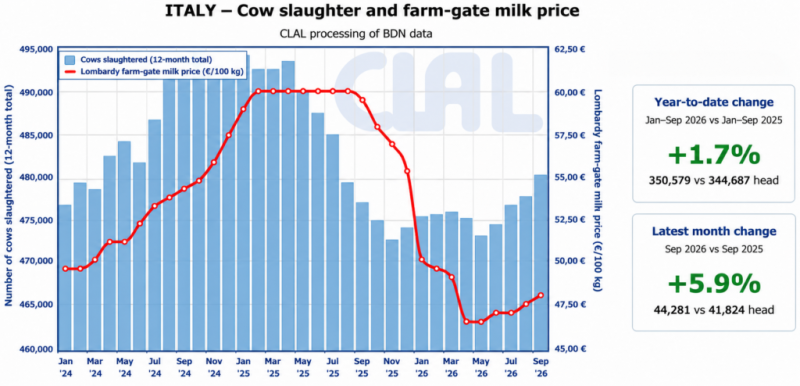
Italy’s National Livestock Database (BDN) recorded a 1.7% rise in cows slaughtered during January–September 2026 against the equivalent nine months of 2025. The year-on-year increase reached 5.9% in September, marking a faster pace than the cumulative figure.
The analysis discusses these movements against a backdrop of pressure on dairy-farm finances and feed supplies. It identifies reduced access to forage as a factor that can make farms more reliant on bought-in feed, adding to expenses while returns from milk are weakening.
In its discussion of herd management, the analysis describes removing lower-producing cows as one possible response to those pressures. Such selection allows feed and labour to be directed towards more productive animals. It also identifies nutrition as important to milk output, cattle health and reproductive performance.
The analysis links the possible effect of smaller herds on future milk supply to several variables, including output per animal, the availability of replacement heifers and productivity on individual farms. It also identifies herd age, replacement rates, animal-disease management and conditions in livestock markets as factors that can affect slaughter activity.