Circularity Fuels raises $7 million to turn dairy biogas into aviation fuel
The proceeds will finance an 18-month programme to take the technology beyond laboratory validation and prepare it for commercial production. Circularity plans to build and run a demonstration plant producing jet fuel daily, finish the engineering for a commercial plant designed to make 75 barrels a day, and negotiate fuel-supply contracts with airlines. Those agreements form part of its preparations for a first commercial facility. Founder and chief executive Dr. Stephen Beaton said the financing would support a larger-scale demonstration and preparations for commercial operations.
The company also intends to start licensing Ouro, its proprietary reactor technology, to partners. Licensing would allow other operators to use the process alongside Circularity’s own facilities. Its production system brings together two reactors: an electrically powered Ouro unit reforms biogas, and a compact Aion reactor uses Fischer-Tropsch synthesis to turn the intermediate output into liquid fuel. The modular equipment is intended for installation at agricultural sites, allowing fuel to be made near the feedstock and potentially limiting the transport of bulky agricultural waste.
In June 2026, Circularity announced that it had converted untreated biogas derived from dairy manure through the full production process into aviation fuel compliant with ASTM D7566 Annex A1. A pilot lasting six months at a dairy farm near Madera, California, validated the conversion. The company estimates that the capital cost of its commercial facilities could be roughly a fifth of the cost of jet-fuel plants now being built in Europe.
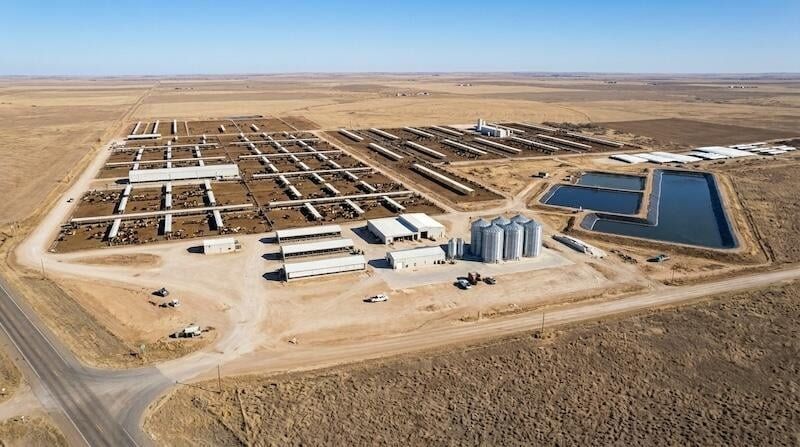
Manure from large dairy farms and other livestock businesses releases methane as it decomposes. Anaerobic digestion converts that organic material into biogas containing mainly methane and carbon dioxide. Existing uses include power generation, heating and the production of renewable natural gas; its use as an aviation-fuel feedstock is less developed. Circularity estimates that large American livestock operations produce almost one trillion pounds of manure each year, but fewer than 6% of those operations collect the biogas. The company’s proposed systems would process raw gas at the farms where it is generated. Converting it into higher-value transport fuels could offer farmers another source of income and improve the economics of manure-management equipment.
Sustainable aviation fuel supplies currently meet less than 1% of worldwide aviation-fuel demand. Used cooking oil is an important input for American SAF producers, but constrained availability has complicated efforts to expand output. Biogas from dairy manure offers another potential input drawn from agricultural waste already produced in large quantities. Airlines are also under pressure to cut emissions and broaden their fuel sources. According to Circularity, American jet-fuel prices rose by 75% during 2026 after conflict broke out in the Middle East.
The US Department of Agriculture has moved Circularity’s loan-guarantee application into the second phase of assessment under its Section 9003 Biorefinery, Renewable Chemical and Biobased Product Manufacturing Assistance Program. The application concerns federal support through a loan guarantee for the company’s development work towards commercial production.
Circularity has obtained approximately $17 million in financing overall. That includes close to $7 million in grants, with ARPA-E and the National Science Foundation among the organisations providing support.