US Dairy Processors Commit $15 Billion to Expansion
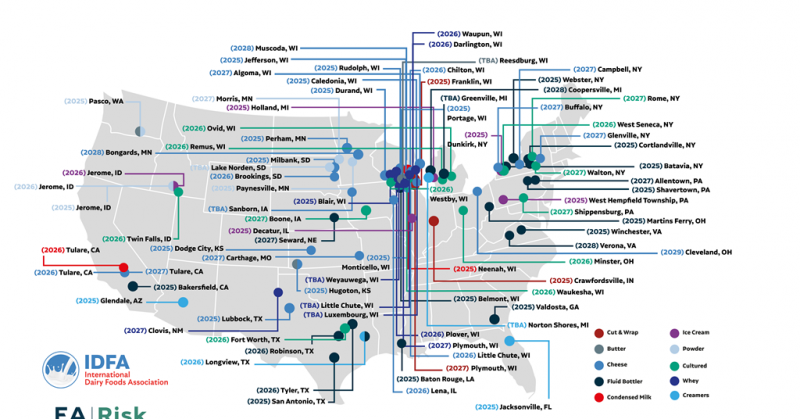
Companies across the US dairy industry are directing more than $15 billion towards additional and modernised manufacturing capacity. The projects span 23 states and are intended to support production for domestic consumers and overseas markets, according to an analysis by the International Dairy Foods Association.
The analysis lists more than 85 initiatives that are either planned or under way by 2030. They include newly built processing facilities, extensions to existing sites, extra manufacturing lines and upgrades to plant equipment. Michael Dykes, IDFA’s president and chief executive, said that “America’s dairy industry is investing for growth” and linked the spending to demand for dairy products in the US and internationally.
The investment figures come as the US Bureau of Labor Statistics forecasts faster growth for dairy manufacturing than for manufacturing as a whole during the next decade. Its projections show inflation-adjusted output rising by almost 30% between 2025 and 2035, from $138.5 billion to $179 billion.
Employment in dairy-product manufacturing is projected to increase by 5.6% over the same period. The corresponding forecasts are 3.5% for total US employment and 0.6% for manufacturing overall.
Trade data also records expansion in overseas sales. The US Dairy Export Council reported that dairy exports rose by 9% on a milk-solids-equivalent basis during the first half of 2026. Their value increased by 12% to $5.31 billion, while cheese exports climbed by 24%.
Milk and cream processing represents the largest category of identified spending, at $5.63 billion. Cheese projects account for $3.76 billion and yoghurt and other cultured dairy products for $3.07 billion. Butter and powder manufacturing make up another $1.86 billion, while ice-cream facilities account for $745 million.
New York has the highest state total, with $2.8 billion in projects. It is followed by Texas with $1.7 billion, Michigan with $1.43 billion, and Wisconsin and Pennsylvania with $1.4 billion each.