EAEU and SCO to explore linking statistical tools with SCO Food Security Atlas
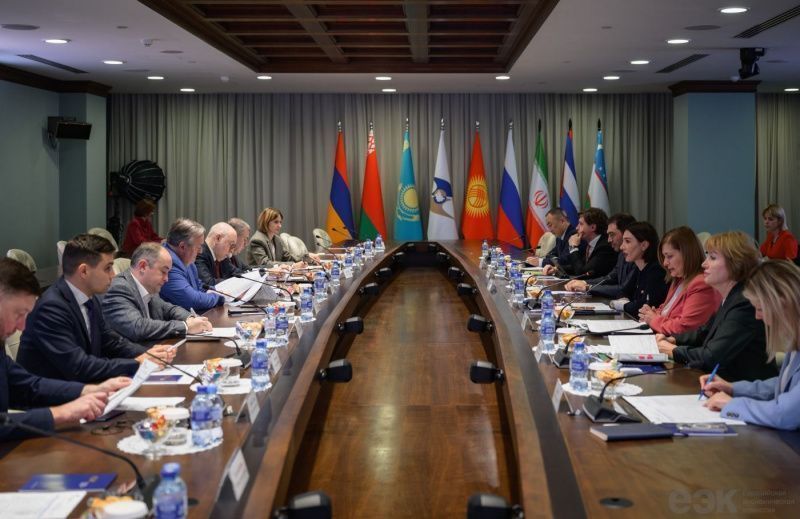
The meeting on mechanisms for transforming agrifood systems was chaired by Goar Barseghyan, who oversees industry and the agro-industrial sector at the Eurasian Economic Commission (EEC). Participants included Shanghai Cooperation Organisation (SCO) Deputy Secretary-General Sohail Khan and Vladimir Rakhmanin, Special Adviser to the Director-General of the Food and Agriculture Organization of the United Nations (FAO). Representatives of government agencies from Eurasian Economic Union (EAEU) countries, international organizations and more than 30 industry associations and unions also joined the discussion. FAO and SCO representatives highlighted the importance of EAEU member states to the global food production and supply system.
The agenda covered resilient food supplies, the use of artificial intelligence (AI), digital platforms, adaptation of agricultural production to climate change and the dissemination of technological developments. Support for agricultural exports and insurance for shipments were discussed separately. Participants reviewed the tools already available to the three organizations and identified areas where they could complement one another. Discussions also addressed increasing food production, improving logistics and coordinating agricultural production, transportation and sales.
According to the EEC, cooperation could deliver practical results by combining FAO’s international agricultural expertise, the SCO’s transport and economic capabilities, and the EAEU’s mechanisms for regulating agricultural markets. Barseghyan expressed confidence that joint efforts would help develop practical solutions. The minister identified FAO’s experience in transforming supply chains, the SCO’s capacity to develop Eurasian transport corridors and the Union’s legal framework as foundations for this work. FAO also has expertise in food security and sustainable supply.
In their discussion of digitalization, participants considered multilateral platforms connecting participants in agrifood supply chains, innovative developments and the use of AI. Barseghyan described the adoption of advanced technologies and the digital transformation of the agricultural market as the main driver of faster growth in agricultural production, a focus of efforts by the Commission and Union member states. In her assessment, using AI while respecting digital sovereignty and sharing technologies helps improve business efficiency, competitiveness and the EAEU’s food supply. The minister separately emphasized the need to respect national sovereignty in the digital sphere.
As part of their work on information tools, the parties intend to examine how resources designed to assess agricultural markets and food supply could work together. FAO and the EEC will also continue jointly exploring the possibility of establishing a digital space for transferring agricultural innovations and technologies. The proposed format would enable countries, research institutions and agrifood businesses to exchange solutions. The article identifies higher yields, more efficient use of water and other resources, improved product quality and reduced production losses as important priorities for the sector.
Kazakhstan is a member of both the EAEU and the SCO and cooperates with FAO on agricultural development. The country’s businesses export grain, flour, oilseeds, livestock products and other agricultural goods. Kazakhstan is already developing a unified digital ecosystem called “e-APK,” designed to bring together the sector’s information resources. Transport infrastructure, data exchange, market forecasting and insurance coverage for shipments are among the issues affecting Kazakh producers and exporters.
The parties also agreed to explore the possibility of holding “EAEU Days” at FAO headquarters in Rome in 2027. The event is intended to showcase the agricultural potential of Union member states and provide a forum for discussing cooperation with foreign partners. The EAEU and FAO previously held talks at the World Food Forum in Rome, where the agenda included innovative solutions, investment and food security.