A Minas Gerais Farmer Doubled Milk Output with a Compost Barn
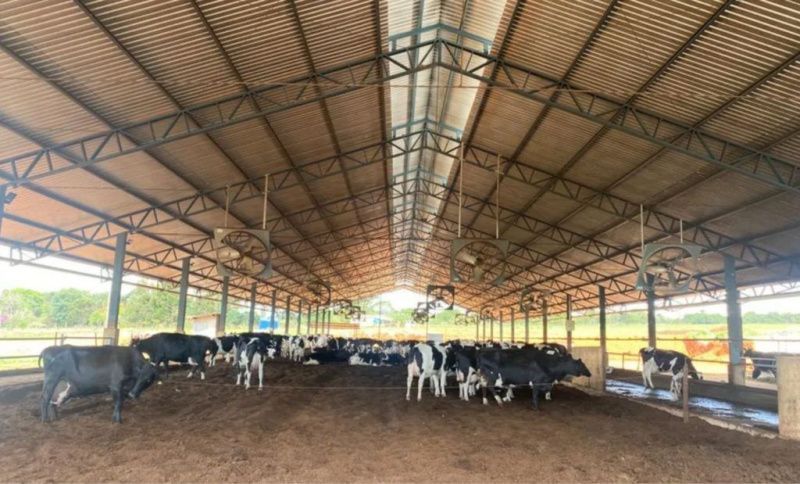
Four years ago, Alisson Gonzaga began changing the daily management of his dairy herd at the Piteiras farm, in the rural area of Divinópolis. He moved the cows from pasture into a Compost Barn, a confinement model in which animals remain loose inside a protected, open-sided building rather than grazing freely.
The farm’s average output rose from 18 to 40 litres of milk per animal per day after the change. The barn measures 54 metres in length and 24 metres in width, and currently houses 90 lactating cows.
The structure is designed to provide shelter from sun and rain while giving the animals a controlled resting area. The floor is covered with a deep layer of organic material, which can include sawdust, peanut shells or straw, depending on availability.
Luiz Fernando Botello, an animal-science specialist, said that the animals’ comfort accounts for a significant part of the increase in production. In his assessment, improved conditions for rest and welfare allow cows to express more of their genetic production potential, which can remain limited in traditional pasture systems.
The bedding requires continuous management. At Gonzaga’s farm, it is turned three times a day, while its moisture level and the general condition of the area are monitored closely. The management is intended to keep the bedding in suitable condition and help prevent health problems in the herd.
Once it has been used by the animals, the organic material can be converted into compost and applied to the farm’s crops, according to Botello. The resulting product is described as nutrient-rich, including in phosphorus. Compost Barn remains a small part of Brazil’s national dairy production, but the system has attracted increasing interest among producers considering alternatives to conventional pasture-based farming.