Kazakhstan Becomes the Only Country in Central and Eastern Asia with Foot-and-Mouth Disease-Free Status
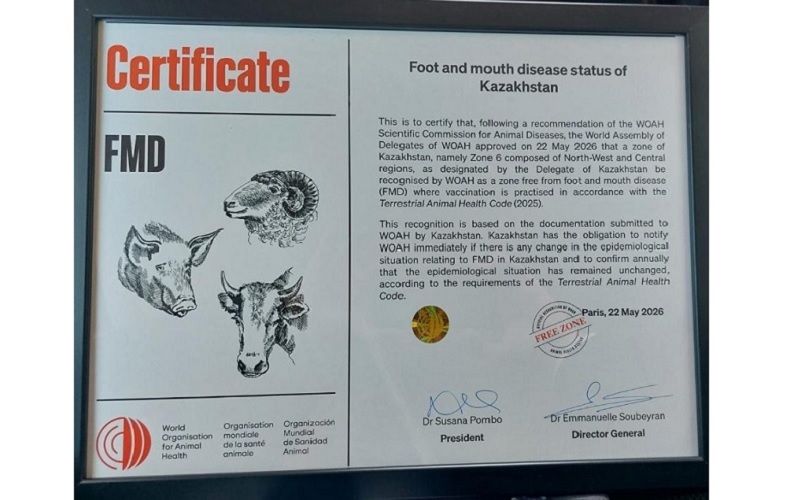
The official certificate was presented to the Kazakh delegation following two years of comprehensive work on the restoration and international recognition of epizootic well-being statuses.
Thus, the entire territory of Kazakhstan is now covered by internationally recognized zones free from foot-and-mouth disease with vaccination. Kazakhstan has become the only state in Central and Eastern Asia with such a status.
The Ministry of Agriculture of the Republic of Kazakhstan notes that the result is due to the government's systemic measures, modernization of the veterinary service, and strengthening of the prevention of particularly dangerous animal diseases.
"Kazakhstan consistently strengthens its system to combat infectious animal diseases and confirms a high level of national veterinary security. Today, the entire country is covered by internationally recognized zones free from foot-and-mouth disease with vaccination, which is an important result of the state's systemic work. Alongside this, Kazakhstan annually confirms its official status of well-being for African horse sickness and classical swine fever, and maintains self-declarations for highly pathogenic avian influenza and African swine fever in accordance with WOAH requirements," noted the Minister of Agriculture of Kazakhstan, Aidarbek Saparov.
In 2025, Kazakhstan conducted extensive work to restore and recognize well-being statuses for a number of diseases, including foot-and-mouth disease in the southeastern regions of the country, highly pathogenic avian influenza, African swine fever, classical swine fever, and African horse sickness.
The obtained statuses have already affected the export opportunities of Kazakh livestock products. China has opened its market for the supply of slaughter cattle, cattle hides, and poultry meat. Azerbaijan has allowed the import of camels, cattle and sheep meat, poultry meat, dairy products, honey, and fish.
Mongolia has opened its market for live small ruminants, Iraq for slaughter cattle and sheep, Georgia for slaughter cattle, as well as slaughter and utility sheep. Iran allowed the supply of hides and wool of hoofed animals, and the European Union countries opened their market for Kazakh honey.