Genetics as a Managed Asset: From DNA to Farm Economics - Presentation by Marzhan Zhulanova, CRI Kazakhstan
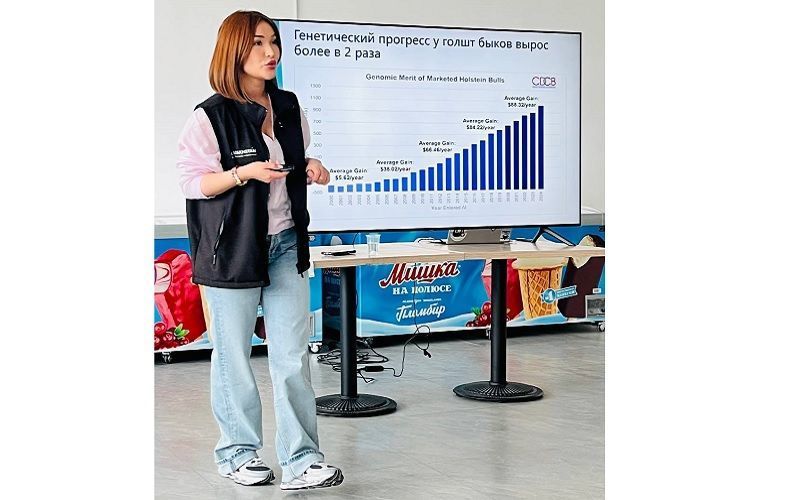
Marzhan Zhulanova discussed the evolution of methods for evaluating breeding value. Historically, selection was based on progeny analysis (BLUP method), which required up to 4 years of waiting. With the transition to genomic evaluation (since 2009), the decision-making cycle has significantly shortened.
The result is a sharp increase in efficiency:
- Milk yield in the USA increased from 5,900 to 12,700 kg
- Genetic progress accelerated more than twofold
- The cattle population decreased but became significantly more productive
According to the head of CRI Kazakhstan, representing Genex in Kazakhstan, there was another baseline shift in the international evaluation system in 2025: instead of cows from 2015, animals born in 2020 were taken as the benchmark. This is a critical point, as the average herd productivity has noticeably increased over five years, thanks to selection, genomic evaluation, and technological progress.
As a result, at the numerical level, something that many perceive as a paradox occurred: the breeding value indicators of bulls "decreased." For example, for the Holstein breed, the yield adjustment was minus 752 pounds, and the values for fat and protein were also revised. However, this decrease does not indicate a deterioration in genetics. On the contrary, it reflects the growth of the population itself.
As Marzhan Zhulanova emphasized to seminar participants, in such a situation, it is not the bull that changes, but the environment it is compared to. Previously, its offspring were evaluated against a weaker base, but now—against a more productive and genetically advanced herd. Consequently, the difference between a particular animal and the average level decreases.
During a heated discussion, seminar participants also talked about the factor of inbreeding. In recent years, the level of genetic relatedness within the population has increased, and this is also taken into account in the calculations. In the new base, the relative impact of inbreeding on the evaluation decreases, which can partially offset the effect of the baseline shift.As noted in her speech, the modern selection focuses on:
- Fertility (DPR, CCR, HCR)
- Udder health (SCS)
- Viability and longevity
- Feeding efficiency
Marzhan Zhulanova emphasized that genetic tests have become a critically important tool: "Today, an error in pair selection is not just biology; it's direct financial loss." Genetics is viewed not as an expense, but as a long-term investment with a high return. "Breeding work is an investment. It requires time and discipline, but it is precisely what determines what the farm will be like in 5–10 years," Marzhan Zhulanova reminded.
Seminar partners: Shin-Line (Kazakhstan), GGI-SPERMEX GmbH (Germany), Republican Chamber of Dairy and Combined Breeds Cattle (Kazakhstan), cri-kazakhstan.kz/">CRI Kazakhstan (Kazakhstan), russia.ru/">Association of Holstein Breed Producers (Russia), molvest.ru/">Molvest (Russia), DairyNews.ru, France Group