Argentina Could Gain Share in the Whole Milk Powder Trade
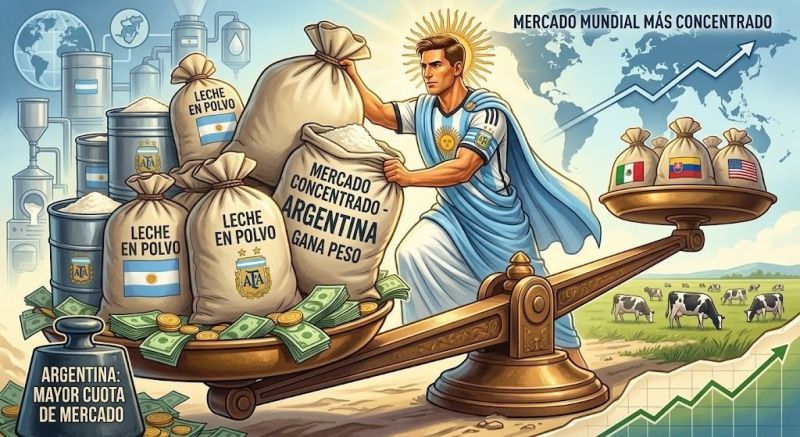
The projections come from the OECD-FAO Agricultural Outlook 2026–2035, which estimates that international dairy trade will reach 13.7m tonnes in 2035. That would be 11% above the average for the period used as the baseline. The analysis by the Rosario Board of Trade identifies whole milk powder as one category in which Argentina could expand its position.
New Zealand is expected to record the largest additional exports, at roughly 118,000 tonnes above the 2023–25 average. Argentina follows with almost 34,000 tonnes, ahead of India, with 32,800 tonnes, the United States, with 21,200 tonnes, and China, with 17,600 tonnes. The projections do not place Argentina as the world’s second-largest exporter; they identify it as the second source for additional export growth during the decade.
The increase would take place as other suppliers reduce shipments. The European Union is projected to export 57,000 tonnes less, Vietnam 22,900 tonnes less and Australia 10,500 tonnes less. Across the remaining exporters, the reduction is estimated at about 77,000 tonnes. Against that background, Argentina’s share of world whole milk powder exports could reach approximately 6% by 2035.
The OECD-FAO outlook does not project a broad increase in real agricultural commodity prices. It expects them to remain stable or slightly below current levels over the coming decade. The Rosario Board of Trade’s analysis therefore links the expansion of Argentine exports to production costs, processing efficiency, available industrial capacity, sufficient volumes and continued access to foreign markets.
Whole milk powder can concentrate milk solids, extend shelf life and lower logistics costs compared with transporting liquid milk. It is used to convert surplus milk into an exportable product, including when domestic production exceeds the absorption capacity of the local market. The projected increase would require additional milk to be processed, greater industrial utilisation and commercial relationships in destinations able to receive the extra supply.
The dairy projections form part of a wider agricultural outlook. The OECD and FAO forecast a 13.3% increase in the value of global agricultural production by 2035, with livestock production rising 15.1% and the use of animal protein for feed increasing 13.5%. Asia-Pacific, sub-Saharan Africa and Latin America are expected to contribute substantially to this growth, while Asia-Pacific is projected to account for 57.5% of the increase in global agricultural production. India alone is expected to represent about one-quarter of the worldwide increase.
Argentina could also increase exports of protein meals, vegetable oils, wheat, maize and beef. The Rosario Board of Trade projects the country to have the largest export increase in meals and oils and to reach 1m tonnes of beef exports. For whole milk powder, the projected change is an additional 34,000 tonnes and a possible 6% share of global exports by 2035.