Zenith Global Commercial: aseptic packaging volumes forecast to reach 159.6 billion litres by 2030
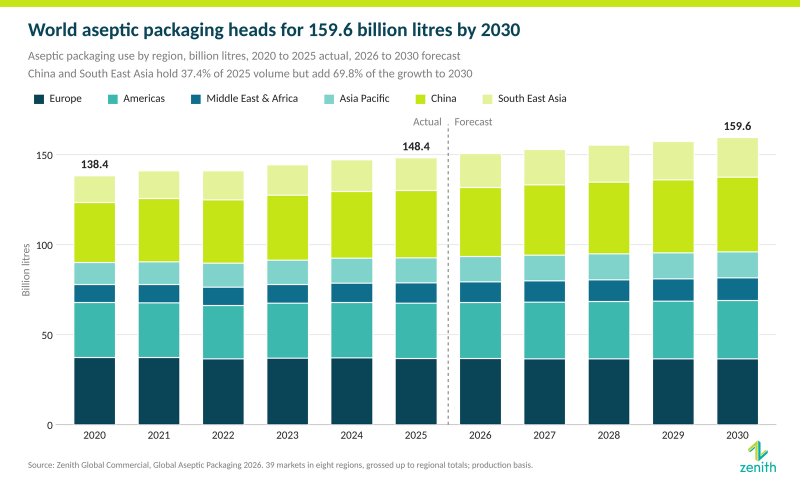
Worldwide aseptic packaging volumes reached 148.4 billion litres in 2025, distributed across 344.2 billion packs, according to Zenith Global Commercial’s Global Aseptic Packaging 2026 report. Volume increased at an average annual rate of 1.4% over 2020–25. The average pack held approximately 431 millilitres. Aseptic packaging is used by dairy and beverage producers for products that can be stored for extended periods without refrigeration until opened. China was the biggest individual market in 2025, consuming 37.4 billion litres, approximately a quarter of the worldwide total. West Europe accounted for 27.2 billion litres and Latin America for 19.7 billion litres.
Beverages were the largest individual application, at 60.2 billion litres and a 40.6% share in 2025. UHT white milk represented 52.7 billion litres, or 35.5%, while other dairy products accounted for 27.2 billion litres, or 18.3%. Together, the two dairy categories made up 53.8% of aseptic volume. Food products contributed 8.3 billion litres, equivalent to 5.6%. The report projects that beverages will retain the highest growth rate among product categories, expanding by 2.3% a year to 67.3 billion litres in 2030. Annual growth is forecast at 2.0% for other dairy products, 0.4% for UHT white milk and 0.2% for food.
The study puts the worldwide increase over 2025–30 at 11.3 billion litres. China is forecast to add 4.0 billion litres and South East Asia 3.9 billion litres. South East Asia’s projected annual growth of 4.0% would make it the fastest-expanding region. Its current share of worldwide volume is 12.2%, while its expected contribution to growth over the forecast period is 34.4%. The Middle East and Africa are forecast to add 1.4 billion litres, with Latin America contributing another 1.1 billion litres.
Among individual countries, Indonesia has the highest projected annual growth rate, at 6.3%. The Philippines, Kenya, India and Taiwan follow in the report’s ranking. Eight markets are forecast to expand by more than 3.5% annually. West Europe, by contrast, is expected to be the sole region with falling volume, declining at an annual rate of 0.4%. Within that region, Germany and France are each forecast to contract by 1.2% a year.
Cartons held a 66.5% share of worldwide aseptic volume and accounted for 91.8% of aseptically packaged UHT milk. The report forecasts annual growth of 0.7% for cartons through 2030, compared with 3.7% for PET packaging. PET’s volume share is projected to increase from 25.2% in 2025 to 28.1% in 2030. In its comparison of technologies for long-life beverages stored at ambient temperatures, the study puts aseptic filling’s current share at 38.9%, against 42.6% for hot filling. It forecasts respective shares of 40.0% and 40.5% by 2030.
Akos Petri, managing director of Zenith Global Commercial, said the industry’s expansion opportunities were becoming increasingly concentrated in Asia. He highlighted regional demand, product categories and packaging formats as important considerations for investment and business decisions. The report also identifies emerging Asian markets, shifts in consumer demand and competition among packaging formats as factors relevant to dairy processors, packaging manufacturers and brand owners. It suggests that expansion could offer dairy businesses opportunities to extend product shelf life and distribution and serve markets where cold-chain infrastructure is developing.
The research is the fifth edition of Global Aseptic Packaging and covers 39 markets in eight regions. Its scope includes white milk, other dairy products, beverages and food, measuring volumes in litres and numbers of packs. Historical figures span 2020–25, followed by forecasts to 2030. The main report runs to more than 900 pages and is accompanied by a separate report on suppliers.