Milky Way contains caramel in the US but not in Europe
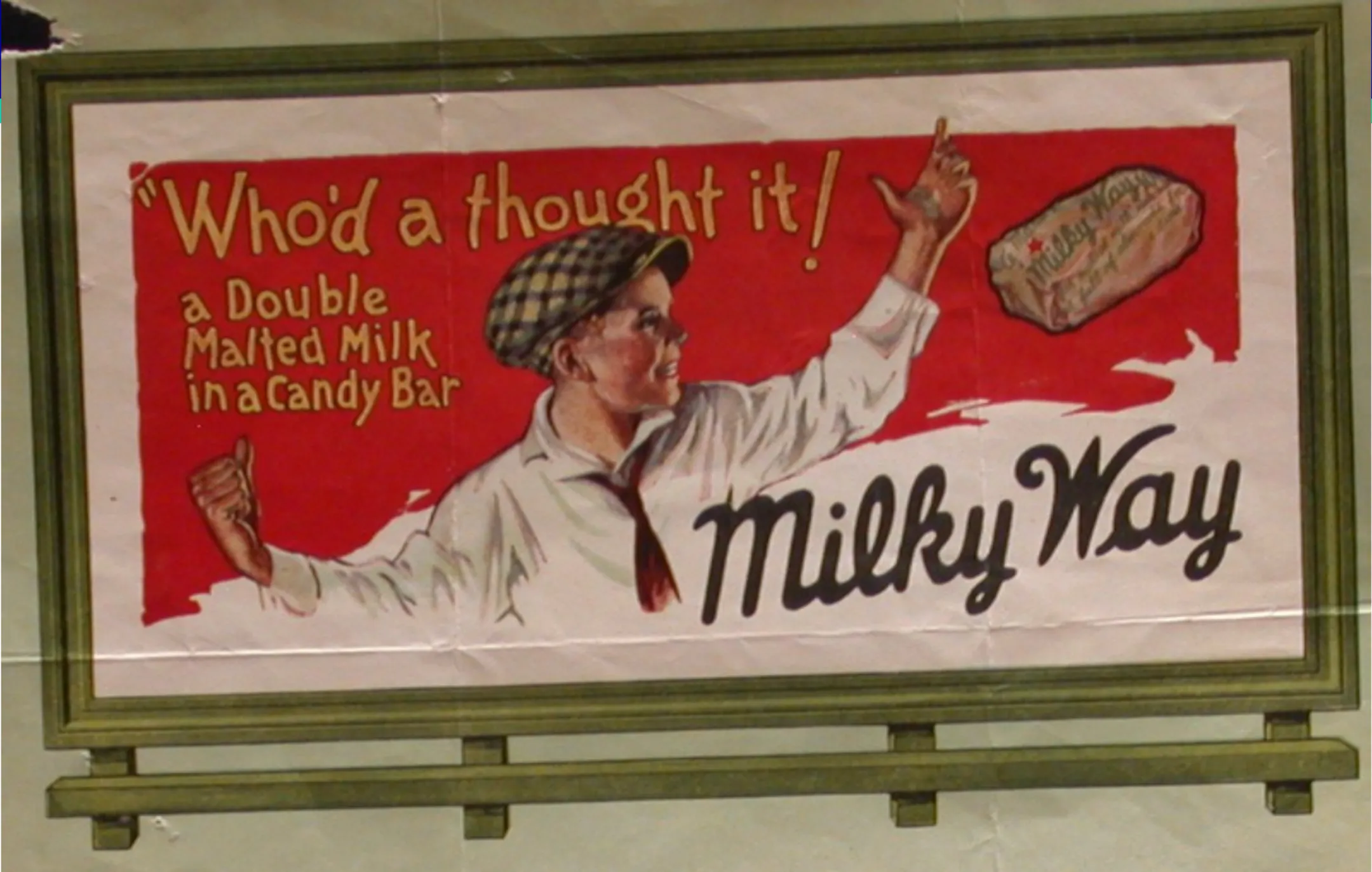
Frank Mars created Milky Way in Minneapolis in 1923. The name referred to a malted milkshake popular in the US at the time. The idea of turning the drink's flavor into a solid product emerged during a visit to a diner by Frank and his son Forrest. For the filling, Mars developed a whipped nougat made from egg whites, sugar syrup and malt. In the early years, the milk chocolate coating was purchased from Hershey’s. The American recipe also included caramel. The bar sold for 5 cents; using airy nougat reduced production costs. In 1924, the family business recorded annual sales of $800,000.
Before introducing Milky Way, Mars had made several attempts to establish a confectionery business. He was born in 1883 in Newport, Minnesota, and after contracting polio as a child, learned at home from his mother how to make candies and coat them in chocolate. In 1911, Mars started a business in Tacoma, Washington, making fudge in his home kitchen and selling it to customers. In 1920, he and his wife Ethel moved to Minneapolis, where he founded Mar-O-Bar Co. The company produced Mar-O-Bar, a confection with an airy cream filling and a chocolate coating. The product proved fragile and did not withstand shipping well.
To expand Milky Way sales, the company used advertising and built a nationwide sales team. The trademark was registered with the US Patent Office on March 10, 1925. By 1929, Milky Way was the best-selling chocolate bar in the US. That same year, the business moved production from Minneapolis to a new factory complex in suburban Chicago. According to Mars, around 200 employees relocated with the company. The new location provided access to rail transport. The range subsequently expanded with Snickers, launched in 1930, and 3 Musketeers, introduced two years later.
In 1932, following disagreements with his father over the development of the business, Forrest Mars received money from him and the rights to produce Milky Way overseas. In Britain, he retained the combination of nougat and caramel, adjusted the sweetness of the chocolate to local tastes and named the product Mars. In 1935, Forrest introduced another bar to the European market, with a lighter filling and no caramel. This was the product that received the Milky Way name. Its density was 0.88 g/cm³, allowing it to float on milk. Thus, the American brand retained the original recipe, while in Europe the same name was used for a product with a different composition.
The closest American equivalent to the European Milky Way was 3 Musketeers. When it launched in 1932, each package contained three separate bars: one with chocolate nougat, one with vanilla nougat and one with strawberry nougat. This combination explained the name, a reference to Alexandre Dumas's The Three Musketeers. During World War II, sugar shortages made producing three fillings more difficult and expensive. Mars retained the most popular chocolate flavor and began producing a single bar. Its nougat has a chocolate flavor, whereas the European Milky Way contains white vanilla nougat. The historic 3 Musketeers name remained in use in the American market.
In advertising for the European Milky Way, the manufacturer emphasized the lightness of the filling. From 1935 until the 1990s, it used the slogan “The sweet you can eat between meals without ruining your appetite.” The campaign targeted parents in particular and presented the product as a snack for children. In a European clay-animation commercial from 1989, a Blue Car ate Milky Way and flew across a bridge, while an overloaded Red Car fell down. Commercials showing the bar floating in milk aired in Britain and Germany in the 1980s and 1990s. The logo design for the European market also changed later.
The American Milky Way range expanded over time to include dark chocolate versions and Simply Caramel, which consists of caramel coated in milk chocolate, without nougat. The brand is part of the portfolio of Mars, Incorporated, a family-owned company and one of the largest privately held corporations in the US. Its confectionery division, Mars Wrigley, also produces M&M’S, Mars, Snickers, Twix, Bounty, Skittles and Orbit chewing gum.









