Global Dairy Enzymes Market Is Projected to Reach USD 10.9bn by 2035
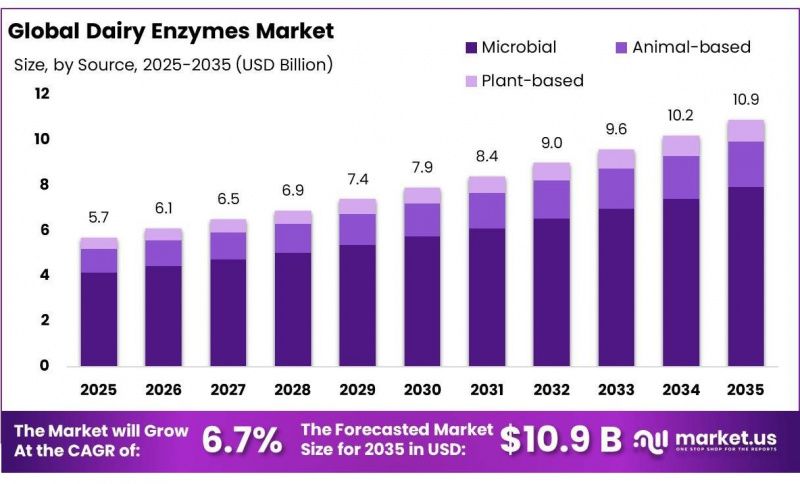
Market.us estimates that the global market for dairy enzymes will rise from USD 5.7bn in 2025 to approximately USD 10.9bn by 2035. The report gives a compound annual growth rate of 6.7%. Dairy enzymes are used in milk, cheese, yoghurt, whey ingredients and other products to support milk coagulation, lactose hydrolysis, protein modification, flavour development and consistency.
Lactose-free products and cheese
Lactase accounted for about 33.6% of the market in 2025. It separates lactose into glucose and galactose, allowing manufacturers to produce lactose-free milk, yoghurt and other dairy products. Suppliers are developing formulations intended to reduce lactose consistently while preserving taste, texture and nutritional characteristics.
Cheese is another major area of use. Microbial rennet and other coagulating enzymes help convert milk into curds and whey for the manufacture of different cheese varieties. Microbial enzymes represented roughly 72.8% of the market by source in 2025, according to the report. The OECD-FAO Agricultural Outlook 2025–2034 said that world milk output rose by 1.1% in 2024, reaching about 950m tonnes. That supply is used in cheese-making, whey treatment, lactose hydrolysis and fermented dairy production.
Regional and product patterns
Europe held approximately 37% of the global market in 2025, generating an estimated USD 2.1bn in revenue. Its established processing base and large cheese industry support the region’s position. Eurostat reported that farms in the European Union produced 161.8m tonnes of raw milk in 2024, of which 150.8m tonnes went to dairies. EU cheese production was about 10.8m tonnes that year.
Liquid enzymes made up approximately 58% of the market in 2025. Their dosing and mixing characteristics suit plants that require controlled application during processing. Powder products are used where storage, transport and handling of dry ingredients are important. The choice between the two formats depends on enzyme stability, manufacturing conditions, packaging and the final product.
Yoghurt accounted for about 31% of the market by application in 2025. Enzymes are used in specialised formulations, including lactose-free yoghurt, and can assist with protein characteristics and product uniformity. They complement, rather than replace, the cultures used for yoghurt fermentation. Direct business-to-business sales represented about 54% of distribution, reflecting the role of technical assistance, dependable supply and customised formulations for large processors.
Capacity, constraints and industry participants
Asia-Pacific is identified as an additional area of market opportunity as dairy consumption grows and producers invest in modern processing facilities. Demand for fermented products, lactose-free milk and specialised dairy ingredients may increase enzyme use in India, China and other markets in the region. The sector also faces changing dairy commodity prices, energy and transport costs, and technical challenges in expanding fermentation-based production. Producers must maintain enzyme activity, purity and compliance with regulatory requirements while controlling manufacturing costs.
Disruptions to energy markets and shipping routes can affect procurement and distribution. Whey treatment provides another application: enzymes can convert lactose-rich whey permeate into galacto-oligosaccharides, or GOS. Commercial use depends on production costs, purification needs, ingredient specifications and demand. Companies named in the report include Novonesis, dsm-firmenich, International Flavors & Fragrances, Kerry Group, AB Enzymes, Amano Enzyme and Advanced Enzyme Technologies. Competition concerns enzyme performance, application assistance, production consistency and specialised formulations.