Brazil’s Fazenda Alagoas lifts daily milk output from 100 to 8,620 litres
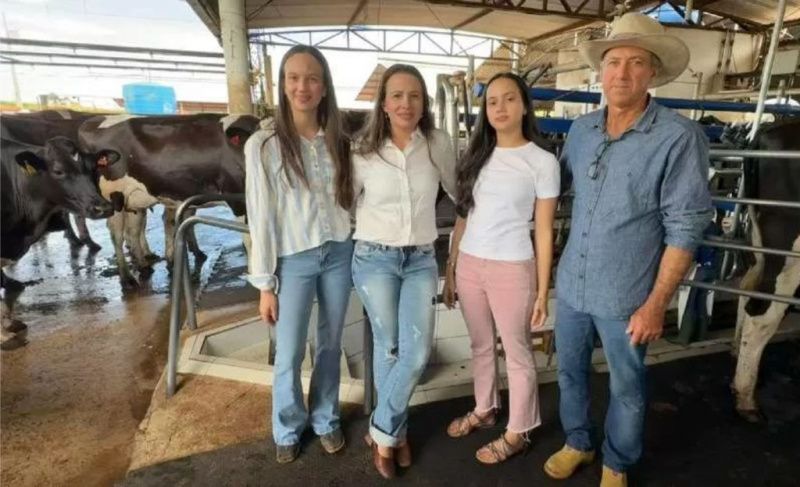
In the early 2000s, Gilson Pereira Cardoso sold his Fiat Uno to buy heifers and expand milk production at Fazenda Alagoas. The farm was then yielding just 100 litres a day, too little to support his household, and he supplemented his earnings by working for neighbours. The property has belonged to the family since 1949, passing from his grandfather to his father before he took over in 2001. Its subsequent expansion has included spending on buildings, equipment and genetic improvement.
About a decade after taking charge, Cardoso approached Nestlé for help with a project to expand milking operations. Instead, the company offered to buy the farm’s milk. Production methods were still largely artisanal, but milk quality was already good; daily volumes stood at between 500 and 700 litres. Cardoso tested the commercial terms by supplying his co-operative for 15 days and Nestlé for another 15. He recalls a difference of 0.14 reais per litre. The quality premium provided money for further improvements, accumulating month by month in what he described as a form of savings.
The herd now consists entirely of Holstein cattle. With Nestlé’s support, Cardoso has also adopted genotyping to assess the animals’ genetic potential. Farm records put daily milk production at 2,478 litres in 2021 and 5,926 litres in 2025. Average yield is now approximately 44.4 litres per lactating cow each day. His wife, Juliana Cardoso, attributes part of the improvement to changes in animal management, feeding and, particularly, the management of employees. The farm has nine workers and runs training programmes covering daily tasks, safety and animal welfare. “Without people, nothing happens,” she said, adding that machinery still requires someone behind it.
The farm’s more recent changes include regenerative agricultural practices encouraged by Nestlé’s Net Zero programme from 2021. It uses about 80 hectares, including 55 hectares of rented land, to grow maize for silage and cattle feed within an integrated crop-and-livestock system. Juliana was initially sceptical about maintaining soil cover with different plant species. The family tested the approach on part of the land and compared it with uncovered areas. After maize planting, the area experienced approximately 40 days without rain. According to Juliana, maize on the covered plots was more uniform and performed better than on plots without cover.
Since 2022, Fazenda Alagoas has used no-till farming, crop rotation and permanent soil cover. Soil organic-matter content increased from 3% in 2021 to 4.1% in 2026. The family has also changed manure management: a solids separator is in use, water is reused to clean facilities and organic residues are applied to crops as fertiliser. The property has reached Gold status in Nestlé’s programme and is awaiting an audit to confirm its position among the initiative’s first Diamond Farms.
Participation in sustainability programmes brings an additional payment. According to Cardoso, the Net Zero project currently adds 0.12 reais per litre to the amount Nestlé pays him. He says his total payment is about 3 reais per litre, compared with the 2.70 reais he cites as the market price for milk without quality differentiation. This payment comes alongside the quality-related remuneration that helped finance the farm’s earlier expansion.
Juliana, the mother of Júlia and Caroline, also describes environmental responsibility as part of the legacy the family wants to leave to future generations. She said the soil-cover trial changed her view of soil management and made its care a continuing priority. “This project brought greater clarity and awareness that we have to produce food, but also think about future generations. That means a great deal to us,” she said.









