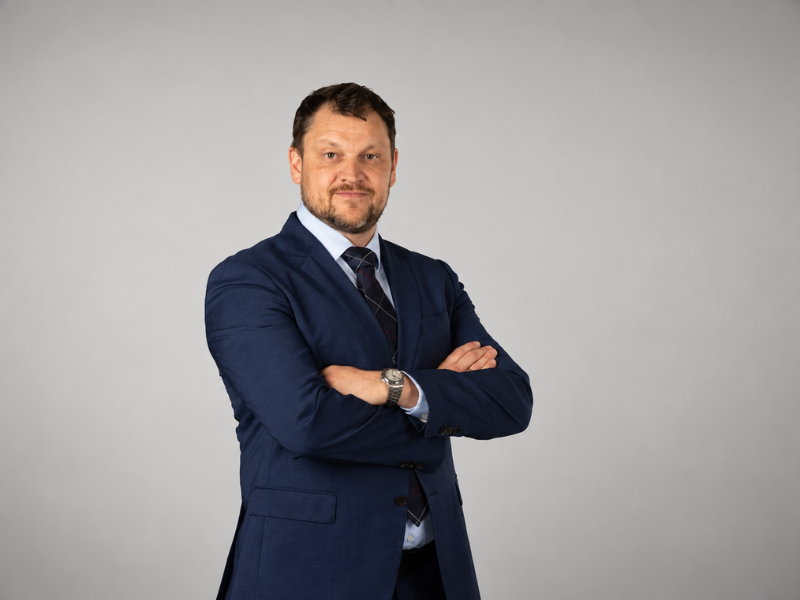
Interview with Sergei Kiselev, Global R&D & Innovation Leader at Al Ain Farms
Could you tell us about your path into food R&D, and what led you to Al Ain Farms?
My career has always been grounded in strong technical foundations, beginning with dairy science.
Very early on, however, I became interested not only in how products work scientifically, but in how that science can be translated into practical solutions: products that can be manufactured reliably, scaled commercially, and valued by consumers.
Over more than 20 years, I have worked across Europe, Asia-Pacific, and the Middle East with companies including Danone, PepsiCo, Mars, Kraft Heinz, and Synlait.
That experience exposed me to very different business models, from consumer products to ingredients, and from local manufacturing to global technology platforms.
Later, completing an MBA in Innovation Management helped me connect the technical and commercial sides of my experience more effectively.
Al Ain Farms appealed to me because it brought these elements together: a fast-growing local business operating across dairy, beverages, and other food categories, in a market that is highly diverse and evolving quickly.
For me, it was an opportunity not only to develop products, but also to build R&D capability, strengthen innovation systems, and translate science into business growth.
What is the best piece of advice you have ever received in your professional journey?
One piece of advice I keep returning to is: do not fall in love with your solution; fall in love with the problem you are trying to solve. But first, make sure the problem is properly defined.
This is especially important in R&D, where a technically elegant solution is not always the right commercial solution.
You need to stay curious enough to challenge your own assumptions and ask the basic questions: does the consumer really need it? Can we manufacture it consistently? Is it compliant? Does the business case work? Can we scale it?
As my career has developed, I have become increasingly focused on this broader understanding of innovation.
It is not enough to create something new; you need to create something that works for the consumer, the factory, and the business at the same time.
As Global R&D & Innovation Leader, what does balancing dairy, functional nutrition, and emerging proteins under one role actually look like day to day?
I try not to see them as separate technical categories. I look at them through the lens of consumer needs and technology platforms.
Protein, fermentation, membrane processing, and nutritional fortification, for example, can create opportunities across several categories rather than a single SKU.
My day can move quickly from reviewing a formulation or industrial trial to analysing consumer data, challenging a claim, resolving a regulatory question, assessing a new ingredient or technology, and discussing portfolio priorities with the management team.
The most important part of the role is not personally solving every technical problem.
It is about building a system and a team capable of repeatedly solving the right problems.
For me, that shift from managing individual projects to building innovation capability is one of the main differences between an R&D manager and an R&D leader.
From where you sit in R&D, how connected is what happens on the production side to what you’re hearing from retailers and consumers?
They need to be fully connected.
A product can perform extremely well in consumer research and still fail if the factory cannot manufacture it consistently.
At the same time, you can have a technically perfect product that consumers simply do not want to buy again.
R&D sits exactly between those two realities.
We need to understand what consumers are telling us, what retailers are seeing on shelf, what Marketing is trying to achieve, and what Operations can manufacture reliably and economically.
For me, successful innovation has three basic tests: the consumer wants it, the factory can produce it, and the business can make money from it.
If one of those three is missing, it is not yet a scalable innovation.
Al Ain Farms has a longstanding position in UAE dairy. How does the team balance core, traditional products with pressure to innovate?
You have to respect what made the brand successful in the first place.
For established dairy businesses, consumers have very clear expectations around taste, freshness and consistency.
Changing a product simply because something is technically possible as new can sometimes destroy value rather than create it.
At the same time, consumer expectations are changing quickly, particularly around sugar, protein, gut health, convenience, ingredients and overall nutritional value.
I normally see innovation in two dimensions.
The first is improving the core, nutrition, quality, cost, sustainability and manufacturing performance, without losing the characteristics consumers already trust.
The second is building new growth platforms in areas such as value-added dairy, functional nutrition, fermented products, and new beverage concepts.
Good innovation is not about choosing between tradition and new things.
It is about understanding what part of the core needs to be protected and what part needs to be added to extend consumer choice. This is especially important in diverse markets such as UAE where “one solution does not fit all”.
What does “building scalable food platforms” mean in practice, and how does an idea move from concept to shelf at scale?
The key word here is platform.
If R&D develops a completely new technical solution every time Marketing asks for another flavour or pack size, the organisation eventually becomes too slow and too expensive.
A platform approach means creating a technical architecture that can support a number of products.
For example, instead of developing one high-protein drink, you build the protein system, processing conditions, ingredient structure, sensory targets, claims strategy and supplier base.
Once these foundations are proven, you can extend the platform into different flavours, pack sizes, brands or consumer occasions much faster.
The process normally starts with a consumer or business need, followed by a technical concept, laboratory validation, sensory and consumer validation where appropriate, pilot or industrial trials, shelf-life and regulatory validation, and finally commercialisation.
Strong Stage-Gate governance is still important.
Speed does not come from removing technical discipline. Speed comes from removing unnecessary repetition and making the right decisions earlier.
What has been one of the biggest challenges you have faced, and how did the company overcome it?
One of the biggest challenges in any fast-moving food business is maintaining the speed of innovation without compromising technical discipline.
There are always urgent commercial priorities.
But proper food development still requires specifications, risk assessment, trials, shelf-life validation, sensory work, regulatory review and change control.
Skipping these steps may look faster initially, but in most cases, it creates bigger problems later.
A major focus for us has therefore been strengthening the R&D system itself: clearer project governance, stronger Stage-Gate and change-control processes, strengthened by a rigid sensory and consumer validation, alternative supplier development, and stronger cross-functional iteration and ownership.
The result is a gradual shift from R&D being seen mainly as the team that develops recipes to R&D acting as a technical and innovation partner to the wider business and, ultimately as an engine of growth.
This type of transformation is never really finished.
In a modern business, capability building is a continuous cycle.
Do you ever feel producers and retailers, or producers and regulators, see the market differently?
Each group looks at the market through a different lens. A retailer looks at shopper behaviour, price points, category rotation and shelf productivity. A producer looks at manufacturing capability, investment, raw-material availability and supply-chain realities. Regulators, quite rightly, focus on food safety, public health, labelling and the scientific basis for claims.
The problem starts when one perspective is treated as the whole picture.
R&D plays a very important role here because we sit at the point where science, consumer demand, regulation, and manufacturing come together.
In one sentence, how would you describe the current state of the Middle East beverage and dairy market?
It is a fast-growing but increasingly sophisticated market, moving from volume- and flavour-led competition toward health, functionality, convenience, and locally relevant nutrition.
What’s the single biggest opportunity you see in this market over the next 3–5 years?
I would call it mainstream functional nutrition.
Historically, specialised nutrition and everyday dairy have been quite separate categories.
I believe that distinction will continue to disappear.
Consumers increasingly expect everyday products to do more, more protein, less sugar, digestive benefits, better satiety, better hydration, or other clearly understood nutritional benefits.
Dairy is very well positioned because it already has strong nutritional credibility.
The opportunity is to take technologies that historically belonged mainly to sports or specialised nutrition and translate them into affordable, enjoyable everyday products.
The winners will not simply add an ingredient and put a claim on the pack.
They will combine real nutritional benefit with good taste, convenience, and strong scientific evidence.
What’s the single biggest challenge or risk facing the industry right now?
Resilience.
The Middle East food industry operates within a very complex global system of ingredients, packaging, feed, energy and logistics.
That means R&D can no longer optimise a formulation only for today’s lowest cost.
We need to think much more about alternative suppliers, ingredient flexibility, localisation, manufacturing efficiency and how quickly a formulation can adapt without compromising quality.
In other words, resilience is becoming part of product design.
For a region where food security is strategically important, I believe this capability will become just as important as traditional product innovation.
Which trend do you think the industry is currently underestimating?
I think the industry may be underestimating how quickly consumers will move from marketing-led functionality to evidence-led functionality.
Putting protein, probiotics, vitamins or another fashionable ingredient on the front of a pack will not be enough forever.
Consumers are becoming more educated, regulators are becoming more demanding, and access to information is almost instant.
The next competitive advantage will therefore be scientific credibility.
You need to understand what the product genuinely delivers, be able to measure it, substantiate it, and communicate it in language consumers can understand.
For me, this is a very interesting shift because it moves science much closer to the centre of brand strategy.
Where do you expect the most growth to come from a specific country, category, or channel?
If I had to choose one area, I would watch functional dairy and ready-to-drink nutrition across the Gulf, particularly in the UAE.
Protein is probably the most obvious example today, but I believe the opportunity will go well beyond sports nutrition.
We will see more products built around everyday occasions, breakfast, work, school, recovery, healthy ageing, and on-the-go nutrition.
The UAE is particularly interesting as an innovation market because of its very diverse population and the opportunity to test concepts across different consumer groups
If you had to predict one major shift in this market by 2030, what would it be?
By 2030, I think the distinction between food and functional nutrition will be much less visible.
High protein, lower sugar, digestive health, more personalised nutritional needs, and scientifically supported functionality will increasingly become normal expectations rather than premium niches.
For dairy companies, the implication is quite significant.
We will need to think less about individual milk, yoghurt or juice SKUs and more about nutritional platforms and consumer occasions.
A bottle of dairy may still look quite familiar in 2030, but the science, processing technology, and consumer proposition behind it will be much more complex.
If you had one piece of advice for a company entering the beverage and dairy space in the Middle East today, what would it be?
Do not simply import a successful product from another market and assume the Middle East will adapt to it.
Start with the local consumer and work backwards.
Understand taste preferences, usage occasions, price architecture, climate, distribution, shelf-life requirements, regulation, cultural context and local manufacturing realities.
Then decide which global technologies can help solve those specific needs.
The Middle East is an extremely international market, but it is not a generic market.
The companies that succeed will combine global science and technology with a clear focus on local needs and relevance.
And I would add one final point: build for scale from the beginning.
A good concept has value. A repeatable innovation system creates much more value.









